
Responding is Mike Hennet, product training specialist, BullEx, Albany, NY.
First, it’s great to hear that you’re taking interest in engaging your employees. People who are interested in your lessons are much more likely to remember them and do the right thing if the time should ever come.
My first piece of advice would be to recommend that you step back and take a look at your training program overall. Are you including all the necessary messages? More importantly, how are you delivering them?
Research shows that combining a traditio- nal classroom learning element with hands-on training increases retention of the information and technique. If you haven’t already, I recommend implementing hands-on fire extinguisher, emergency response and evacuation training. It’s a surefire way to change things up for your veteran employees and give new employees the best education possible.
If you’re currently conducting hands-on extinguisher training the traditional way, you might be failing to make sure that everyone gets a turn to fully extinguish the fire. Because dry chemical extinguishers are so messy and expensive to refill, many people will only let a certain number of trainees use them or will discourage trainees from fully extinguishing the flames. Choosing repeatable and controllable hands-on fire extinguisher training systems eliminates these issues. By using training extinguishers, your employees will be able to use an extinguisher with the same weight, feel and discharge time. They’ll be able to learn the necessary skills, and everyone will get a chance for hands-on training.
Veteran employees who have mastered the P.A.S.S. (Pull, Aim, Squeeze, Sweep) method need to be challenged to continue to be engaged. One way to do this is to train on more than just extinguisher training and fire prevention methods. Many companies also incorporate R.A.C.E. (Rescue, Alert, Confine, Extinguish) training into their programs. This training focuses on what trainees should do before attempting to put out an incipient-stage fire.
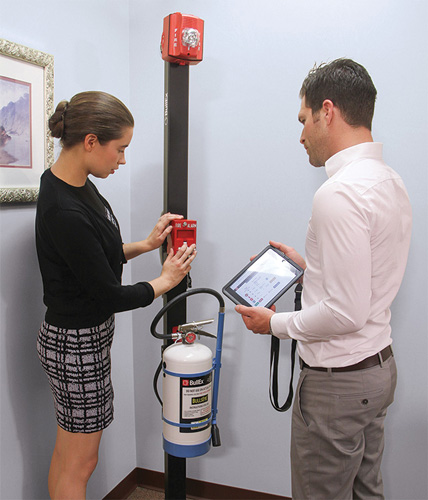
When conducting R.A.C.E. training, use a training phone so trainees can dial 911, and use a pull station that they can activate. By making the evolution as close to real life as possible, trainees are forced to recall the skills you’ve taught them and put them to the test.
With any type of fire safety training, you can amp up the difficulty by setting up the scenario in a place where your employees may really be faced with an emergency. Think about the risk areas of your workplace – the kitchen in the break room or the shop floor, for example. Set up the extinguisher training system there. Have trainees practice confining the space. Have them find the nearest fire alarm and the nearest phone to dial 911. Not only will this stimulate veteran employees, it will help everyone build muscle memory so they can respond appropriately under pressure.
Adding smoke is another way to continue engaging trainees and make the situation as realistic as possible. Add smoke to your evacuation training with a non-toxic smoke generator or use a digital fire to block the normal way of egress and force your trainees to find another way out. Move the digital fire in between evolutions and make your trainees explore different ways of evacuating.
Like all training, fire prevention training is most effective when trainees can get involved and when they are kept on their toes. Good luck!
Editor's note: This article represents the independent views of the author and should not be construed as a National Safety Council endorsement.