

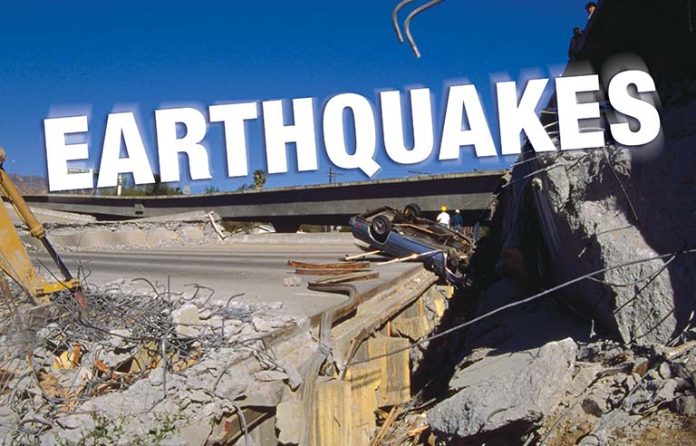
Earthquakes were never really a concern for Jennifer Serne while growing up in Louisiana. “They aren’t No. 1 on our list,” she said. “We obviously have something (hurricanes and tropical storms) that comes up a lot higher than that.”
In 2001, however, she experienced the 6.8-magnitude Nisqually earthquake. The epicenter was northeast of Olympia, WA. “I will never forget it,” said Serne, who was in college at the time. “I’d heard about them, but I hadn’t experienced anything like that. It’s a pretty stunning effect to feel the earth move under you like that.”
Now, encouraging workers and safety professionals – no matter where they live or work – to be prepared for earthquakes is part of her role as an assistant professor in the safety and health management program at Central Washington University.
According to the U.S. Geological Survey, from 2010 to 2015, Alaska and California had the most earthquakes of any state, with 9,020 and 1,545, respectively. Additionally, 40 states had a least one earthquake with a magnitude of 3.0 or greater.
These events can’t be predicted, so occupational safety and health experts say the best defense is planning and preparation.
‘Drop, cover and hold on’
Less than 10 miles from Closure Systems International’s bottle cap manufacturing plant in Salt Lake City is the town of Magna, UT – the epicenter of a 5.7-magnitude quake that took place March 18, 2020.
“It really freaked a lot of people out,” said Marshall Greer, environmental, health and safety manager at the facility. “That initial 5.7 lasted about 15 seconds. Everyone ducked and covered.”
Greer said workers at the facility participate in annual Great ShakeOut earthquake drills, a nationwide initiative sponsored by FEMA, USGS and others. As part of the initiative, numerous state and federal agencies, as well as preparedness organizations, promote the “drop, cover and hold on” strategy for personal safety during an earthquake.
(The 2021 Great ShakeOut is set to take place Oct. 21. For more information, go to shakeout.org.)
“The point is to get low on the ground, or make yourself as low as possible, and cover your head and neck to avoid potential injury,” said Brian Blake, associate director of the Central U.S. Earthquake Consortium.
“It’s important that people know what to do when the ground starts to shake,” he added. “You want to stay where you are. If you’re outside, you never want to go inside a structure when it’s shaking. If you drop, cover and hold on when you’re outside, you’re still less likely to be injured.”
Move with caution
One thing not to do during an earthquake? Run.
“There’s a high likelihood if it is a large earthquake, you can be thrown to the ground and be injured,” Blake said. “When people are running, they’re not reducing their potential for injury – they’re increasing it.”
Serne said the “drop, cover and hold on” strategy works well and, when the shaking stops, everyone should cautiously evacuate the building. “You want them to understand to immediately take shelter, but then they should go,” she said.
That’s what the workers at Greer’s facility did without incident. “Everyone knew what to do, so that was good,” he said. “If you’re not doing this (training) beforehand, you’ll run into a lot of problems.”
Part of that training should include preparing for aftershocks, which can be equally jolting for individuals who may have frayed nerves from the initial tremor. According to the University of Utah Seismograph Stations, more than 700 aftershocks were felt over the next two weeks after the Magna quake occurred. Of those, 34 had a magnitude of 3.0 or higher.
“We actually had more product damaged in the aftershocks than the initial shock in our warehouse,” Greer said.
Value of practice
Relatively speaking, earthquakes don’t last long, but they can have long-lasting effects. According to the Ready Business QuakeSmart Toolkit, citing 2014 data from FEMA and the Department of Labor, 40% of small businesses won’t immediately reopen after a natural disaster such as an earthquake. One year later, an estimated 25% more will close.
To better help employers understand the potential challenges they could face after an earthquake, Serne suggests conducting an annual tabletop exercise with key safety leaders and company executives. “Put some people in a room once a year and say, ‘We’ve had an earthquake and here’s what is happening to our facility.’ Run through some scenarios and see how you do,” she said. “That’s the way to test your emergency plan. That’s how you find the holes. You’d be surprised. There’s stuff that comes up that you hadn’t thought of.”
OSHA covers emergency action plans in its 1910.38 standard, which requires employers to designate and train workers to assist in safe evacuations, as well as review the plan with every employee who is covered by it.
To assist employers with risk assessment, the Department of Homeland Security’s Ready.gov website features a diagram detailing the three-step process. The first step is hazard identification, which involves determining the probability and magnitude of events such as a natural hazard, fire, pandemic or an explosion. Next is considering what assets are at risk: property, equipment, supply chains and, most importantly, people. Finally, safety leaders should conduct an impact analysis with a look at what could be lost in an event such as an earthquake, including lives.
Additionally, being prepared requires regular training to make sure the actions workers must take to keep themselves and others safe are top of mind. “We encourage people to do, at minimum, an annual earthquake drill, just like they would do for active shooter or tornado or fire,” Blake said.
In FEMA’s “Every Business Should Have a Plan” booklet, the agency recommends including emergency preparedness information in newsletters, on a company intranet, in periodic emails to workers, and/or in other internal communication tools. The agency adds that special considerations must be made for individuals with disabilities.
At Closure Systems International, Greer said the company’s commitment to preparation and having a disaster plan was an important factor in its ability to get the facility back up to full capacity within three days. (For a downloadable disaster plan template, go to Ready.gov.)
“Being able to respond to an emergency is great,” Serne said, “but being prepared for one is just so much better.”

