
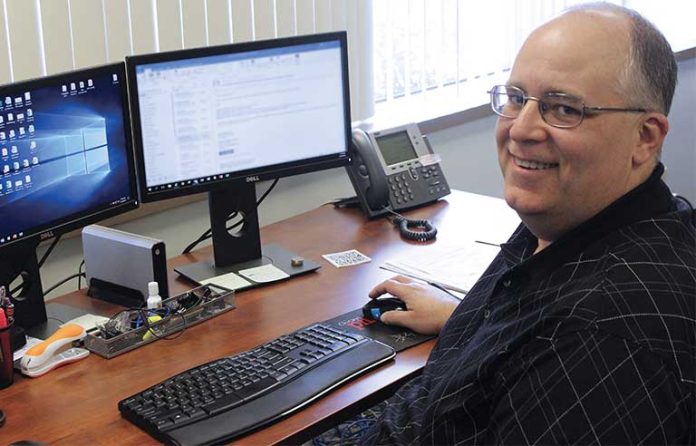
Danny Smith likes to joke that he was put in charge of safety because he didn’t run fast enough.
The responsibility was handed to him more than 25 years ago, when he was working in manufacturing operations for a direct mail advertising company. As the organization began to grow, the chief operating officer told Smith that someone was needed to oversee safety – and that he’d been tapped for the role.
“We were having a good number of accidents and really didn’t have a safety program,” said Smith, who is now a senior safety consultant at SafeStart. “We started from scratch.”
Have you suddenly been put in charge of safety? Whether you’ve been asked to move from another department or safety has been added to your list of current job duties – or you’ve simply been told, “You’re the safety person,” despite no previous experience – the important task of preventing worker injuries and illnesses is now yours.
Here’s where to start.
Make connections
One of the first steps you should take is to gain an understanding of the scope and responsibilities of your new role, said Barbara Boroughf, retired global vice president of environmental, health and safety management at the Lear Corp.
Next, start building relationships – especially with key decision-makers.
“It’s imperative that you know the C-suite executives,” Boroughf said, “because they’re the ones that’ll provide support and funding of the processes and programs.”
It’s also vital to establish connections with frontline supervisors and plant managers. Be visible and attend meetings with them whenever possible.
Boroughf emphasized that you need to get to know the workers as well – walk the plant floor and shake their hands, greet them and chat with them.
“You don’t want to just show up when there’s a problem. Show up daily,” she said. “If you show up just when there’s an accident or when somebody’s complained about something, they’re going to say, ‘Oh, this person doesn’t really care.’”
Remember, of course, that employees have jobs to do, so make sure your interactions don’t take too much time away from their work. During those interactions, let workers know you’re there to help and tell them how they can contact you.
“I have learned through 10 years of surveying employers that it is vital for safety practitioners to have positive interactions and learn from the people they serve,” said Crystal Cannan, director of workplace training and survey services at the National Safety Council.
Page 2 of 3
Getting to know OSHA
When establishing relationships and connections, you’ll also need to fulfill legal and compliance obligations. A major part of that involves federal OSHA or an OSHA State Plan, depending on the state in which you work. The federal agency’s website features recommended practices for safety and health programs.
“Start there,” Smith said.
The website also has a list of “key employer responsibilities.” In the list, OSHA mentions certain responsibilities that may prove surprising, depending on your level of expertise, Boroughf noted.
“Somebody may come in and say, ‘I want to have access to the OSHA log,’” she said. “They need to understand who can have access to the log of work-related injuries and illnesses.
“Also, there are specific legal requirements in OSHA for reporting all work-related fatalities and hospitalizations, amputations, and losses of an eye. Then, the employee (or an employee’s ‘designated representative’) does have the right to have access to their medical records and exposure records.”
An important question to answer: Is your workplace covered under a national, regional or local OSHA emphasis program? If so, that means OSHA inspectors are likely to show up more often at your establishment.
That scenario raises another question: Do you know what to do if an OSHA inspector comes to your workplace and how that inspection would proceed? The agency has a step-by-step guide on its website. Another resource is the Safety+Health feature, “What to expect when OSHA is inspecting,” published in the June 2019 issue.
Smith noted that OSHA’s On-Site Consultation program is available to help many small and medium-sized businesses. He cautions, though, that any hazards identified during the consultation process must be corrected – or your organization will likely face a potential citation down the road.
Additionally, Smith recommended striving to get into OSHA’s Voluntary Protection Programs. To be included, employers submit applications to the agency and “undergo a rigorous onsite evaluation by a team of safety and health professionals.” OSHA then reevaluates participating organizations every three to five years.
One significant benefit of VPP inclusion is organizations don’t have to undergo programmed inspections as long as they retain their status.
Workers’ compensation
Another major obligation is workers’ compensation. One key term to know is “experience modifier.” The Ohio Bureau of Workers’ Compensation defines it as a measure of expected future claims costs. Importantly, the experience modifier – sometimes referred to as “the mod” – determines the amount of your premium payments.
Insurers typically use three years of data for an organization, including the frequency and severity of workplace incidents. They then compare that data with companies of similar classification or operation, according to the National Council on Compensation Insurance.
“Some of those metrics are ones that really affect the bottom line,” Smith said. “And that’s one of the things that I think every safety professional needs to understand. If you control your workers’ comp costs, that’s going to have a benefit for years to come.”
States have different rules on workers’ comp, Smith pointed out, such as whether an employee or employer has the right to select a doctor.
If you have a third party that handles your workers’ comp claims, Boroughf said safety pros need to understand that they have to report injuries to that administrator and provide detailed incident investigations. She warned that taking a hands-off approach with third parties isn’t wise.
“It’s important to have at least monthly reviews of the workers’ comp claims to ensure the claims are moving along to closure,” she said. “Just because you have a third-party administrator, you just can’t disengage. You have to be on the ball and ensure the claims are moving along.”
Page 3 of 3
Beyond ‘minimum compliance’
When it comes to regulatory bodies such as OSHA, JoAnn Dankert, senior safety consultant of workplace training at NSC, cautions that the agencies enforce “minimum compliance.” Additionally, their regulations don’t cover every hazard.
That means, in some situations, it may be wise to look to other consensus standards, such as those from the American National Standards Institute or the National Fire Protection Association.
One key part in going beyond minimum compliance is continuous improvement, “the core of any safety management system,” Cannan said.
“Ask these two questions: Where is your organization now? Where are you going?” she said.
One way to gauge that is by looking at your worker injury and illness logs. If these aren’t in place, estab-lish them immediately. (For more information, go to osha.gov/recordkeeping.)
“You have to know where to start pointing your actions,” Boroughf said.
From there, Smith recommends starting regular inspections and performing Job Safety Analyses – also known as a job hazard analysis or task hazard analysis – focusing on high-hazard areas first. Identify the hazards and conditions that might change, or try to anticipate new hazards.
Among his other advice:
- Look at near-miss reports and incident investigations.
- Provide ways for workers to report safety issues.
- Learn how to put equipment out of service.
- Formulate safe work practices and procedures.
With all of your new responsibilities, it’s easy to feel overwhelmed or even a little dispirited. When he first started out, Danny Smith sought help by getting employees involved in the safety process.
Your organization also should review its maintenance records, emergency and evacuation procedures, and medical and first aid treatment. Smith suggested placing a log, which workers should fill out, next to the first aid cabinet to help keep track of supplies and potentially provide other valuable information.

Photos: Mike Sharkey
For example, say you notice that multiple employees who are working in the same area of the facility have needed adhesive bandages in a short period of time. This is a sign of a likely issue that needs examining.
“You have one person that nicks their finger on this piece of equipment today,” Smith said.
“Tomorrow, you have somebody else that does it. The third day, fourth day, a month from now, you get something. You can look at that log and you can gather that information.”
When seeking to prevent or mitigate hazards, use the Hierarchy of Controls. But go beyond personal protective equipment when you can, Smith advised.
“Don’t overthink things,” he said, “but also know hazard prevention and control is more than just putting up a sign.”
Speaking and presenting
Some potentially new – and perhaps daunting – skills that new safety professionals may need to obtain involve public speaking or presenting.
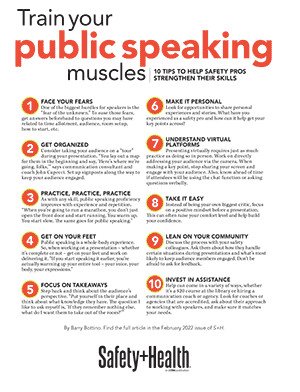
Communications consultant John Capecci provided speaking tips during the December episode of Safety+Health’s official podcast, “On the Safe Side.” Those tips are also detailed in “Train your pubic speaking muscles,” an article in the February issue of the magazine, complete with a downloadable tip sheet about shoring up your speaking skills.
Among Capecci’s advice: focus on takeaways, get organized and solicit help from others.
Danny Smith, senior safety consultant at SafeStart, said his organization encourages people to videotape themselves as well. In terms of presentations, Smith said one tip is avoiding “death by PowerPoint,” such as reading directly off the slides.
Most of all, go easy on yourself as you learn.
“It is important to remember that we are our own worst critic,” Smith said.
Don’t be afraid to ask for help
With all of your new responsibilities, it’s easy to feel overwhelmed or even a little dispirited.
When he first started out, Smith sought help by getting employees involved in the safety process, such as offering advice on policies and procedures.
“I’d ask the people who were doing the work to help me,” Smith said. “That made sure it didn’t just ‘look good on paper’ and would actually work and be used on the shop floor.”
He said he assigned workers from certain areas of a plant to perform self-inspections using the same checklist that he would use, or he’d let them fill out a portion of it.
A beneficial byproduct of this? Increased employee engagement. “In many cases, they were able to correct the issue without my involvement,” Smith said. “Educating folks on what was safe or at-risk in their work area and getting them involved in that process was a huge win.”
If possible, find a mentor – either within your organization or externally.
“Networking is a fundamental pillar in one’s safety career,” said David Consider, another senior safety consultant at NSC. “Get involved with global, national, and local safety associations and conferences.”
Angela Brown, senior manager for workplace practice at NSC, suggests using credible resources to “keep you from reinventing the wheel.”
She continued: “Review the research on what’s already been done. The purpose and benefit of research is continuing to build on what already has been done. Reach out to other companies/organizations and establish working relationships with external partners that do similar work. Don’t be afraid to ask questions, or even to take a visit to see how things work within another organization.”
Boroughf’s suggestion is to stay organized, using a whiteboard or another method to write down your to-do list – with tentative and reasonable time frames.
“A very energetic person may come in and say, ‘Wow, I can do that in a month,’” she said. “But you’ve got to remember that there’s other roles and responsibilities and projects that may come your way. You may be delayed a week or two. It’s no shame to revise your timeline. You just have to show that you’re making progress.
“Stay focused and don’t get too many irons in the fire.”
As an example, she said don’t start a PPE assessment along with a lockout/tagout program and then something else. Instead, focus on your high priorities or “big hitters.”
In addition, look for “quick wins” to show early success and gain buy-in from your teams.
That brings up another point. You can’t do everything by yourself, Smith said, especially if you have a multifaceted role. It’s vital to establish relationships.
“You have to have the support of lots and lots of people throughout the organization,” he said.