
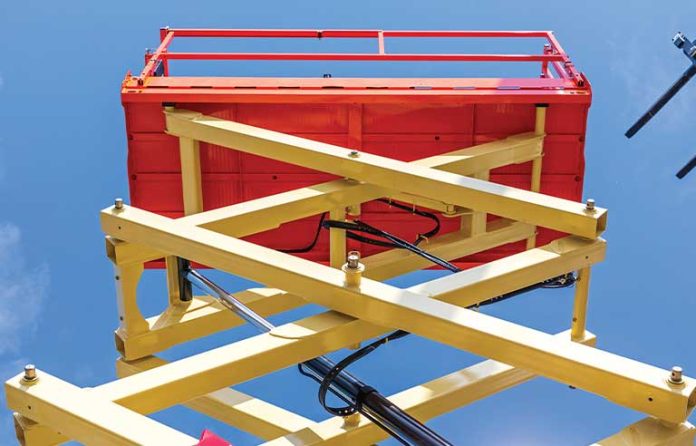
Scissor lifts – named for the way the lifting mechanism’s crossed beams raise and lower the work platform – are often used by manufacturing, warehouse and construction workers.
To safely operate a scissor lift, OSHA says two main elements must be addressed before work begins: proper positioning and stabilization.
Here’s what workers and employers can do:
Positioning
- Implement traffic control measures around the lift to prevent other workers or equipment from approaching.
- Use ground guides when operating or moving the lift.
- Place the lift at least 10 feet away from power lines and other sources of electricity, as well as away from overhead hazards such as tree branches.
Stabilization
- Digital Partners -
- Don’t move the lift while it’s in the upright position.
- Work in areas that have a level surface and don’t have hazards (holes or bumps) that can cause instability.
- Use the lift outside only if weather conditions are good.
- Don’t bypass safety features designed to stop the lift from collapsing.
- Never allow the weight on the work platform to exceed the manufacturer’s load rating.
- Don’t use equipment (such as a forklift) other than the scissor lift mechanism to raise the work platform.
And, as always, “Only trained workers should be allowed to use scissor lifts,” OSHA says, “and employers should make sure that those workers show that they can use a scissor lift properly.”
Employers should train workers to:
- Check that a guardrail system is in place before working on the lift.
- Stand only on the work platform – never stand on the guardrails.
- Position work tasks within easy reach of the lift to avoid leaning away from it.