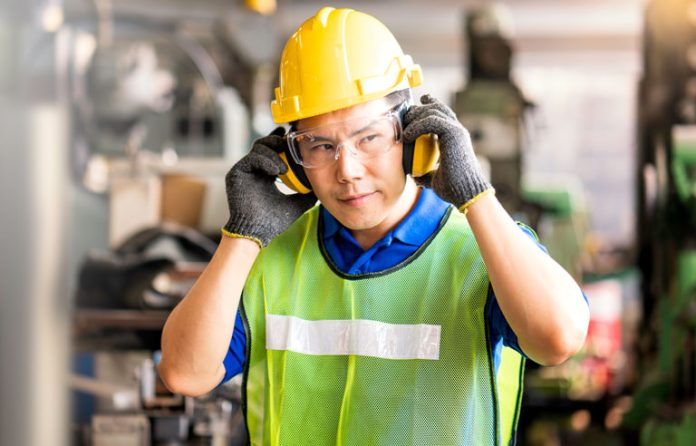
Washington — Citing technological advancements, a recent NIOSH policy update calls on employers to use “individual, quantitative fit testing” to assess the effectiveness of workers’ hearing protection devices.
Published in January, the update revises guidance featured in the agency’s June 1998 criteria document for a recommended standard covering occupational noise exposure.
At that time, NIOSH said workers “ideally” should receive individual fit testing for hearing protection but noted that commercially available fit-test systems weren’t readily available. So, “NIOSH instead recommended derating the manufacturer’s labeled noise reduction rating to estimate a worker’s ‘as worn’ hearing protector attenuation,” the update states.
Now, however, modern “advances in research and technology have made it possible to quickly check the attenuation that each worker receives from their preferred hearing protection devices at the worksite,” NIOSH says. Additionally, “several hearing protector fit-test systems are now available” that determine a personal attenuation rating, or PAR, “that accurately reflects the level of sound reduction an individual worker receives while wearing a specific hearing protector.” The PAR also may determine “an individual has achieved a specified level of protection.”
The agency emphasizes that although it recommends the use of individual hearing protector fit testing in the field as a best practice for employers, it doesn’t favor any particular fit-testing method.
CORRECTION: In the original version of this article, it said “individual, qualitative fit testing” instead of “individual, quantitative fit testing.” S+H regrets the error. Thank you to our eagle-eyed reader Chris Kirkham, loss prevention manager at State Compensation Insurance Fund in California, for bringing the mistake to our attention.