
The first year Erendira Santillan organized a safety fair for her workplace, she could count on one hand the number of vendors that participated.
“I only had two or three come out,” she said. “Sometimes you just have to plant the seed and see if there’s any worker interest.”
There was: The fair became “the event for that company and it continued to grow every year,” added Santillan, who’s now the environmental, health and safety manager at Sloan, a commercial plumbing systems manufacturer.
Safety fairs are an interactive way for employers – as well as community groups, local businesses and safety product manufacturers – to provide education on injury prevention, emergency preparedness and health. Participants can hand out safety or health information or gear, host activities, and talk with workers and their families.
“You get the opportunity to give unlimited safety awareness information,” said Sharli Adair, workplace and compliance administrator for the City of Memphis (TN) who’s experienced in planning and overseeing a citywide safety fair. “You get to not only speak from an organizational perspective but to bring in those people that provide safety PPE or all types of safety training. It gives people a safe space to gain information and learn.”
Want to start – or grow – a safety fair? Here’s what some experts recommend.
Set goals
Whether you’re launching or reimagining a safety fair, the first step is determining your goal.
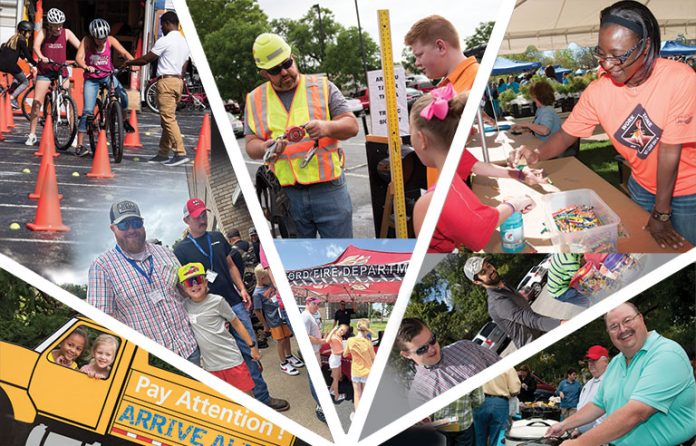
“We started out first with a bike rally for kids and handed out helmets,” said Todd Kindred, an electrician and consultant for the Rockford, IL-based International Brotherhood of Electrical Workers Local 364/National Electrical Contractors Association safety committee, which oversees an annual Safety Day.
From there, Kindred said, the goal was to grow the event. In addition to the bike fair, it now features dozens of vendors, including manufacturers, local agencies, the local police and fire departments, the local park district, elected officials, and food trucks.
Getting company leaders involved should also be a priority.
“Have a conversation with management first,” Santillan said. “There’s going to be a little bit of investment of time and resources, so it’s important for a safety professional to have that conversation beforehand. That can serve as a baseline to plan.”
Get creative
The more vendors that agree to participate, the more opportunities for safety conversations to take place.
This year, IBEW-NECA asked a local law enforcement agency’s bomb squad to conduct a demonstration of its robots. Attendees also got a chance to see a local hospital’s Life Flight helicopter.
For the City of Memphis’ safety fair, Adair focuses on themes.
“Last year, we did a circus theme,” she said. “We correlated an animal with some type of safety slogan. We had mental health – the elephant in the room – with pictures of an elephant. We had ‘roar loud’ when you see something that’s not safe. For that, we used a lion.”
This year’s theme is the planets, with Mercury – the closest to the sun – linked to heat stress.
“We do it differently every year so people will be eager to come,” she said.
Make it fun
Santillan recalled how, for one of her past safety fairs, the owner of the company made a special contribution.
“It was a lumber company, and the owner built me this pretty cool prize wheel,” she said. “I had small items – pens, keychains, $5 gift cards. Every employee had an opportunity to spin the wheel.”
She’s also introduced safety-focused crossword puzzles.
For its annual Safety Break for Oregon, which took place in May, Oregon OSHA invites both employers and workers statewide to take a safety-focused break to “create a space to celebrate their accomplishments on behalf of workplace safety and health,” said Aaron Corvin, the agency’s public information officer.
Participating employers have conducted a Jeopardy-style game, a Spot the Hazard contest, scavenger hunts, a forklift rodeo and a safety slogan contest.
Sprinkle in training
Although safety fairs often don’t include hourlong training sessions with 40-slide presentations, organizers have plenty of other ways to incorporate safety lessons and gain workers’ attention.
“Engagement is a trump card,” Adair said. “If you engage people, you allow them to have ownership.”
IBEW-NECA has a fire extinguisher vendor who shows attendees how to properly operate their products, along with tool manufacturers who demonstrate their products.
“Anytime we do something, we try to have a learning piece to it,” Kindred said.
One of Santillan’s past events featured a local health clinic that hosted discussions on back health and safety, while the Illinois State Police demonstrated a distracted driving simulator.
Employers who have participated in the Safety Break for Oregon have conducted trainings on deescalation, natural disaster response at work and home, CPR, asbestos awareness, ergonomics, and needlestick prevention.
Make it a welcoming place
The IBEW-NECA 2026 Safety Fest in June featured 18 vendors and plenty of family-focused events.
“We want to play up more outdoor activities,” Kindred said. That included the park district bringing an inflatable ice-skating rink and promoting local hiking and biking trails.
In Memphis, Adair said the citywide fair shares safety messages with community members.
“We say, ‘Come in and see how we keep our employees safe while we serve the city,’” she said.
For example, the city’s Solid Waste Department explains how citizens can safely dispose of chemicals or other potentially hazardous items.
Families are invited to the event to keep the safety discussions going at home. “I tell my teams all the time that if I only speak to you about being safe at work, then that’s very selfish,” Adair said.
Keep your ears open
Inviting feedback can help organizers ensure their safety fairs thrive. Collecting anonymous input via a suggestion box is one way to do so.
“We say, ‘If you see an unsafe situation right now, drop it in the box,’” Adair said. “That builds morale, builds courage and builds confidence.”
Kindred, meanwhile, often receives direct feedback on the most popular vendors and asks volunteers to listen carefully to conversations about the event. “Outside of work, people are more relaxed,” he said. “They will open up more. Volunteers listen for feedback on what was good, what was bad.”
Santillan knew her company’s fair was a success when employees offered their thoughts.
“It was clear to them that the company really cared,” she said. “Knowing that the company cares about them and the well-being of their families really connects people.”
Find ideas
As safety fairs evolve, change is a constant. New ideas often come from seeking out options.
Kindred said he and his colleagues travel to safety-focused shows, such as the National Safety Council’s Safety Congress & Expo, to meet potential vendors. In recent years, other unions have attended the Rockford fair. “Local 292 out of Minneapolis came to ours to take notes,” he said.
IBEW-NECA representatives also attend local National Night Out events, which are designed to promote police-community partnerships, neighborhood camaraderie and community safety. The efforts have led to the union including, along with the bomb squad robots, demonstrations from a local animal rehab organization and K-9 team.
“We try to add a little bit each year to keep it fresh,” Kindred said. “There’s a lot of work that goes into it, but it’s well worth it when you see the looks on the kids’ and the families’ faces.”
The effort can pay off handsomely.
“It creates an environment of friendliness,” Santillan said. “Safety can be fun.