

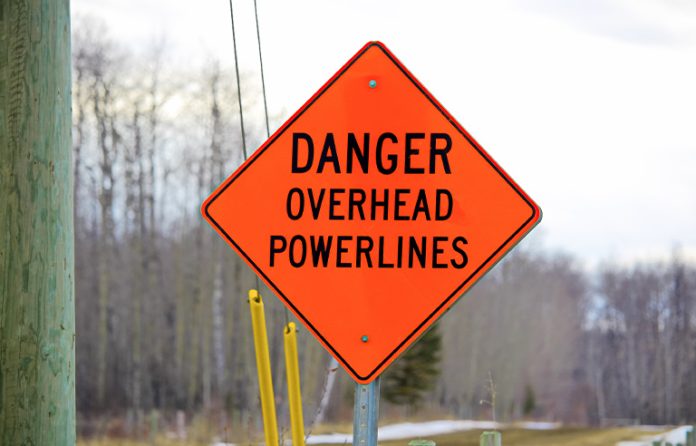
Vancouver — Nearly 3 out of 4 power-line incidents involve workers from nonelectrical trades, according to WorkSafeBC – a British Columbia agency that promotes safe and healthy workplaces.
Agency data from 2015 to 2025 shows that 74% of short-term, long-term and fatal claims related to contact with power lines involved workers in nonelectrical occupations.
A press release notes that WorkSafeBC has issued 688 orders in the past 10 years for “failing to maintain required separation distances from energized high-voltage equipment.” That includes 531 orders to construction employers.
In addition to the study, a survey of 200 workers in British Columbia conducted by the electric utility BC Hydro found that 41% of nonelectrical workers couldn’t identify the required safe distance from power lines.
“Awareness of underground electrical hazards is also limited,” the release states. “Forty-two percent of workers said they had not heard of, or were unsure they had heard of, BC 1 Call, and nearly 15% were unsure what steps must be taken before digging.”
Among WorkSafeBC and BC Hydro’s safety tips for employers and workers:
Know the requirements. Understand minimum approach distances and required safeguards.
Look up, look down and stay back. Identify overhead and underground power lines before starting work and always stay at least 10 feet away.
Choose the right equipment. Never use conductive ladders, such as those made of metal or aluminum, near power lines. Fiberglass ladders reduce risk but don’t eliminate electrical hazards or allow work within minimum approach distances.
Call for help. If you encounter a downed, damaged or low-hanging power line; exposed underground cable; or equipment that has contacted a line, treat it as live and dangerous – even if it’s not sparking or making a sound. Stay back at least 33 feet and call 911.
“Electrical hazards remain a serious risk on jobsites, especially for workers whose primary role is not electrical work but who are operating near power lines,” Matt Wilson, senior vice president of safety at BC Hydro, said in the release. “Construction, maintenance, excavation, tree trimming and traffic control workers are often exposed to electrical infrastructure. As workloads increase over the summer months, so does the risk of injury.”
The release notes that BC Hydro offers free electrical safety awareness training for trade workers, first responders and others who may operate near high-voltage power lines.