
If you haven’t yet been involved in a conversation about artificial intelligence, welcome to the party.
AI is dominating the occupational safety and health conversation, but before we get ahead of ourselves, we must paint a clear picture of the state of AI.
AI for general consumer use is no longer fully science fiction – it’s rapidly evolving. However, its current capabilities are nowhere near what we see in movies.
In his LinkedIn Learning course, “Introduction to Artificial Intelligence,” Doug Rose says that AI is “a computer system that shows behavior in a way that could be interpreted as human intelligence, provided the system is dealing with pattern matching.”
On the spectrum of weak AI, in which systems are confined to very narrow tasks, to strong AI – machines display all behaviors associated with a human being – the reality is that we’re very much buried in the weak end.
Even so, we’re continually finding opportunities to get these AI systems to make our jobs and our lives more productive and efficient (without replacing the OSH professional). Dozens of use cases for AI in OSH have already been cited, even if not widely implemented, including those for regulatory compliance, data management, proactive risk management, and workflow optimization and automation.
Does that mean we’re falling behind if we aren’t using AI?
Although technology developers might be at risk for losing their competitive edge without AI integration, most end users – especially those with OSH functions – must approach innovation with AI in a measured fashion to minimize risk and maximize optimization.
Here’s how to navigate innovation with AI for OSH.
- Start with the problem and assess your risk
First, organizations shouldn’t buy AI just to have AI. These systems should be strategically positioned to solve a specific problem. For OSH functions, this means starting by assessing your risk and gathering worker feedback to identify pain points. Where are injuries most likely to occur? What hazards could result in the most severe consequences? What can we do about them? AI is the latest shiny object, but it’s important to be careful not to implement the solution before you’ve identified the problem you’re trying to solve.
- Identify solutions
Once you know the problem you’re trying to solve – whether it’s a specific hazard, an area of inefficiency or a lack of visibility – then you can begin to identify what type of AI system may help. At this point, you must also evaluate the complexity of potential systems and determine if they’re user friendly, if they will integrate well with current systems and if they’re scalable. Most importantly, you must understand the scope of data and be transparent with your organization, and especially your workers, about what data is being collected, why it’s being collected, how it’s being used and how it’s protected. Additionally, remember that you may not need massive, expensive models to solve OSH problems. Often, smaller, domain-specific AI models are more efficient and secure.
- Determine your readiness
Determination of readiness is the opportunity to fully evaluate the organization’s willingness and ability to use, maintain and apply new technologies. Will the new solution align with business values? How will the system impact users and groups across the organization? What supporting elements are needed? Is our data clean and organized for use by an AI model? Are we ready for the errors and unintended consequences that will occur?
- Make the business case
Perhaps the most difficult part of trying something new is communicating return on investment. This will look different for every organization, but it’s important to focus on the immediate gains compared with operating business as usual, not only cost avoidance. Identify the key metrics, establish a baseline to demonstrate need and show outcomes.
- Pilot, refine and implement
Always start small, then scale. Piloting new systems allows users to learn, iterate and reduce the initial investment risks by trialing on a smaller scale. Implement the plan-do-check-act cycle to ensure you’re setting measurable goals for success, gathering feedback and improving before widespread use of AI.
Much opportunity exists for improving productivity and efficiency for OSH functions by using AI, but only if we take the time for responsible and ethical implementation. Always start with the problem you’re trying to solve, then determine how AI could help.
Still, even if you’re not ready to roll out a big AI solution, now is the time to play around a bit. You may not need to feed a generative AI system any proprietary information or try to create complex models, but you can see what it can do. Try testing an AI system by having it generate a precise time and temperature for smoking a brisket, or have it draft a meal and exercise plan for yourself. Then, hypothesize how it can solve your bigger problems.
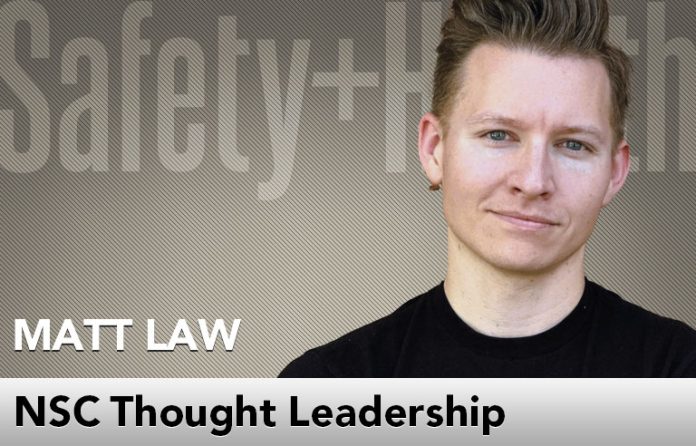
Matt Law, DrPH, CSP, REHS, is a researcher, business strategist, author and speaker. He currently leads the National Safety Council Work to Zero initiative, which seeks to eliminate workplace fatalities by 2050 using innovative safety technologies. He’s also the host of “Prove It To Me,” a podcast that reviews occupational health and safety research in an effort to provide practitioners with a grounded perspective on published research. Matt is an adjunct professor in the Advanced Safety Engineering and Management graduate program at the University of Alabama at Birmingham and serves as an environmental health officer in the U.S. Navy Reserve.