Washington — Despite once again facing elimination under the Trump administration’s most recent budget request, the Chemical Safety Board is continuing its work – including collaborating with industry and worker groups.
Speaking during a June 18 public business meeting, board member Sylvia Johnson highlighted recent CSB contributions to conferences and safety workgroups, including those involving the United Steelworkers, American Fuel and Petrochemical Manufacturers, and American Petroleum Institute.
“Investigations alone don’t improve safety, but what does improve safety is people,” Johnson said. “Workers who speak up, leaders who act early, industries willing to learn from past failures instead of repeating them. That is why stakeholder engagement remains central to the mission of this agency.”
The White House’s budget request, released in April, includes the sixth attempt – across President Donald Trump’s two terms – to shutter the agency. Although Congress didn’t follow through on any of those requests, a bill approved in May by the House Appropriations Interior, Environment and Related Agencies Subcommittee would trim CSB’s budget by more than 41% for fiscal year 2027, which begins Oct. 1.
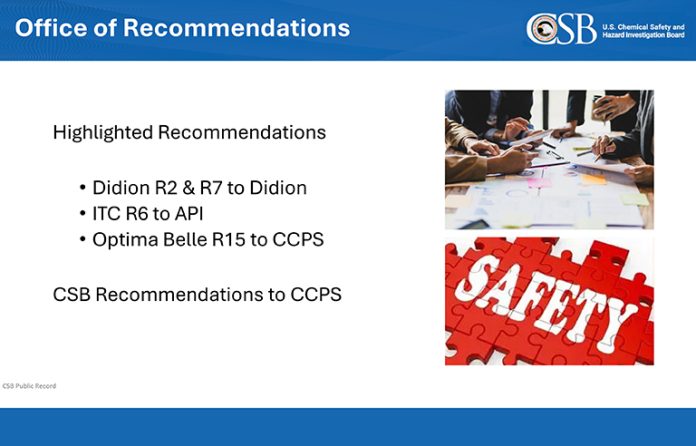
CSB didn’t address those developments during the call, instead reviewing activity related to incident investigations and agency recommendations.
Johnson further highlighted board contributions to panel discussions at recent industry gatherings, saying, “Those discussions matter because safety lessons only create value when they’re shared and applied.”
She added: “Preventing disasters requires more than recommendations; it requires partnership. And progress happens when government, workers and industry all sit at the same table before tragedy strikes.”
In an update on reporting under the agency’s accidental release reporting rule, Steve Klejst, executive director of investigations and recommendations at CSB, said the reporting rate was growing “more normalized.”
The board observed a spike in reportable events during the second quarter of 2026, as the three-month moving average reached 13 in April.
“This data is very important for companies to recognize that these events are still occurring,” Klejst said, “and the efforts necessary to ensure a safe and secure operation for their organizations to minimize injury and property damage to both the facility as well as the surrounding community.”