In many respects, the occupational safety and health profession is slowly coming into its own, shedding its past as a compliance-driven afterthought and taking its place as a crucial component of business.
“Years ago, you’d never hear the words ‘chief safety officer,’” said Carl Heinlein, senior safety consultant for the American Contractors Insurance Group and director at large for the American Society of Safety Professionals. “Now you’re seeing safety professionals in the C-suite that are involved in strategic decision-making day in and day out.”
Although some indicators suggest the profession is arriving, others show it’s not quite there yet. John Dony, director of the Campbell Institute and environmental, health and safety at the National Safety Council, points to the most recent data from the Bureau of Labor Statistics. It shows a slight increase in preventable worker fatalities, to 4,414 deaths in 2017 from 4,398 in 2016, according to an NSC analysis.
Analysis of preventable work deaths in Injury Facts, a reference source for safety statistics published by the National Safety Council.
“These numbers are unacceptable,” Dony said, noting that improvement will depend on a healthy supply of well-qualified safety professionals. “We have seen that organizations that go beyond safety compliance and put safety management systems in place are best positioned to keep their workers safe. These systems require trained OSH professionals to run them smoothly.”
Despite rising demand for safety professionals, however, awareness among the general public – and thus the number of graduates entering the profession – has yet to catch up.
| What’s the Job Outlook for Safety+Health readers? Browse the results of our 2019 survey. |
||
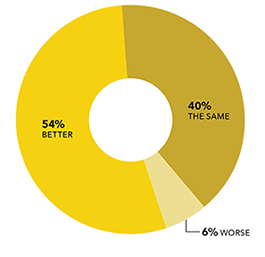 Job market |
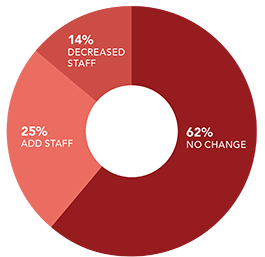 Department staffing |
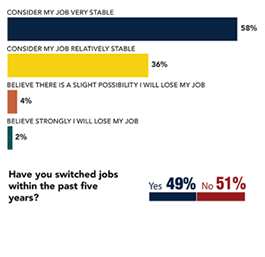 Personal outlook |
Addressing the shortage
NIOSH’s most recent National Assessment of the Occupational Safety and Health Workforce, published in 2011, found that demand for safety professionals was significantly outpacing supply. Employers reported that they had planned to hire more than 25,000 OSH professionals in the five years after the survey, while academic programs in the field expected to graduate fewer than 13,000 qualified job candidates.
Compounding the problem, employers expected 10 percent of safety professionals to retire within a year after the survey, and 48 percent of the occupational safety workforce was at least 50 years old, which means that many more now are nearing retirement.
Why is it that more students aren’t entering the safety profession? For one, many simply don’t know it exists. When asked what obstacles kept students away from OSH, 59 percent of educational providers who responded to the NIOSH survey cited a lack of knowledge of the programs.
“If you ask a young child what they’d like to be when they grow up, you hear things like fireman, police officer, doctor, lawyer,” Heinlein said. “You typically don’t hear safety professional.”
He attributes some of the lack of public awareness to the fact that workplace safety doesn’t make for splashy headlines. “Typically what you see in the news is that there’s been an accident or incident,” Heinlein said, “not that an organization went three years without an injury or five years without an environmental issue.”
Peter Dooley is senior project coordinator at the National Council for Occupational Safety and Health, a worker advocacy group. Dooley said he believes the public may not be aware of the need for safety professionals because the risks workers face on a daily basis are a bit of a dirty secret.
“It’s a hidden epidemic that work can be so dangerous and cause so much harm,” he said.
Even those who are clued into safety professionals’ existence may not understand what they actually do. “There is a lack of awareness of safety being more than the absence of harm – that ensuring safety requires a defined program, organizational implementation and employee engagement,” said Treasa M. Turnbeaugh, CEO of the Board of Certified Safety Professionals.
To maintain the profession’s growing momentum and ensure a good supply of well-trained graduates, experts believe the case for OSH needs to be made more widely to employers, to academic institutions and especially to young people.
“The future is bright for this profession,” Heinlein said. “So the question is, how do we help sell the industry?”
| Next: Making the case to employers, academia and students | > |

Making the case to employers
“The business mentality around safety has changed a lot in the last 20 to 30 years,” said Kristen Chipman, EHS supervisor at Pittsfield, ME-based Cianbro Corp. and chair of the NSC Young Professionals Division, “and more businesses are identifying it as an area they need to focus on.”
Learn more about the NSC Young Professionals Division.
However, employers who hire safety professionals simply to avoid running afoul of OSHA are plentiful, and the task of making the case for safety – to workers and upper management – often falls to those same safety pros, who “have to do a lot of education and training within their own business unit, fighting the misconceptions that safety is a waste of time, safety costs a lot of money, safety makes my job go slower,” Chipman said.
To shift this burden, ASSP’s recently formed Council on Academic Affairs and Research is pushing for more business leaders to come prepared with a working knowledge of OSH.
“Prevention programs that optimize worker health and safety are essential to businesses’ bottom line,” said ASSP Vice President Jim Ramsay, professor of security studies at the University of New Hampshire, “but there’s not an MBA program in the country that requires business majors to understand things like occupational safety and health. So getting more of our strategies and tactics into the hearts and minds of people that run businesses is critical.”
Making the case to academia
Experts say educational opportunities in OSH are growing, with more safety programs promoting skill sets that go beyond compliance – even online safety degrees are coming onto the scene. However, the bright future of OSH education may be clouded by a lack of investment. In the NIOSH survey, a second barrier cited by education providers was a decline in college and university funding for OSH programs, particularly those not funded by NIOSH.
Further, even NIOSH funding has been threatened in recent years. “One of NIOSH’s prime missions is to nurture the field of occupational safety and health professionals,” Dooley said, “and they primarily do that through their Educational Research Centers program, which funds university-based regional academic programs.”
Dooley said protecting and growing these programs is essential to the safety field’s ability to widen its pool of candidates and attract the diversity needed to serve workers of different nationalities and who speak other languages. “The ERCs need to be available so that students of all backgrounds have those educational opportunities, but funding for those programs has been constantly under attack,” he said.
ASSP’s Council on Academic Affairs and Research is calling for safety degree programs around the country to make another kind of investment in the future of the profession: program-level accreditation. To gain the kind of status and public recognition that OSH merits, Ramsay argued that the profession must define itself by establishing consistent educational standards.
“The sovereignty of a profession means that there are barriers to occupational entry,” he said. “The profession knows what it is and what it isn’t, and those ideas are usually contained in a series of educational standards that define the requirements for that profession – technical and knowledge-based competencies, operating expectations, and ethical and professional obligations.”
Currently, ASSP lists only 20 accredited programs nationwide.
| What’s the Job Outlook for Safety+Health readers? Browse the results of our 2019 survey. |
||
|
Job market |
Department staffing |
Personal outlook |
Making the case to students
Professional organizations are looking for ways to reach students at a younger age and lay out a clear career path. A prime example is BCSP’s “Choose Safety” campaign, launched in 2017.
“We define the path from initial interest to building one’s knowledge in a trade or accredited college, entering the profession with a designation, and continued professional advancement with a recognized certification,” Turnbeaugh said. “The audience includes college students looking to choose a major; university faculty in safety, health and the environment; high school youth planning their future; and school counselors seeking ways to engage and support students.”
Learn more about the “Choose Safety” campaign.
Many organizations are also stressing the importance of mentoring programs and student internships. For example, in addition to offering free membership to students pursuing a safety degree, the Young Professionals Division at NSC recently introduced a mentorship program that pairs active safety professionals with student members to provide educational guidance, career advice, and information on internships and work opportunities.
According to Dooley, OSH professional groups have created programs designed to inspire teens and young workers to get involved in the field by giving them “a chance to experience not only the issues that they may face at work, but how important it is that workers know what their rights are.”
|
NEXT How to “sell” safety |
> |
Selling by word of mouth
Although professional societies are taking the lead, experts agree that individual safety pros have a role to play in recruiting the next generation of students.
“It is crucially important for OSH professionals to share their experiences with others in their communities,” Dony said, “whether it be a career night at a high school or participating in a mentorship program.”
Some ways safety pros can spread the word include:
Talk about the need for OSH. “We all need to be giving people a sense of how urgent the prevention effort is,” Dooley said. “Advocate for young people to find out more about how much this field is needed, how tragic it is that workplace fatalities have been increasing in the U.S. in the last several years and how preventable all those deaths are.”
Tout the selling points of OSH. A career in OSH comes with a multitude of benefits likely to appeal to students (see “Selling points of a career in OSH.”). “The large number of job opportunities will hopefully make it easier to secure a job upon graduation,” said Dony, who also listed advantages such as job stability, advancement opportunities, competitive salaries and the satisfaction of making a difference in people’s lives.
Relate OSH to issues young people know and care about. “Take any opportunity you have to go out and educate people on a safety topic,” Chipman said. “If they take an interest in distracted driving or the opioid crisis, help them see that this transfers to a career path.”
Get involved in OSH societies. Developing relationships with professional associations gives safety pros more opportunities to share lessons learned and participate in outreach activities.
“It’s a Johnny Appleseed scenario,” Heinlein said. “Keep planting seeds. Anytime you have an opportunity to talk this profession up or point someone in the direction of an occupational safety school, credential or group, it helps. It’s going to take all of us in this profession – from societies to individuals – to keep talking about the great careers we’ve had.”
| What’s the Job Outlook for Safety+Health readers? Browse the results of our 2019 survey. |
||
|
Job market |
Department staffing |
Personal outlook |
|
NEXT Survey results: Your take on the safety job market |
> |
Survey results: Your take on the safety job market
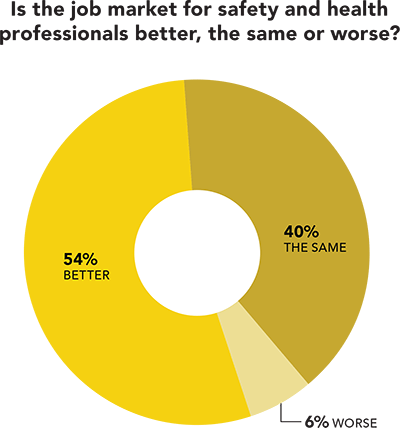
Read open-ended respondent comments answering these questions:
- How would you describe the current job market for occupational safety and health professionals?
- What can be done to encourage safety and health professionals to stay longer with their organizations?
- What can be done to attract new people to the profession?
- Going forward, what skills will be most important for safety and health professionals to be hired and promoted?
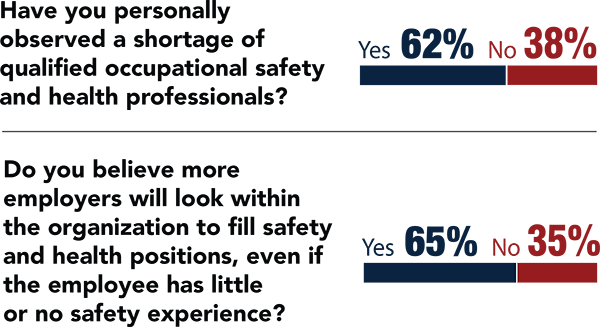
Note: Percentages may not add up to 100 percent because of rounding.
The Safety+Health 2019 Job Outlook survey was emailed in March to
13,272 S+H subscribers; 487 responded for a 3.7 percent response rate.
|
NEXT Survey results: The safety function at respondent organizations |
> |
Survey results: The safety function at respondent organizations
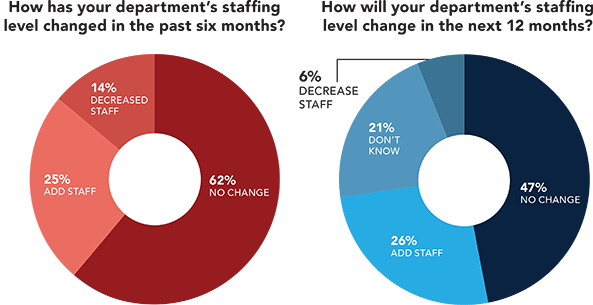
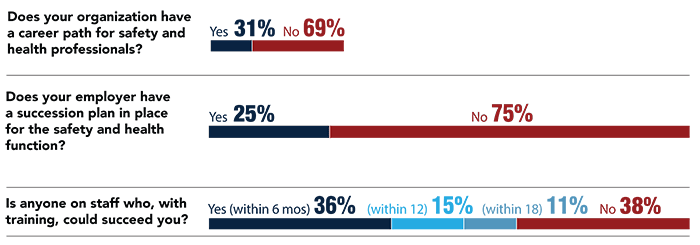
Note: Percentages may not add up to 100 percent because of rounding.
The Safety+Health 2019 Job Outlook survey was emailed in March to
13,272 S+H subscribers; 487 responded for a 3.7 percent response rate.
|
NEXT Survey results: Personal outlook and respondent profile |
> |
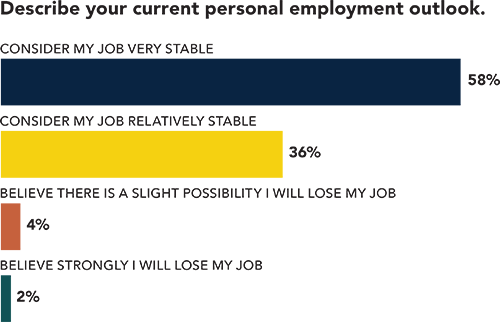
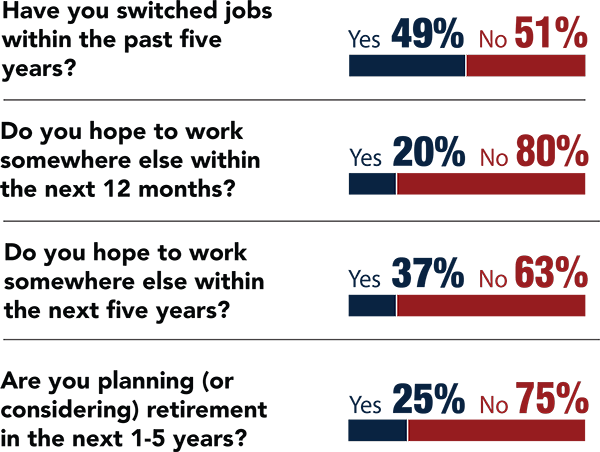
Survey results: Personal outlook and prospects
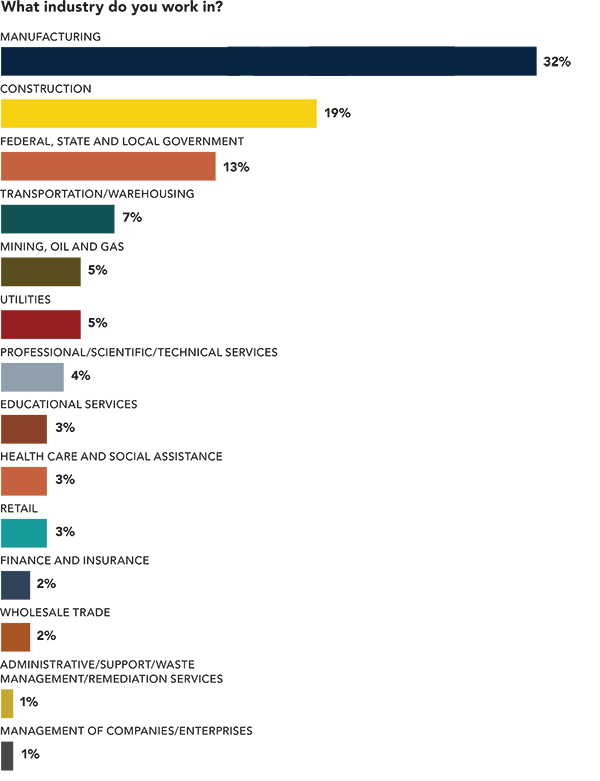
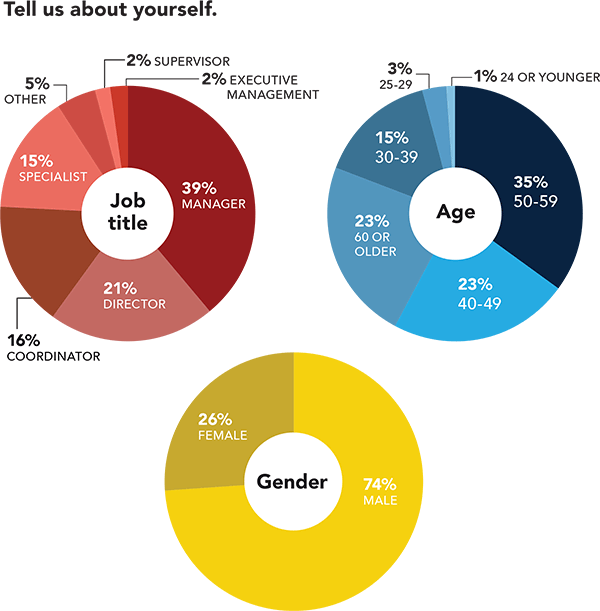
Survey results: Respondent profile
Note: Percentages may not add up to 100 percent because of rounding.
The Safety+Health 2019 Job Outlook survey was emailed in March to
13,272 S+H subscribers; 487 responded for a 3.7 percent response rate.
|
<< Return to the first page of the article |