Responding is Jeremy Artz, product manager, Systems LLC, Germantown, WI.
Vehicle restraints are designed to improve loading dock safety by keeping trailers connected to the dock as they’re being loaded or unloaded by forklifts. This helps prevent a dangerous gap from forming between the trailer and the dock, which can lead to a forklift fall-through incident. Forklift fall-through is one of the most dangerous types of incidents that occur at loading docks. It most often results from trailer creep or premature departure.
Trailer creep: A forklift loading or unloading an unrestrained trailer transfers its momentum to the trailer, moving it away from the dock.
Premature departure: A truck driver mistakenly thinks loading or unloading is complete and pulls an unrestrained trailer away from the dock.
Both scenarios create a dangerous gap between the trailer and the loading dock that forklifts can fall into, causing serious injury or death to the forklift driver and anyone nearby.
This type of incident is so serious that OSHA requires all trailers to be restrained by wheel chocks or vehicle restraints during loading and unloading (29 CFR 1910.178(k)(1) and (m)(7), OSHA Instruction STD 1-11.7).
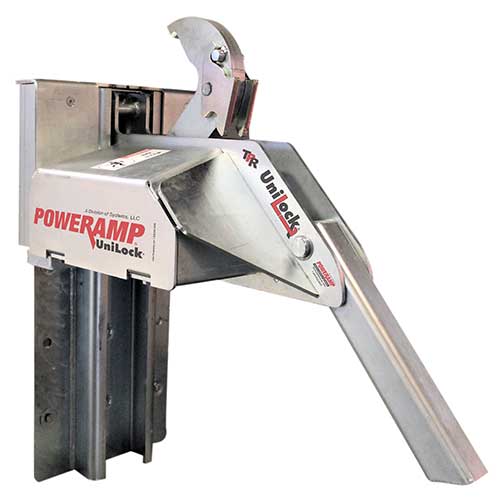
Vehicle restraints are designed to improve loading dock safety by keeping trailers connected to the dock during loading and unloading, preventing dangerous gaps. The most common type of vehicle restraint uses a rotating hook to capture and hold a trailer’s rear impact guard (RIG), keeping the trailer connected to the dock during loading and unloading.
Trailer creep or an attempted premature departure often creates so much pressure between the RIG and the restraint hook that the restraint can’t disengage when loading or unloading is complete. This is called RIG Wedge.
To escape RIG Wedge, the truck driver must back the trailer up against the dock to relieve the pressure between the RIG and the restraint hook so it can disengage. It can take several minutes to release a trailer from RIG Wedge. It requires time from the truck driver and at least one dock employee, and can delay other trucks scheduled for that dock. RIG Wedge causes costly departure delays in an industry in which time is money.
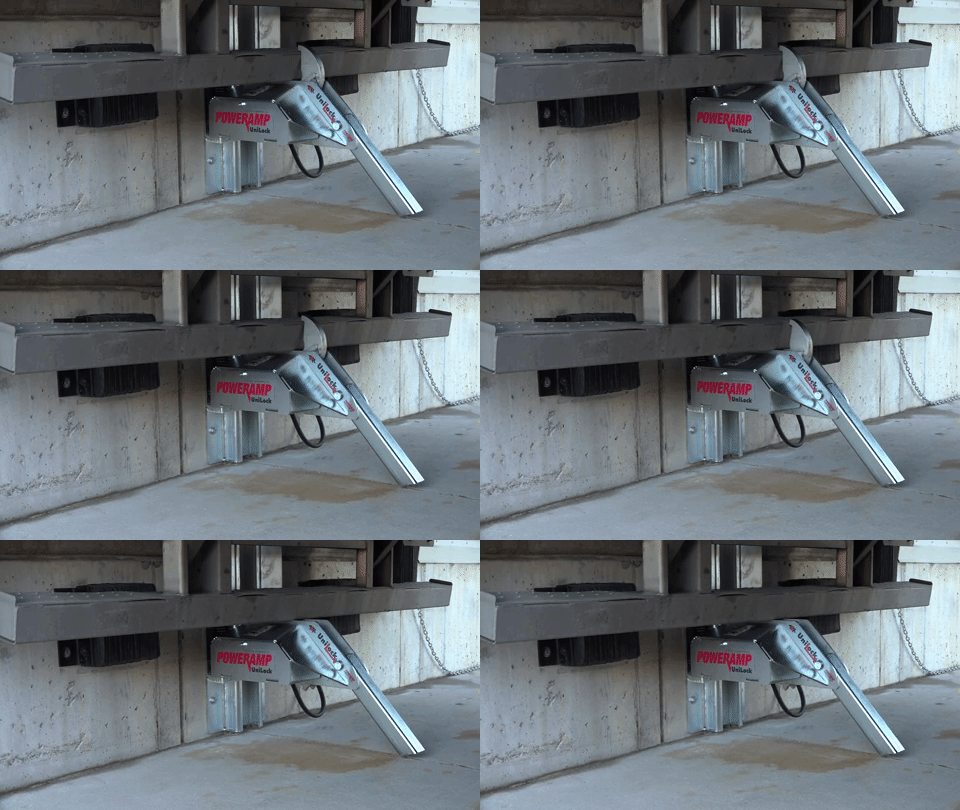
Fortunately, not all rotating hook vehicle restraints are vulnerable to RIG Wedge. Choose a rotating hook restraint that is designed to avoid RIG Wedge by rotating the hook away from the RIG as it disengages. Rotating the hook away from the RIG automatically relieves the pressure that causes RIG Wedge, helping to eliminate the need to back the truck up before it can leave the loading dock. A restraint with this capability can improve loading dock safety while minimizing departure delays resulting from RIG Wedge.
Editor's note: This article represents the independent views of the author and should not be construed as a National Safety Council endorsement.