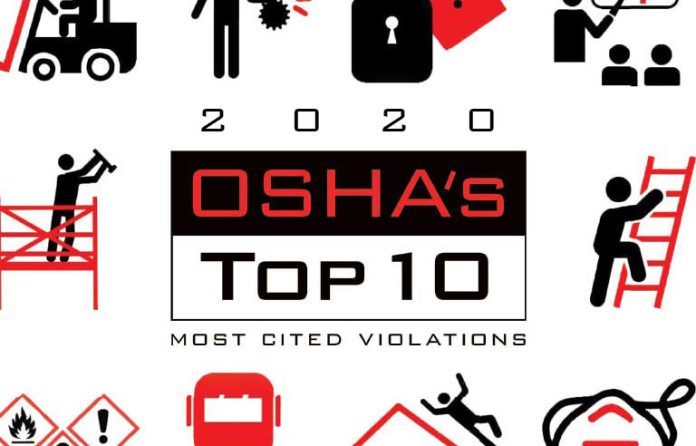
Part III of this blog series on OSHA’s Top 10 most cited violations focused on oil and gas extraction, paper manufacturing, and wood products.
Here, we’ll look at the Top 10 violations in fiscal year 2020 for the following industries: telecommunications; computers and electronics manufacturing; machinery manufacturing; and electrical equipment, appliances and components manufacturing.
As a reminder, OSHA in FY 2020 conducted 21,680 inspections – one of the lowest totals on record and down from 33,401 in FY 2019. Hence, the total number of violations in FY 2020 is much lower than in FY 2019, but the most cited violations remain consistent.
In FY 2020, OSHA issued only 68 violations to employers in the telecommunications industry. Fifty-two of the violations were cited as serious. Most of the violations were related to hazards cited only once or twice by OSHA. The top three violations cited:
- 1910.67(c)(2) – Aerial lifts, extension and articulating boom platforms (five citations)
- 1926.453(b)(2) (construction) – Aerial lifts, extension and articulating boom platform (four)
- 1910.22(d)(1) – Fixed ladders capable of supporting the load (weight) (four)
The Top 10 OSHA violations in FY 2020 for computer and electronics manufacturing:
| Rank | OSHA standard | No. of violations | Standard description |
|---|---|---|---|
| 1 | 1910.212(a)(1) | 27 | General Machine Guarding |
| 2 | 1910.212(a)(3) | 15 | Machine Guarding – Point of Operation Guarding |
| 3 | 1910.1200(e)(1) | 13 | Hazard Communication – Written Hazard Communication Program |
| 4 | 1910.147(c)(4) | 12 | Lockout/Tagout – Lack of Energy Control Procedures |
| 5 | 1910.134(c)(1) | 9 | Respiratory Protection – Lack of a Written Respiratory Protection Program |
| 6 | 1910.134(e)(1) | 8 | Respiratory Protection – Lack of Medical Evaluations |
| 7 | 1910.303(b)(2) | 7 | Electrical – Installation and Use |
| 1910.1200(h)(1) | 7 | Hazard Communication – Lack of Employee Training and Communication | |
| 9 | 1910.212(b)(9) | 6 | Machine Guarding – Guarding of Belts, Pulleys, Gears and Shafts |
| 1910.147(c)(7) | 6 | Lockout/Tagout – Lack of Training and Communication | |
| 1910.147(c)(6) | 6 | Lockout/Tagout – Periodic Inspections Not Conducted | |
| 1910.151(c) | 6 | Medical and First Aid – Lack of a Shower and Eyewash Station | |
| 19120.215(b)(9) | 6 | Grinders – Exposure Adjustment Between the Wheel and the Rest Point |
The standouts in this section of OSHA’s Top 10 violations are machine guarding, lockout/tagout, respiratory protection and hazard communication. For the industry, 350 total violations were issued in FY 2020, with 252 of them cited as serious.
The Top 10 OSHA violations in FY 2020 for the machinery manufacturing industry:
| Rank | OSHA standard | No. of violations | Standard description |
|---|---|---|---|
| 1 | 1910.212(a)(1) | 132 | Machine Guarding – General Machine Guarding |
| 2 | 1910.147(c)(4) | 64 | Lockout/Tagout – Energy Control Procedures |
| 1910.212(a)(3) | 64 | Machine Guarding – Point of Operation Guarding | |
| 4 | 1910.1200(e)(1) | 51 | Hazard Communication – Written Hazard Communication Program |
| 5 | 1910.147(c)(6) | 50 | Lockout/Tagout – Periodic Inspections |
| 6 | 1910.1200(h)(1) | 47 | Hazard Communication – Training and Education |
| 7 | 1910.147(c)(7) | 46 | Lockout/Tagout – Training and Education |
| 8 | 1910.134(e)(1) | 39 | Respiratory Protection – Medical evaluation |
| 9 | 1910.215(b)(9) | 29 | Grinders – Exposure Adjustment Between the Grinding Wheel and the Tool Rest |
| 10 | 1910.134(c)(1) | 26 | Respiratory Protection – Written Respiratory Protection Program |
As for the standards cited, the clear standouts are lockout/tagout, machine guarding and respiratory protection. Although not making the Top 10 list, several health-related OSHA standards were cited:
- Noise (1910.95) – Overexposure to noise, lack of a hearing conservation program, not providing personal protective equipment and employee training
- Asbestos (1910.1001) – Overexposure to asbestos, lack of controls and housekeeping
- Arsenic (1910.1018) – Housekeeping
- Beryllium (1910.1024) – Notification of employees of monitoring results
- Lead (1910.1025) – Lack of monitoring, no initial determination, employee notification of sampling results, lack of PPE, housekeeping, lack of hygiene facilities and information/training to employees
- Hexavalent chromium (1910.1026) – Employee overexposure above the PEL, lack of exposure determination, employees not notified of sampling results, lack of respiratory protection, lack of hygiene facilities and employee training
- Cadmium (1910.1027) – Lack of exposure monitoring, employees not notified of the sampling results, housekeeping and employee hazard training
- Benzene (1910.1028) – Lack of employee notification of the sampling results
- Bloodborne pathogens (1910.1030) – Lack of a written program
- Formaldehyde (1910.1048) – Lack of exposure monitoring
- Methylene chloride (1910.1052) – Lack of exposure monitoring, lack of initial monitoring, hygiene facilities and employee hazard training
- Crystalline silica (1910.1053) – Lack of an exposure assessment
The total number of violations cited in FY 2020 for this industry was 1,823, of which 1,329 were cited as serious.
The Top 10 OSHA violations in FY 2020 for the electrical equipment, appliance and components manufacturing industry:
| Rank | OSHA standard | No. of violations | Standard description |
|---|---|---|---|
| 1 | 1910.212(a)(1) | 20 | Machine Guarding – General Machine Guarding |
| 2 | 1910.1200(e)(1) | 19 | Hazard Communication – Written Program |
| 3 | 1910.1200(h)(1) | 16 | Hazard Communication – Employee Training and Education |
| 4 | 1910.147(c)(4) | 14 | Lockout/Tagout – Energy Control Procedures |
| 5 | 1910.147(c)(8) | 11 | Lockout/Tagout – Energy Isolation by Authorized Employees |
| 6 | 1910.147(c)(7) | 10 | Lockout/Tagout – Employee Training and Communication |
| 1910.147(c)(6) | 10 | Lockout/Tagout – Periodic Inspections | |
| 8 | 1910.212(a)(3) | 9 | Machine Guarding – Point of Operation Guarding |
| 9 | General Duty Clause | 8 | |
| 10 | 1910.134(k)(6) | 7 | Respiratory Protection – Employee Training, Providing Basic Information from Appendix D |
Not surprisingly, 60% of the Top 10 violations cited were related to lockout/tagout and machine guarding. Regarding the General Duty Clause https://www.safetyandhealthmagazine.com/articles/19258-oshas-general-duty-clause, there was no apparent trend in hazards cited. For FY 2020, OSHA issued a total of 427 violations, of which 305 were cited as serious.
Part V of this series will include the top violations in FY 2020 for three other industries – yet to be named.
This article represents the views of the authors and should not be construed as a National Safety Council endorsement.
 Richard Fairfax (CIH, retired 2017) joined OSHA in January 1978 and retired from the agency in 2013. At OSHA, he was a practicing field industrial hygienist, as well as the deputy director and director of enforcement programs. In 2008, Richard served as acting director of construction and, in 2010, was designated deputy assistant secretary – overseeing all field, enforcement and training operations. From 1993 through 2010, Richard wrote an industrial hygiene column entitled, “OSHA Compliance Issues” for the Journal of Occupational and Environmental Hygiene. He still serves on the Editorial Review Board. Richard now works part time for NSC-ORC HSE.