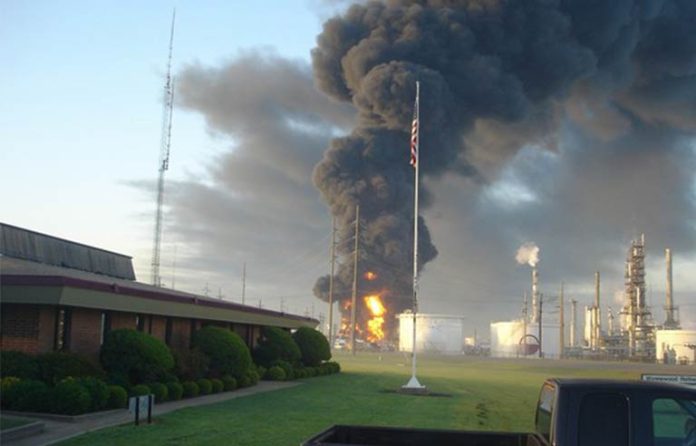
The U.S. Court of Appeals for the 10th Circuit recently issued a decision (No. 19-9533) on the appeal of OSHA citations related to process safety management at the Wynnewood Refinery in Wynnewood, OK. The court ruled in favor of the agency.
I suspect that this case has caused some consternation on the part of the industry regarding the future intent of OSHA based on this decision. But first, a little background as reported in the court’s decision.
Background: In September 2012, one of the Wynnewood Refinery’s boilers – the Wickes boiler – exploded because of an excess of natural gas that had accumulated inside. As a result of the explosion, two employees died. OSHA and the company agreed that the boiler didn’t contain highly hazardous chemicals in excess of PSM threshold quantities, and that at the time of the incident, it was operating on utility-supplied natural gas – not the usual refinery gas. But it was connected to two other parts of the refinery that did contain threshold quantities of HHCs – the fluid catalytic cracking unit and the alkylation unit.
Shortly after the explosion and the resulting fatalities, OSHA began an investigation into the incident. The agency ended up citing the refinery for various violations of 29 CFR 1910.119 (PSM), some of which were classified as repeat violations. The company contested the citations and an administrative law judge affirmed all but one of the violations. OSHA initially based the repeat violations on those that occurred under previous ownership, under the company name Wynnewood Inc., and not Wynnewood LLC. The judge changed the characterization of several of the violations from repeat to serious on the basis that the refinery was under substantially new management. Upon appeal of the judge’s decision to the Occupational Safety and Health Review Commission, the commission affirmed the judge’s decision.
OSHRC had determined that the Wickes boiler could be part of a PSM-covered process even though it didn’t contain threshold quantities of HHCs. OSHRC analyzed the text of 29 CFR 1910.119(b) and determined that the boiler was part of a process covered by the regulation – in other words, it was part of a “PSM-covered process” or was “PSM-covered.” This was based on OSHRC determining that the boiler was interconnected with the fluid catalytic cracking unit and the alkylation unit – both of which are covered under the 29 CFR 1910.119.
Second, the commission determined that the boiler “was covered by the PSM standard because it was ‘located such that a highly hazardous chemical could be involved in a potential release.’” Id. at 1152 (quoting 29 CFR 1910.119(b)). (A failure in the boiler system could affect the release of highly hazardous chemicals from the adjoining PSM-covered process, e.g., by proximity.)
Both OSHA and the company appealed the OSHRC decision. Wynnewood argued that the regulation at issue (PSM) didn’t apply to the Wickes boiler and that the commission erred in affirming those violations. The secretary argued that OSHRC erred by characterizing the violations as serious rather than repeat.
On appeal of OSHRC decision, Wynnewood argued that:
- The Wickes boiler was not PSM-covered because it didn’t contain any HHCs.
- The boiler wasn’t PSM-covered because of either its interconnection with or location near a process.
- It shouldn’t defer to the secretary because the new interpretation deprived Wynnewood of fair notice. And, citing Kisor v. Wilkie, Wynnewood urged the court to interpret the regulation by examining its “text, structure, history and purpose,” even if the text of the regulation is unambiguous.
The court determined that because the Wickes boiler was an interconnected part of a PSM-covered process, it affirmed the PSM standard violations. And because OSHRC correctly applied the substantial-continuity test and substantial evidence supports its finding that Wynnewood Inc. and Wynnewood LLC weren’t the same employer, the court affirmed the characterization of violations as serious rather than repeat. Much of the above discussion was taken from U.S. Court of Appeals for the 10th Circuit’s decision, which can be read in full at https://law.justia.com/cases/federal/appellate-courts/ca10/19-9533/19-9533-2020-10-27.html.
The questions now being asked concern whether OSHA’s PSM enforcement policy will change based on this decision. The answer, in my opinion, is that no changes will be forthcoming. The Wynnewood Refinery decision simply affirmed how OSHA has always enforced co-location/interconnection. Many in the process safety consulting community have claimed that the decision has now expanded PSM. I believe that OSHA would disagree, and this decision affirms how this issue has always been enforced by the agency.
Further thoughts on Wynnewood: The boiler was in fact PSM-covered for several reasons, in roughly decreasing order of importance:
- The boiler normally ran on refinery gas, clearly interconnected to a greater-than-threshold quantity of flammable gas from various refinery units. At the time of the incident, it was running on natural gas, but there’s prior OSHA guidance and case law explaining that closing a valve doesn’t get you out of coverage.
- It was so located that an explosion could easily have impacted a covered process. As it happened, the debris missed, which was fortunate.
- The boiler produced steam that was used for safety critical functions, such as snuffing steam for flares and steam for purging process vessels.
If the boiler had been in a different location (isolated from any PSM-covered processes) and with appropriate barriers in place, I suspect OSHA wouldn’t have pursued PSM coverage in its incident investigation.
This article represents the views of the author and should not be construed as a National Safety Council endorsement.
 Richard Fairfax (CIH, retired 2017) joined OSHA in January 1978 and retired from the agency in 2013. At OSHA, he was a practicing field industrial hygienist, as well as the deputy director and director of enforcement programs. In 2008, Richard served as acting director of construction and, in 2010, was designated deputy assistant secretary – overseeing all field, enforcement and training operations. From 1993 through 2010, Richard wrote an industrial hygiene column entitled, “OSHA Compliance Issues” for the Journal of Occupational and Environmental Hygiene. He still serves on the Editorial Review Board. Richard now works part time for NSC-ORC HSE.