
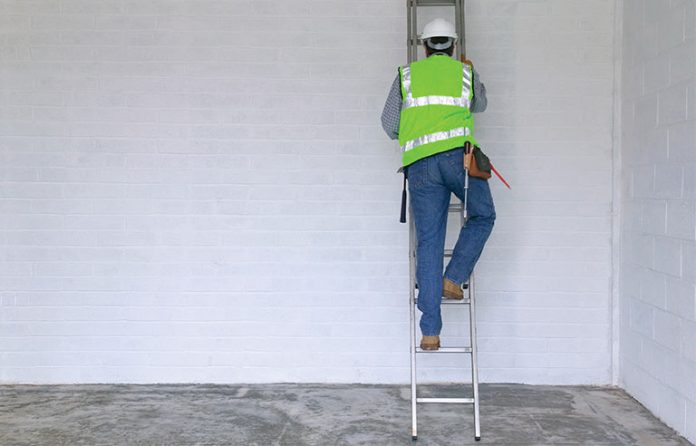
While analyzing more than 350 NIOSH fatality reports involving ladders, Seth Patterson found a major theme: inadequate training.
“If the employers had effective ladder training, that could have prevented most of these incidents from happening,” said Patterson, an environmental, health and safety engineer at Lockheed Martin.
One possible reason for the lack of employee training is that ladders are relatively simple to use compared with other more complex equipment such as aerial lifts, according to Mike Kassman, director of OSHA and Disaster Response Training at CPWR – The Center for Construction Research and Training.
Despite continuing advances in ladder-related safety equipment, such as outriggers to maintain side-to-side stability, training remains important.
In the construction industry, for example, more than 70 workers are killed as a result of a fall from a ladder each year, and 4,000-plus suffer lost-time injuries, according to a 2018 CPWR hazard alert.
In Patterson’s research, half of the fatalities (88 of 175) resulted from a fall. In five more instances, the victim was shocked and then fell. Forty-two other victims were electrocuted while on or holding onto a ladder for someone else. The remaining 40 fatalities were from a variety of causes, including 15 in which the victim was on a ladder in a confined space when overcome, and 12 others in which the ladder and/or user was struck by something.
Ladders earned a spot on OSHA’s annual “Top 10” list of most-cited violations in 2005 and has been on the list ever since. Employers can help prevent ladder-related injuries by providing supervision and determining whether a ladder is the appropriate equipment for the job, which is a common practice among employers in the commercial construction industry, according CPWR experts. Instead of using ladders, these employers often have lifts or scaffolds because they have the space and budget for them.
However, ladders aren’t likely to be going away anytime soon in industries such as residential construction – in part, experts say, because they’re inexpensive and portable.
Training
Ladder safety was discussed during an episode of “On the Safe Side,” Safety+Health’s podcast.
Under OSHA regulation 1926.1060, employers are required to provide ladder safety training to workers via a “competent person,” covering subjects such as fall hazards and weight capacity. The agency’s general industry regulations don’t specify ladder training, but the agency in 1910.30(a)(3)(i) does say that each employer must educate employees on fall hazards in “the work area.”
The California Division of Occupational Safety and Health, also known as Cal/OSHA, goes a step further and requires that “supervisors of employees who routinely use ladders shall also be trained in ladder safety.”
The American Ladder Institute has four ladder safety training videos on its website covering mobile ladders, single and extension ladders, articulated ladders, and stepladders. The organization also has a webpage detailing basic ladder safety.
One major topic covered is maintaining three points of contact while climbing. Spencer Schwegler, former director (retired) of OSHA and disaster response training at CPWR, as well as a retired union painter, pointed out that although OSHA doesn’t “spell out” a requirement for three points of contact, it’s implied in 1926.1053(b)(20-22).
What’s considered three points of contact? OSHA and ALI agree that it can mean two hands and one foot or two feet and one hand. A knee or elbow isn’t considered a point of contact, Schwegler added.
“Early in my career, I deluded myself thinking my knee was a point of contact so I could carry more tools and paint up the ladder,” Schwegler told Safety+Health.
OSHA rule 1926.1053(b)(22) states that employees on a ladder should not carry an object or any load that could cause them to lose their balance or fall. Instead, they should plan ahead on how they’re going to get their tools or other objects to their work area.
ALI recommends using “towlines, a tool belt or an assistant to convey materials so that the climber’s hands are free when climbing.” The CPWR hazard alert emphasizes: “Do not carry tools and materials while climbing. Use a rope to haul or hoist materials to the upper level.”
The organization’s experts stress not to use a ladder horizontally or as a plank, not to stand on the top two steps of a stepladder, and that employers and workers should make sure the height of the ladder is right for the job. ALI says workers should keep the center of their belt buckle or stomach between the ladder side rails while working. Don’t lean or overreach, as that could make a ladder tip sideways.
Page 2 of 2
Inspections
Ladders must “be inspected by a competent person for visible defects on a periodic basis and after any occurrence that could affect their safe use,” according to OSHA regulation 1926.1053(b)(15).
Under OSHA’s general industry rules – 1910.23(b)(9): “Ladders are inspected before initial use in each work shift, and more frequently as necessary, to identify any visible defects that could cause employee injury.”
Both sets of regulations require employers to mark defective ladders with “Do not use” or similar words, and remove them from service.
Where do physical issues often appear on ladders? One area is the feet. Patterson said when he’s looking at a ladder, he’ll have a co-worker stand it up and see if all four feet touch the ground evenly. “If all four feet don’t have firm contact, it’s time to get rid of it,” he said.
Along with the feet, CPWR recommends a check of the rails, rungs, rung locks and spreaders before each use of the ladder. ALI provides an inspection checklist on its website.
Additionally, make sure labels are attached, especially the danger labels on the top step and top cap as well as the load-rating label, Patterson said. If any labels come off, he advised getting replacement danger labels or using an indelible marker to write the load-rating information on the ladder while seeking replacement labels.
Tools
ALI has a webpage to help employers and workers choose the right ladder for the job. One aspect to check is the maximum weight the ladder can support, also known as its duty rating. That weight includes the employee, clothing/personal protective equipment, and any tools or supplies. Ladder duty ratings range from Type III (light duty) – able to support up to 200 pounds – to Type IAA (extra heavy duty), able to support a max weight of 375 pounds.
NIOSH debuted its ladder safety phone app in 2013 and updated it in 2016. The tool shows how to pick the right ladder based on user characteristics and tasks. This includes avoidance of electrical hazards.
The app also features an inspection tool and a way to ensure a ladder is level or set at the proper angle if resting against a structure such as a wall, also known as the “4-to-1 rule.” This means that for every 4 feet above the surface level, the ladder is moved 1 foot away from the vertical structure on which it’s resting.
Although not required under OSHA standards, performing a risk assessment of which type of ladder or other equipment to use could aid in their safe use. Such an assessment is required by the Health and Safety Executive – the United Kingdom’s version of OSHA.
“They recognize that ladders can be a higher-risk type of device,” Patterson said.