Washington — OSHA plans to publish by November a proposed rule intended to modernize its standard on lockout/tagout (1910.147), according to the federal government’s most recent regulatory agenda.
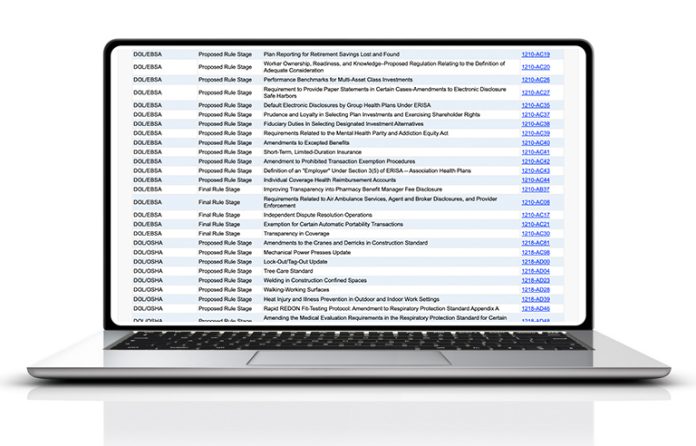
Issued July 3, the 2026 Regulatory Plan and Unified Agenda of Federal Regulatory and Deregulatory Actions includes 32 combined proposals from the Department of Labor’s safety agencies – 30 from OSHA and two from the Mine Safety and Health Administration.
The lockout/tagout proposed rule likely would include computer-based controls for hazardous energy as the agency aims to update a standard promulgated in 1989. Lockout/tagout was OSHA’s fourth most frequently cited standard during fiscal year 2025, and proponents believe an update would help reduce the number of workers at risk.
“OSHA recognizes that recent technological advances may have resulted in safety improvements to control-circuit-type devices,” DOL says. “Modernizing the standard to better align with current technologies may improve safety effectiveness and, indirectly, potentially increase operation efficiency.”
Additionally, OSHA is targeting December as the publication date for a supplemental notice of proposed rulemaking for its long-anticipated heat rule. The Code of Federal Regulations states that a supplemental notice may be issued if a proposed rule “has been substantially changed from the original notice” or if “considerable time has elapsed” since the original notice was published.
In August 2024, the agency published a proposed rule on heat illness and injury prevention in outdoor and indoor settings, and then hosted a series of informal stakeholder hearings in June and July 2025.
Although several states have issued heat protections, “a standard specific to heat-related injury and illness prevention would more clearly set forth enforceable employer obligations and the measures necessary to effectively protect employees from hazardous heat,” OSHA says.
The White House Office of Information and Regulatory Affairs typically issues a regulatory agenda twice a year. The agenda provides the status of and projected dates for all potential regulations listed in three stages: pre-rule, proposed rule and final rule.
Overall, the second agenda of President Donald Trump’s second term aligns with a previous deregulatory push. Trump signed an Executive Order in January 2025 directing federal agencies to eliminate 10 regulations for each new one introduced, similar to the “2-for-1” EO he issued in January 2017.
To that end, OSHA this month intends to publish a proposal that would revise its mechanical power presses standard from the early 1970s.
After weighing input on a July 2021 Request for Information – including comments on advances in technology and the use of hydraulic or pneumatic power presses – DOL says the update will be limited to “eliminating the reporting requirements for specific injuries.” The agenda adds: “The agency believes these requirements create a burden on employers that does not result in significant reductions in injuries.”
Among other proposals are those to rescind OSHA’s construction illumination requirements in 1926.26 and 1926.56.
Revised silica proposal expected from MSHA
Under its “proposed rule” docket, MSHA included a revised proposal on miner exposure to respirable crystalline silica, slated for July.
The agency published a final rule in April 2024 that reduced its permissible exposure limit for respirable crystalline silica to 50 micrograms per cubic meter of air over an 8-hour time-weighted average. The new PEL is half the previous limit and matches the one established by OSHA in 2016.
The rule also increases silica sampling and enforcement at metal and nonmetal mines and requires mine operators to provide periodic health exams at no cost to miners.
However, enforcement of the rule has been delayed because of a lawsuit in the 8th U.S. Circuit Court of Appeals. MSHA announced late last year its intent to reconsider the rule.
The new proposal “includes changes to provisions for exposure monitoring, medical surveillance and respiratory protection,” the agency says.
Final rule stage
OSHA lists an update concerning emergency response within its “final rule” forecast. The agency issued a Request for Information on the matter in 2007 and hosted two stakeholder meetings in 2014.
OSHA says that its regulation of aspects of emergency response and preparedness wasn’t initially “designed as comprehensive.” Therefore, it doesn’t “address the full range of hazards or concerns facing” the industry, nor “reflect all the major developments in safety and health practices that have already been accepted by the emergency response community and incorporated into industry consensus standards.”
Other potential regulations listed in the final rule stage: handling retaliation complaints under various statutes, removing a subpart from since-terminated rulemaking on COVID-19 exposure in health care settings, using administrative subpoenas, and terminating separate rules on open fires and house falls in marine terminals.
Among MSHA’s final rules are those withdrawing regulations governing “outdated effective dates and requirements” for industry equipment and protocol, including:
- Approval of conveyor belts in underground coal mines
- Blacksmith shops at surface metal and nonmetal mines
- Diesel emission limits for equipment in underground coal mines
- Permissible flame safety lamps in underground coal mines
Long-term actions
OSHA shifted to its long-term actions list four proposed or final rules from the reg agenda published in September:
- Communication Tower Safety
- Powered Industrial Trucks Design Standard Update
- OSHA Standards Improvement Project
- Shipyard Fall Protection – Scaffolds, Ladders and Other Working Surfaces
A rule concerning workplace violence in health care and social assistance remained on the long-term actions list, as did a rule titled Occupational Exposure to Crystalline Silica: Revisions to Medical Surveillance Provisions for Medical Removal Protection.
MSHA’s long-term actions list includes a rule titled Safety Requirements for Fall Protection.
Classifying an item as a long-term action typically means the agency doesn’t plan to make progress on a regulation for at least six months.