
Despite the recent withdrawal of OSHA’s emergency temporary standard on COVID-19 vaccination, testing and masking and the partial withdrawal of the agency’s ETS on COVID-19 for health care workers, a lot of questions remain regarding mask and respirator use.
Stakeholders are asking what OSHA is expecting if someone is using a mask in their facility that is covered under the standard on respiratory protection (1910.134). The agency is working on its COVID-19 FAQs document to address this issue. However, the time frame for the guidance to be finalized and posted is unknown. This blog post will hopefully provide some opinion and guidance until OSHA issues its updates.
The questions NSC-ORC HSE most commonly receive include:
- Will OSHA accept a KN95 mask?
- Is a KN95 mask covered by 1910.134?
But, first, a little background: On its website, the Mayo Clinic answers the question: “How well do facemasks protect against COVID-19?” The clinic states:
“The [Centers for Disease Control and Prevention] says that you should wear the most protective mask possible that you’ll wear regularly and that fits. Respirators such as nonsurgical N95s give the most protection. KN95s and medical masks provide the next highest level of protection. Cloth masks provide less protection.” (CDC has previously stated that surgical N95 masks should be reserved for health care providers. Since that early statement, quantities of N95 respirators have become readily available for purchase without impacting health care supply chains.)
“A KN95 mask is a type of respirator that meets certain international standards. It offers more protection than a medical mask does because it filters out both large and small particles when the wearer inhales.” (They typically are secured to the user by a set of ear loops. However, be cautious when buying a KN95, as many fake masks are sold that don’t meet quality requirements.)
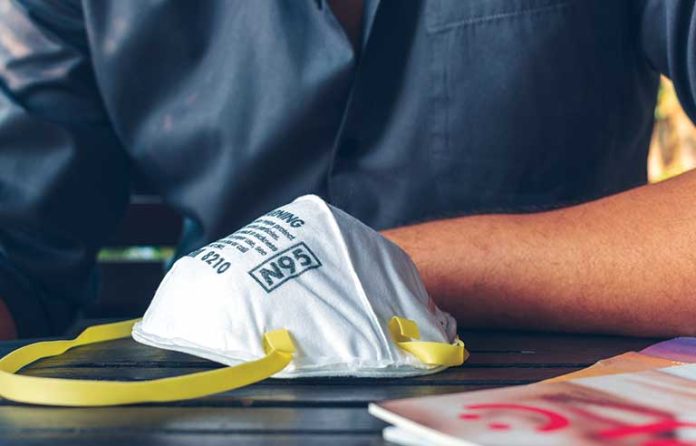
“An N95 mask is a type of respirator that meets U.S. quality standards. An N95 offers the highest level of protection. It offers more protection than a medical mask does because it filters out both large and small particles when the wearer inhales. Nonsurgical N95s can be used by the general public.”
As a separate note, the “N” in N95 means “not resistant to oil.” If you work in an environment where an oil mist is present, such as a machine shop, an N95 wouldn’t be an appropriate respirator to use. Instead, a P95 mask, which is strongly resistant to oil, should be used.
Regarding the counterfeit mask issue, if you’re using an N95, reference the testing and certification (TC) number on the respirator with the NIOSH-Approved Particulate Filtering Facepiece Respirators webpage. If you have a product that isn’t listed on the provided tables, use the agency’s searchable certified equipment list.
During the early months of the pandemic, N95 respirators were in short supply. This resulted in a lot of K and KN95 masks reaching the marketplace, many of which may be counterfeit. Employers trying to comply with mask mandates and protect their workers who purchased these masks and are now wondering if they’re considered OSHA-compliant. Regarding K and KN95, CDC says:
- They’re designed to standards that don’t often have a quality requirement.
- They filter varying levels of particles in the air depending on the standard they’re designed to meet.
- They seal tightly to your face when fitted properly.
- It’s important to pick a respirator that fits your face and seals well, because not all fit the same.
NIOSH-certified respirators, on the other hand, are designed to fit properly and tightly to the wearer’s face through the use of two straps (not ear loops) and a metal nose piece. NIOSH-approved respirators don’t have loops that fit around the ears, creating a face cover but not a tight fit.
As for coverage under 1910.134, the standard states: “The employer shall select a NIOSH-certified respirator. The respirator shall be used in compliance with the conditions of its certification (1910.134(d)(1)(ii)).” Because K or KN95 masks aren’t NIOSH certified, they aren’t covered by 1910.134. An N95 respirator is certified by NIOSH and therefore is covered under 1910.134. An employer requiring a respirator such as an N95 would be covered by the elements of the standard. A respirator worn voluntarily (not required by OSHA or the employer) needs only comply with Appendix D of the standard, as follows:
Appendix D to Sec. 1910.134 (Mandatory) Information for Employees Using Respirators When Not Required Under the Standard
Respirators are an effective method of protection against designated hazards when properly selected and worn. Respirator use is encouraged, even when exposures are below the exposure limit, to provide an additional level of comfort and protection for workers. However, if a respirator is used improperly or not kept clean, the respirator itself can become a hazard to the worker. Sometimes, workers may wear respirators to avoid exposures to hazards, even if the amount of hazardous substance does not exceed the limits set by OSHA standards. If your employer provides respirators for your voluntary use, or if you provide your own respirator, you need to take certain precautions to be sure that the respirator itself does not present a hazard.
You should do the following:
- Read and heed all instructions provided by the manufacturer on use, maintenance, cleaning and care, and warnings regarding the respirators limitations.
- Choose respirators certified for use to protect against the contaminant of concern. NIOSH, the National Institute for Occupational Safety and Health of the U.S. Department of Health and Human Services, certifies respirators. A label or statement of certification should appear on the respirator or respirator packaging. It will tell you what the respirator is designed for and how much it will protect you.
- Do not wear your respirator into atmospheres containing contaminants for which your respirator is not designed to protect against. For example, a respirator designed to filter dust particles will not protect you against gases, vapors, or very small solid particles of fumes or smoke.
- Keep track of your respirator so that you do not mistakenly use someone else’s respirator.
Recommendation: Conduct a risk assessment that includes evaluating the community risk, incidents in your facility and the type of work done at your facility. If your industry is considered high risk (e.g., health care, meatpacking, or any situation where workers work side by side or have direct contact with the public), require the use of an N95 or better respirator. Regardless of risk, if masks are mandated, use N95s. As for K and KN95 masks, N95 respirators are far more protective. Employers who have K and KN95 masks should switch to N95 respirators – a shortage of N95s no longer exists, and these respirators provide the greatest protection.
This article represents the views of the author and should not be construed as a National Safety Council endorsement.
 Richard Fairfax (CIH, retired 2017) joined OSHA in January 1978 and retired from the agency in 2013. At OSHA, he was a practicing field industrial hygienist, as well as the deputy director and director of enforcement programs. In 2008, Richard served as acting director of construction and, in 2010, was designated deputy assistant secretary – overseeing all field, enforcement and training operations. From 1993 through 2010, Richard wrote an industrial hygiene column entitled, “OSHA Compliance Issues” for the Journal of Occupational and Environmental Hygiene. He still serves on the Editorial Review Board. Richard now works part time for NSC-ORC HSE.