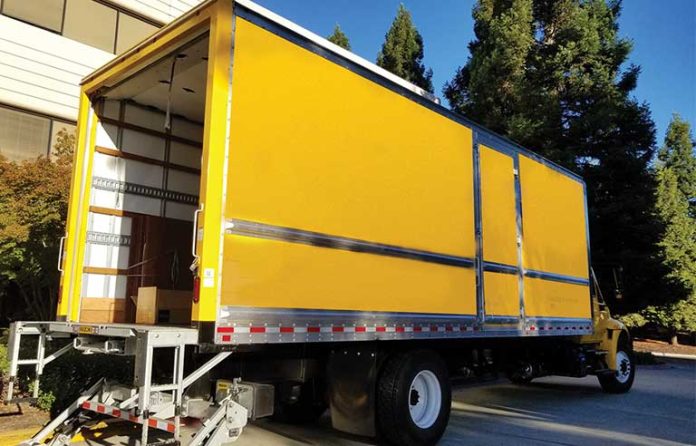
Severed fingers and toes are injuries commonly associated with using truck liftgates. So are crushed feet.
Other injuries can occur if a runaway load falls over or off a liftgate and onto a worker who’s standing either next to or below the load. KeepTruckingSafe.org, a NIOSH-funded program from the Washington State Department of Labor & Industries, details an incident in which a truck driver injured his neck and back trying to stop a shipment from falling off his truck’s broken liftgate.
The driver arrived at a customer site with a heavy load of office equipment. He hauled the freight in a standard box truck equipped with a rail-style hydraulic liftgate.
Unaware of the liftgate’s unsafe condition, he stood on the liftgate platform and flipped the control switch to lower it. As the platform dropped, its left runner got stuck in the rail and the platform tilted unevenly to the right. The load shifted close to the edge. The driver reacted in a sudden twisting motion to save the freight from crashing down.
A medical exam revealed the driver had suffered serious strain injuries to his neck and back. He was unable to work for several months.
KeepTruckingSafe.org has tips to help avoid liftgate-related injuries.
Management:
- Provide proper liftgate inspection, operation and safety training to drivers and mechanics.
- Make sure mechanics regularly perform liftgate maintenance and parts replacement according to the manufacturer’s requirements.
Drivers:
- Make sure you’re fully trained to use liftgates safely.
- Conduct pre-trip inspections, checking for liftgate damage, fluid leaks, unsafe alteration or poor maintenance.
- Never operate a faulty liftgate until problems are properly corrected.
- Report liftgate problems immediately to a supervisor or mechanic.