
Case report: #71-234-2023
Issued by: Washington State Fatality Assessment and Control Evaluation Program
Date of report: Feb. 27, 2023
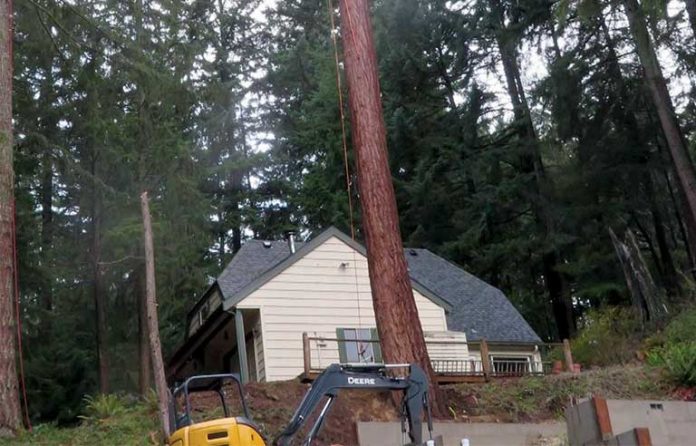
A 28-year-old tree trimmer was part of a four-person crew removing a 127-foot fir tree from a residential property. The employer of the tree service and landscaping company was not onsite to supervise. The crew planned to use a lowering device (port-a-wrap) to lower tree sections and limbs. However, they did not have a rope long enough, so they tied two ropes together. The knot tying the ropes together would not fit in the port-a-wrap, so, instead, they wrapped the rope twice around the tree for friction to lower the tree sections. A climber then worked from the tree – rigging and cutting sections while the tree trimmer and another worker held the rope for lowering the sections to the ground. The climber cut off a 330-pound section from the tree. It fell about 1 foot before the rope holding it became taut. The weight of the section caused shock loading on the rope, which lifted the tree trimmer and the other worker off the ground. The workers struggled to control the section as its momentum pulled them toward an embankment. The tree trimmer lost his grip on the rope, stumbled and fell backward down the embankment, hitting his head on a rock. He died at the scene.
To help prevent similar occurrences, employers should:
- Develop accident prevention program policies that require a job hazard analysis, with worker participation, for each job. A JHA would have identified the hazardous rigging and lowering practices and the potential for being struck by the uncontrolled tree section.
- Have a qualified arborist make decisions about safe tree removal practices, and train and directly supervise workers involved in tree work.
- Use ANSI Z133 American National Standard for Arboricultural Operations – Safety Requirements to train workers and to ensure they use proper tree removal methods as well as understand and account for additional forces resulting from the rigging design, rope angles, and the number of lines and/or line parts that will act on any rigging or anchor point.