
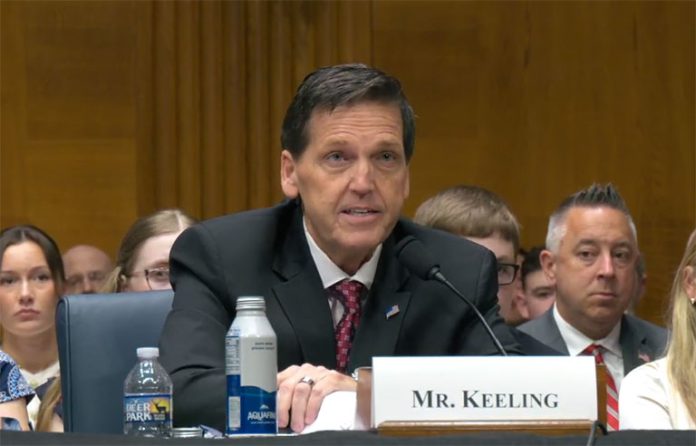
Washington — David Keeling has three main goals for OSHA if he’s confirmed as leader of the agency.
During his June 5 confirmation hearing before the Senate Health, Education, Labor and Pensions Committee, the former UPS and Amazon safety executive’s opening statement provided an overview – but didn’t delve into the finer details.
Nominated by President Donald Trump on Feb. 12, Keeling shared the stage during the hearing with nominees for three other posts, limiting the questions he may have fielded if he was alone.
Three goals
Modernization in regulatory oversight and rulemaking: Using technologies and predictive analytics to move beyond “simple regulatory compliance and post-injury response to injury prevention and informed design.” Keeling said this would involve taking advantage of existing global industry consensus standards, “which have gone through much more rigorous review, regular updating and continuous improvement than have many of OSHA’s existing rules.” He didn’t say, nor did his written testimony expand on, which global industry consensus standards the agency would use.
Expanding OSHA’s cooperation and collaboration efforts: Keeling specifically mentioned the agency’s potential collaboration and cooperation with professional groups, companies and unions: “We all want the same thing,” he said, “although we differ sometimes on what the best road is to get there. We must move beyond existing silos and self-imposed barriers to achieve real improvement.”
He also floated modernizing and updating OSHA’s Voluntary Protection Programs. “The current VPP programs provide a basic platform, but it’s only a start. Critical work needs to be done in this area to achieve successful outcomes.”
OSHA’s “enforcement transformation”: Keeling said the agency could harness existing data “to greatly enhance onsite safety efforts through predictive analytics.” He didn’t specify what kind of data and what type of predictive analytics. He also said OSHA must engage “at-risk employers and employees through proactive risk mitigation and reduction programs before a worksite tragedy has taken place or a fatality has occurred.”
He concluded: “We should never get to a worksite after it’s too late. If confirmed, I’m committed to working with each of you so that no family sits down at the dinner table to an empty chair.
“I believe that by working with this committee and the stakeholders across ideological spectrum, we can achieve real and meaningful progress, and I hope to achieve these goals with your help.”
In her opening statement, Sen. Tammy Baldwin (D-WI) noted that OSHA expects to conduct around 10,000 fewer workplace safety inspections this coming fiscal year than in FY 2024 (the most recent year for which data is available). The agency’s FY 2026 budget justification states that the agency is expected to conduct nearly 25,000 inspections. OSHA conducted more than 34,600 inspections in FY 2024.
“Reducing the number of inspections leads to more unsafe environments, more injuries and more families facing uncertainty that comes from losing hours on the job or dealing with a work injury,” Baldwin said.
NIOSH
Sen. Lisa Murkowski (R-AK) asked how OSHA plans to fill the “data and information gap” left by NIOSH after massive cuts to that agency’s staff and budget.
“OSHA has traditionally relied on NIOSH data and recommendations for many of the workplace safety standards,” Murkowski said. “I’m concerned this is going to hamper some of the vital research that is out there.”
Keeling said OSHA could use data and research from professional groups and private entities to help fill some of those gaps. He also said, “Obviously, I’m not in place and haven’t spoken to the career side from OSHA on that point.”
He concluded, “There are ways to fill the gap, not necessarily easily, but there are ways.”
Emergency response standard
Sen. Angela Alsobrooks (D-MD) asked about OSHA’s proposed standard on emergency response. The agency published the proposal in February 2024 in an attempt to update its decades-old fire brigade standard (1910.156).
Keeling said a possible “path through” exists for the standard, but it may come in a revised form. He mentioned “there are some concerns from volunteer fire departments and others about how they make [the standard] work from a voluntary firefighter and limited budget perspective.”
Keeling continued: “All workers, including our emergency response service members, need to be able to return home healthy at the end of the day, so there’s no disagreement at all there. I think there’s a path through, but I haven’t been in contact with the career folks at OSHA yet.”
Other news
In his opening statement, Keeling mentioned that his “passion” for workplace safety was influenced by the death of his 17-year-old uncle, Lonny Crouch, on a farm.
“I never had the opportunity to know my uncle,” he said. “Because of the pain of his death, his name wasn’t used every day. However, his loss was always there at my grandparents’ house, an empty chair that was always present at the dinner table.”
Keeling also took a moment to thank the “dedicated career employees at OSHA, both past and present.”
Keeling added: “I want to ensure them that their passion is recognized and that they are greatly respected by their industry peers.
“I also want to reassure them that a great opportunity lies in front of us. I believe that we’ve reached a crossroads in terms of OSHA’s future and direction. My fear is that OSHA is at risk of losing its position as a leader in the global health and safety space, not because of any failure on the part of OSHA’s people, but because of outdated systems and processes that have resisted past administrations’ efforts in commonsense improvements.”