Responding is Christopher Heinz, product manager – construction, GMG EnviroSafe, Chicago.
Managing workplace risks is essential to protect people, property and environment, while maintaining regulatory compliance. For safety professionals across all industries, minimizing identified risks requires more than simply checking off items on a list. It involves putting into action practical strategies that lead to lasting improvements.
So, how can organizations effectively minimize these risks? Here are some steps you can take to create a safer work environment.
Understanding the Hierarchy of Controls
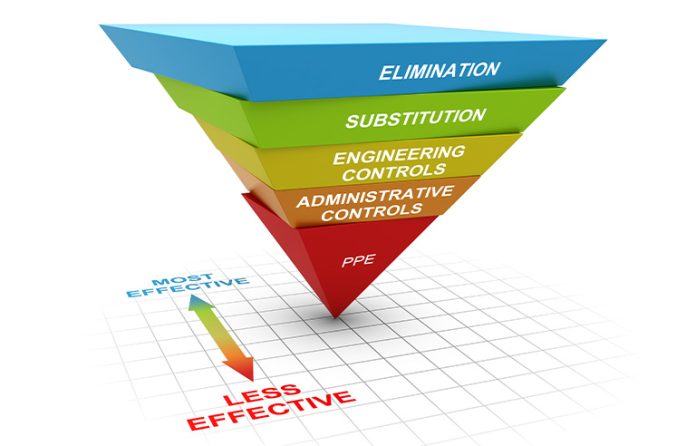
To manage risks in the workplace, it helps to understand the Hierarchy of Controls. This is a guide that ranks the most effective ways to minimize risk, from most to least effective, to reduce hazards.
How it works:
- Elimination is removing the hazard completely. For example, if a job involves toxic chemicals, the safest option might be to change the process, so those chemicals are no longer needed.
- Substitution is replacing something dangerous with something safer, such as switching to a less harmful chemical.
- Engineering controls involve making physical changes to the workplace, such as adding ventilation systems or putting machines in protective enclosures.
- Administrative controls change how people do their work. This could include rotating shifts to limit exposure or adding safety training and additional work rules.
- Personal protective equipment, which includes helmets, gloves, safety glasses and respirators.
Although all these steps are important, the best results usually come from using the higher levels (elimination, substitution and engineering controls) whenever possible. These steps help create more sustainable and safer workplaces.
Involve all levels of employees to manage risk
Employees who work with risks every day are often the best source of information. Their insights can reveal hidden hazards or gaps in current procedures. Simple ways to gather input include hosting safety meetings, offering anonymous reporting options and scheduling regular check-ins. More importantly, employee feedback should be acted on. When workers see their concerns addressed, it builds trust and encourages ongoing involvement in safety efforts, further building the organization’s safety culture.
Build a culture of safety
A strong safety culture means safety is more than just a policy – it’s part of how the organization operates. Supervisors play a key role by modeling safe behavior, listening to concerns and recognizing safe practices. A positive safety culture is one where employees feel responsible not just for their own safety but for that of their co-workers as well. Over time, safety becomes a natural part of the daily routine.
Take practical steps across different industries
No matter the industry, these strategies can work anywhere. When trying to minimize identified risks, keep an open mind. Often, several potential solutions may be available to minimize the identified risk, and more often the best solution is a combination of these strategies. Be patient and implement changes at a digestible pace suitable for the level of risk and your organization. Small, positive actions – delivered over a period of time – can lead to big improvements and have tremendous benefits.
Minimizing identified risks isn’t just another action item to check off; it requires a hands-on approach built on proven safety methods. By implementing the Hierarchy of Controls, involving employees, creating a safety-focused culture and making steady improvements, organizations can lower risks and create safer, healthier workplaces.
Editor’s note: This article represents the independent views of the author and should not be considered a National Safety Council endorsement.