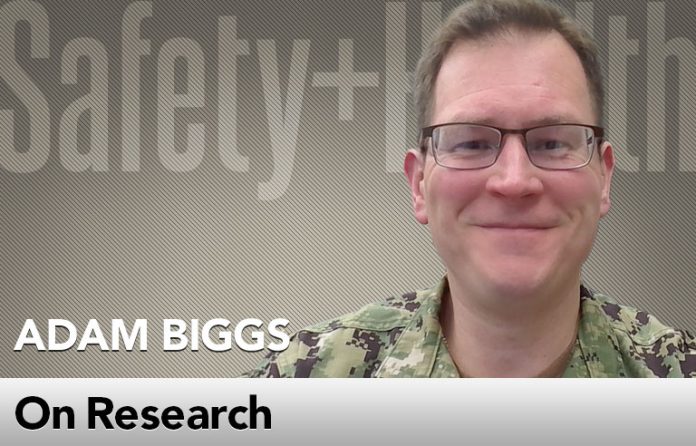
To study the relationship between worker fatigue and safety climate, Lt. Cmdr. Adam T. Biggs chose a setting that’s unusual – yet quite familiar to him.
His research involved surveying more than 12,000 sailors on U.S. Navy ships.
“The people aboard these ships are undergoing a military deployment, so it is inherently stressful,” Biggs said. “This is by no means a cruise or even a typical professional setting.”
He spoke with Safety+Health about the study, titled “Safety climate and fatigue have differential impacts on safety issues.” It was published in Volume 92 of the National Safety Council’s Journal of Safety Research.
The following is an edited transcript of the conversation
What’s your study about?
The study was looking at a specific question involving fatigue and the safety climate. In a naval operating environment, fatigue and safety are inevitably overlapping issues. If you’re on the same ship for months at a time, in addition to standing watch or conducting drills, you also have to keep all the other trainings and accreditations and everything up to speed. Maintenance requirements don’t stop just because the team is tired. There are a lot of challenging things in an environment that’s highly atypical – very complex environments and challenging military scenarios where crews are going to have to operate at very high levels. If you don’t, incidents can happen.
What happens if you have safety climate issues and fatigue issues, or a good safety climate but high fatigue problems? Are they separate? Does one dominate the other?
Our study showed that the influence of safety climate and fatigue had differential outcomes on safety issues. Specifically, the influence of safety climate changes across the outcome type. The largest influence is with unreported safety events or near misses experienced, with a smaller influence on actual safety events. Meanwhile, fatigue had the same influence on actual mishaps as it does on near misses and on underreporting. Beyond that, there’s an interplay where it’s not just one or the other. The combination of these two further augments the likelihood of safety mishaps and outcomes.
Did anything surprise you?
We know there’s a pervasive problem with fatigue and the naval operating environment. The more interesting piece was the overlap between fatigue and safety climate as a concomitant contributing factor. The more fatigued you are, the more it contributes to a bad safety climate, and the more those combined factors contribute to a negative safety outcome. The finding really highlights how both your perception of the safety environment and physiological state at any point in time can contribute to safety outcomes.
What will your follow-up research focus on?
There’s a bit of a “chicken and the egg” argument of which came first. Were they fatigued and that led to a poor safety climate? Or did the poor safety climate lead to greater fatigue? That’s an interesting question that needs to be unpacked in future research. Distinguishing between physiological and cognitive fatigue is also one of those directions we should explore.
What drove your interest in this topic?
“Doctor” is one of my titles, but “lieutenant commander” always comes first. With study co-author Lt. Cmdr. Todd Seech, we’re both active-duty members of the U.S. Navy. So, our interest is not merely an academic one. We’re deeply committed to the safety of our sailors. We joined the military looking not just to make a difference but to make it better. For us, it’s both personal and professional.
 The Journal of Safety Research, a joint publication of the National Safety Council and Elsevier Ltd., disseminates peer-reviewed research in all areas of safety and health. Learn more.