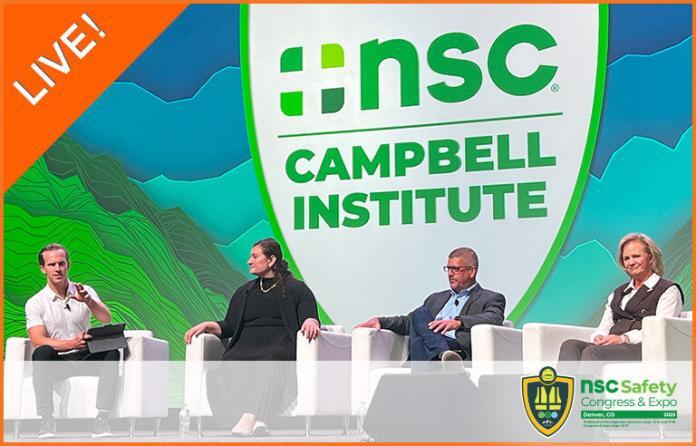
Denver — Shifting occupational safety approaches to focus on preventing serious injuries and fatalities, or SIFs, doesn’t happen overnight.
A panel of experts stressed that observation to attendees at Monday’s Campbell Institute Forum during the 2025 NSC Safety Congress & Expo, before exploring strategies to begin initiating change.
Catherine West, vice president of environment, health and safety at Amentum, finds that the process starts at the top. She called on supervisors to fully engage with workers’ concerns, doing more than simply listening.
“Being real, being vulnerable,” West said. “Don’t go out there with this air of, ‘I’m the leader, I’m in charge. Do what I say.’ You’re not going to get that trust. So, go out there and share your mistakes. Where have I failed? Share those experiences.”
Attendees began the session by following a prompt to tell one person sitting nearby that they’ve changed before thanking another for the observation. Short presentations and a panel discussion that followed reinforced the theme that change happens one conversation at a time, even if it takes 1,000.
At Colgate-Palmolive, a daily discussion at jobsites has helped reduce organizational SIFs, says Marty Stern, the company’s vice president of global EHS. Members of all stakeholder groups address the critical task for the day and how to control associated hazards.
“What are we doing? What are the controls, and are we comfortable that the controls are going to prevent the adverse outcome?” Stern asked.
Stern also advocates for watching teams at work.
“You can learn so much when you’re on the shop floor talking with operators, observing the work they do day in and day out, and seeing if they’re deviating from the procedure enough that you potentially have a risk present,” he said.
Elif Erkal, associate director of research and strategy at the University of Colorado-Boulder’s Construction Safety Research Alliance, discussed the need for management to pivot from using the traditional metric of total recordable injury rate as a chief gauge of safety.
“There are more actionable, more proactive, more important and more contextual metrics out there that we can actually use together,” she said.
Erkal explained the concept of high-energy control assessment, or HECA, a real-time job assessment that examines life-threatening hazards. Calculating the proportion of high-energy – or life-threatening – hazards with direct controls may be one of the more valuable metrics than TRIR, Erkal argued.
West credited the American Society for Testing and Materials for developing various standards intended to clarify classification criteria for SIFs. Updates are expected soon.
“It will be applicable regardless of the size of your organization,” West said.