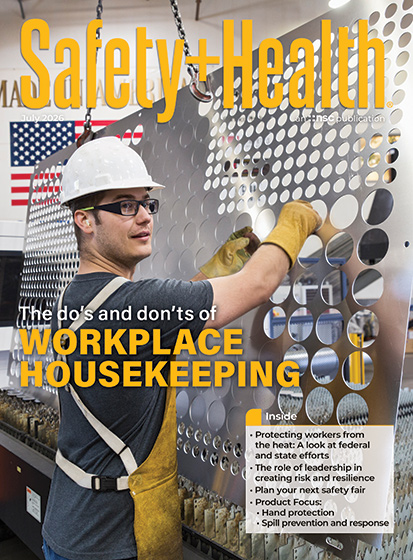


For the 15th consecutive fiscal year, Fall Protection – General Requirements (1926.501) sits atop OSHA’s preliminary list of the 10 most frequently cited standards.
And the number of violations is “likely to grow” when the agency releases finalized data for fiscal year 2025 in the spring, said Eric Harbin, regional administrator for OSHA’s Dallas Region.
Harbin was onsite in September at the 2025 NSC Safety Congress & Expo in Denver to present the preliminary list. One of his main messages was that OSHA wants to help employers get – and stay – in compliance.
“I encourage small and medium-sized employers to reach out to OSHA’s On-Site Consultation Program,” he said. (Note: The federal government shutdown was still in effect when Safety+Health went to press.)
Here, we present the preliminary list, which reflects OSHA Information System data collected from Oct. 1, 2024, through Aug. 12, 2025. You’ll also find the Top 10 standards cited by the highest cumulative proposed penalties, “willful” and “serious” violations, and more.
1
 Fall Protection – General Requirements
Standard: 1926.501
Total violations: 5,914
Fiscal year 2024 ranking: 1 (6,307 violations)
This standard outlines where fall protection is required, which systems are appropriate for given situations, the proper construction and installation of safety systems, and the proper supervision of employees to prevent falls. It’s designed to protect employees on walking-working surfaces (horizontal or vertical) with an unprotected side or edge above 6 feet.
Top 5 sections cited:
-
1926.501(b)(13): Each employee engaged in residential construction activities 6 feet or more above lower levels shall be protected by guardrail systems, safety net systems or personal fall arrest systems unless another provision in paragraph (b) of this section provides for an alternative fall protection measure. – 4,446 violations
-
1926.501(b)(1): Each employee on a walking-working surface (horizontal and vertical surface) with an unprotected side or edge that is 6 feet or more above a lower level shall be protected from falling by the use of guardrail systems, safety net systems or personal fall arrest systems. – 563
-
1926.501(b)(10): Except as otherwise provided in paragraph (b) of this section, each employee engaged in roofing activities on low-slope roofs with unprotected sides and edges 6 feet or more above lower levels shall be protected from falling by guardrail systems; safety net systems; personal fall arrest systems; or a combination of warning line system and guardrail system, warning line system and safety net system, warning line system and personal fall arrest system, or warning line system and safety monitoring system. – 358
-
1926.501(b)(11): Each employee on a steep roof with unprotected sides and edges 6 feet or more above lower levels shall be protected from falling by guardrail systems with toeboards, safety net systems or personal fall arrest systems. – 257
-
1926.501(b)(4): “Holes.” – 135
2
 Hazard Communication
Standard: 1910.1200
Total violations: 2,546
Fiscal year 2024 ranking: 2 (2,888 violations)
This standard addresses chemical hazards – both those chemicals produced in the workplace and those imported into the workplace. It governs the communication of those hazards to workers.
Top 5 sections cited:
-
1910.1200(e)(1): Employers shall develop, implement and maintain at each workplace a written hazard communication program that at least describes how the criteria specified in paragraphs (f), (g) and (h) of this section for labels and other forms of warning, Safety Data Sheets, and employee information and training will be met. – 895 violations
-
1910.1200(h)(1): Employers shall provide employees with effective information and training on hazardous chemicals in their work area at the time of their initial assignment and whenever a new chemical hazard the employees have not previously been trained about is introduced into their work area. Information and training may be designed to cover categories of hazards (e.g., flammability, carcinogenicity) or specific chemicals. Chemical-specific information must always be available through labels and Safety Data Sheets. – 646
-
1910.1200(g)(8): The employer shall maintain in the workplace copies of the required Safety Data Sheets for each hazardous chemical and shall ensure they are readily accessible during each work shift to employees when they are in their work area(s). – 309
-
1910.1200(f)(6): Workplace labeling. Except as provided in paragraphs (f)(7) and (f)(8) of this section, the employer shall ensure each container of hazardous chemicals in the workplace is labeled, tagged or marked. – 236
-
1910.1200(g)(1): Chemical manufacturers and importers shall obtain or develop a Safety Data Sheet for each hazardous chemical they produce or import. Employers shall have a Safety Data Sheet in the workplace for each hazardous chemical which they use. – 185
3
 Ladders
Standard: 1926.1053
Total violations: 2,405
Fiscal year 2024 ranking: 3 (2,573 violations)
This standard covers general requirements for all ladders.
Top 5 sections cited:
-
1926.1053(b)(1): When portable ladders are used for access to an upper landing surface, the ladder side rails shall extend at least 3 feet above the upper landing surface to which the ladder is used to gain access; or, when such an extension is not possible because of the ladder’s length, then the ladder shall be secured at its top to a rigid support that will not deflect, and a grasping device, such as a grab rail, shall be provided to assist employees in mounting and dismounting the ladder. In no case shall the extension be such that ladder deflection under a load would, by itself, cause the ladder to slip off its support. – 1,632 violations
-
1926.1053(b)(4): Ladders shall be used only for the purpose for which they were designed. – 189
-
1926.1053(b)(13): The top or top step of a stepladder shall not be used as a step. – 173
-
1926.1053(b)(16): Portable ladders with structural defects, such as, but not limited to, broken or missing rungs, cleats or steps; broken or split rails; corroded components; or other faulty or defective components, shall either be immediately marked in a manner that readily identifies them as defective, or be tagged with “Do Not Use” or similar language, and shall be withdrawn from service until repaired. – 80
-
1926.1053(b)(22): An employee shall not carry any object or load that could cause the employee to lose balance and fall. – 69
4
 Lockout/Tagout
Standard: 1910.147
Total violations: 2,177
Fiscal year 2024 ranking: 5 (2,443 violations)
This standard outlines minimum performance requirements for the control of hazardous energy during servicing and maintenance of machines and equipment.
Top 5 sections cited:
-
1910.147(c)(4): Energy control procedure. – 675 violations
-
1910.147(c)(7): Training and communication. – 422
-
1910.147(c)(6): Periodic inspection. – 345
-
1910.147(c)(1): The employer shall establish a program consisting of energy control procedures, employee training and periodic inspections to ensure that before any employee performs any servicing or maintenance on a machine or equipment where the unexpected energizing, startup or release of stored energy could occur and cause injury, the machine or equipment shall be isolated from the energy source and rendered inoperative. – 208
-
1910.147(d): Application of control. The established procedures for the application of energy control (the lockout or tagout procedures) shall cover the following elements and actions and shall be done in the following sequence. – 152
5
 Respiratory Protection
Standard: 1910.134
Total violations: 1,953
Fiscal year 2024 ranking: 4 (2,470 violations)
This standard directs employers on establishing or maintaining a respiratory protection program. It lists requirements for program administration; worksite-specific procedures; respirator selection; employee training; fit testing; medical evaluation; respirator use; and respirator cleaning, maintenance and repair.
Top 5 sections cited:
-
1910.134(e)(1): The employer shall provide a medical evaluation to determine the employee’s ability to use a respirator, before the employee is fit-tested or required to use the respirator in the workplace. The employer may discontinue an employee’s medical evaluations when the employee is no longer required to use a respirator. – 403 violations
-
1910.134(c)(1): In any workplace where respirators are necessary to protect the health of the employee or whenever respirators are required by the employer, the employer shall establish and implement a written respiratory protection program with worksite-specific procedures. The program shall be updated as necessary to reflect those changes in workplace conditions that affect respirator use. – 288
-
1910.134(f)(2): The employer shall ensure an employee using a tight-fitting facepiece respirator is fit-tested prior to initial use of the respirator, whenever a different respirator facepiece (size, style, model or make) is used and at least annually thereafter. – 251
-
1910.134(c)(2): Where respirator use is not required. – 177
-
1910.134(k): Training and information. This paragraph requires the employer to provide effective training to employees who are required to use respirators. The training must be comprehensive, understandable and recur annually (more often if necessary). This paragraph also requires the employer to provide the basic information on respirators in Appendix D of this section to employees who wear respirators when not required by this section or by the employer to do so. – 122
6
 Fall Protection – Training Requirements
Standard: 1926.503
Total violations: 1,907
Fiscal year 2024 ranking: 7 (2,050 violations)
This standard addresses training requirements for employers in regard to fall protection.
Top 5 sections cited:
-
1926.503(a)(1): The employer shall provide a training program for each employee who might be exposed to fall hazards. The program shall enable each employee to recognize the hazards of falling and shall train each employee in the procedures to be followed to minimize these hazards. – 1,216 violations
-
1926.503(b)(1): The employer shall verify compliance with paragraph (a) of this section by preparing a written certification record. The written certification record shall contain the name or other identity of the employee trained, the date(s) of the training, and the signature of the person who conducted the training or the signature of the employer. If the employer relies on training conducted by another employer or completed prior to the effective date of this section, the certification record shall indicate the date the employer determined the prior training was adequate rather than the date of actual training. – 491
-
1926.503(a)(2): The employer shall ensure each employee has been trained, as necessary, by a competent person. – 97
-
1926.503(c)(3): Inadequacies in an affected employee’s knowledge or use of fall protection systems or equipment indicate that the employee has not retained the requisite understanding or skill. – 90
-
1926.503(c): “Retraining.” When the employer has reason to believe that any affected employee who has already been trained does not have the understanding and skill required by paragraph (a) of this section, the employer shall retrain each such employee. – 11
7
 Scaffolding
Standard: 1926.451
Total violations: 1,905
Fiscal year 2024 ranking: 8 (1,873 violations)
This standard covers general safety requirements for scaffolding, which should be designed by a qualified person and constructed and loaded in accordance with that design. Employers are bound to protect construction workers from falls and falling objects while working on or near scaffolding at heights of 10 feet or higher.
Top 5 sections cited:
-
1926.451(g)(1): Each employee on a scaffold more than 10 feet above a lower level shall be protected from falling to that lower level. – 583 violations
-
1926.451(c)(2): Supported scaffold poles, legs, posts, frames and uprights shall bear on base plates and mud sills or other adequate firm foundation. – 224
-
1926.451(e)(1): When scaffold platforms are more than 2 feet above or below a point of access, portable ladders; hook-on ladders; attachable ladders; stair towers (scaffold stairways/towers); stairway-type ladders (such as ladder stands); ramps; walkways; integral prefabricated scaffold access; or direct access from another scaffold, structure, personnel hoist or similar surface shall be used. Cross braces shall not be used as a means of access. – 196
-
1926.451(b)(1): Each platform on all working levels of scaffolds shall be fully planked or decked between the front uprights and the guardrail supports. – 190
-
1926.451(g)(4): Guardrail systems installed to meet the requirements of this section shall comply with the following provisions (guardrail systems built in accordance with Appendix A to this subpart will be deemed to meet the requirements of paragraphs (g)(4)(vii), (viii) and (ix) of this section). – 104
8
 Powered Industrial Trucks
Standard: 1910.178
Total violations: 1,826
Fiscal year 2024 ranking: 6 (2,248 violations)
This standard covers the design, maintenance and operation of powered industrial trucks, including forklifts and motorized hand trucks. It also covers operator training requirements.
Top 5 sections cited:
-
1910.178(l)(1): Safe operation. – 413 violations
-
1910.178(l)(4): Refresher training and evaluation. – 223
-
1910.178(l)(6): The employer shall certify that each operator has been trained and evaluated as required by this paragraph (l). The certification shall include the name of the operator, the date of the training, the date of the evaluation and the identity of the person(s) performing the training or evaluation. – 223
-
1910.178(l)(2): Training program implementation. – 134
-
1910.178(p)(1): If at any time a powered industrial truck is found to be in need of repair, defective or in any way unsafe, the truck shall be taken out of service until it has been restored to safe operating condition. – 120
9
 Personal Protective and Lifesaving Equipment – Eye and Face Protection
Standard: 1926.102
Total violations: 1,665
Fiscal year 2024 ranking: 9 (1,814 violations)
This standard addresses appropriate personal protective equipment for workers exposed to eye or face hazards, such as flying particles and chemical gases or vapors.
Top 5 sections cited:
-
1926.102(a)(1): The employer shall ensure each affected employee uses appropriate eye or face protection when exposed to eye or face hazards from flying particles, molten metal, liquid chemicals, acids or caustic liquids, chemical gases or vapors, or potentially injurious light radiation. – 1,648 violations
-
1926.102(a)(2): The employer shall ensure each affected employee uses eye protection that provides side protection when there is a hazard from flying objects. Detachable side protectors (e.g., clip-on or slide-on side shields) meeting the pertinent requirements of this section are acceptable. – 8
-
1926.102(b)(1): Protective eye and face protection devices must comply with any of the following consensus standards: – 7
-
1926.102(a)(3): The employer shall ensure each affected employee who wears prescription lenses while engaged in operations that involve eye hazards wears eye protection that incorporates the prescription in its design, or wears eye protection that can be worn over the prescription lenses without disturbing the proper position of the prescription lenses or the protective lenses. – 1
-
1926.102(a)(5): Protectors shall meet the following minimum requirements. – 1
10
 Machine Guarding
Standard: 1910.212
Total violations: 1,239
Fiscal year 2024 ranking: 10 (1,541 violations)
This standard covers guarding of machinery to protect operators and other employees from hazards, including those created by point of operation, ingoing nip points, rotating parts, flying chips and sparks.
Top 5 sections cited:
-
1910.212(a)(1): Types of guarding. One or more methods of machine guarding shall be provided to protect the operator and other employees in the machine area from hazards such as those created by point of operation, ingoing nip points, rotating parts, flying chips and sparks. – 858 violations
-
1910.212(a)(3): Point of operation guarding. – 284
-
1910.212(a)(2): General requirements for machine guards. Guards shall be affixed to the machine where possible and secured elsewhere if for any reason attachment to the machine is not possible. The guard shall be such that it does not offer an accident hazard in itself. – 41
-
1910.212(b): Anchoring fixed machinery. Machines designed for a fixed location shall be securely anchored to prevent walking or moving. – 38
-
1910.212(a)(5): Exposure of blades. When the periphery of the blades of a fan is less than 7 feet above the floor or working level, the blades shall be guarded. The guard shall have openings no larger than one-half inch. – 9
Which industries had the most citations?
Fall Protection – General Requirements (1926.501)
238160 – Roofing Contractors
238130 – Framing Contractors
238170 – Siding Contractors
236115 – New Single-Family Housing Construction
236220 – Commercial and Institutional Building Construction
Hazard Communication (1910.1200)
238160 – Roofing Contractors
327991 – Cut Stone and Stone Product Manufacturing
238140 – Masonry Contractors
332710 – Machine Shops
721110 – Hotels (except Casino Hotels) and Motels
Ladders (1926.1053)
238160 – Roofing Contractors
238130 – Framing Contractors
238170 – Siding Contractors
236115 – New Single-Family Housing Construction
236118 – Residential Remodelers
Lockout/Tagout (1910.147)
326199 – All Other Plastics Product Manufacturing
332710 – Machine Shops
332999 – All Other Miscellaneous Fabricated Metal Product Manufacturing
311812 – Commercial Bakeries
321920 – Wood Container and Pallet Manufacturing
Respiratory Protection (1910.134)
327991 – Cut Stone and Stone Product Manufacturing
811121 – Automotive Body, Paint, and Interior Repair and Maintenance
332312 – Fabricated Structural Metal Manufacturing
238140 – Masonry Contractors
337110 – Wood Kitchen Cabinet and Countertop Manufacturing
Fall Protection – Training Requirements (1926.503)
238160 – Roofing Contractors
238130 – Framing Contractors
238170 – Siding Contractors
236115 – New Single-Family Housing Construction
236220 – Commercial and Institutional Building Construction
Scaffolding (1926.451)
238140 – Masonry Contractors
238130 – Framing Contractors
238170 – Siding Contractors
238160 – Roofing Contractors
236220 – Commercial and Institutional Building Contractors
Powered Industrial Trucks (1910.178)
493110 – General Warehousing and Storage
238130 – Framing Contractors
332710 – Machine Shops
327991 – Cut Stone and Stone Product Manufacturing
321920 – Wood Container and Pallet Product Manufacturing
Personal Protective and Lifesaving Equipment – Eye and Face Protection (1926.102)
238160 – Roofing Contractors
238130 – Framing Contractors
238170 – Siding Contractors
238140 – Masonry Contractors
236115 – New Single-Family Housing Construction
Machine Guarding (1910.212)
332710 – Machine Shops
332999 – All Other Miscellaneous Fabricated Metal Product Manufacturing
326199 – All Other Plastics Product Manufacturing
332312 – Fabricated Structural Metal Manufacturing
332322 – Sheet Metal Working Manufacturing
Top 10 standards cited as “serious,” fiscal year 2025
OSHA defines a “serious” violation as “one in which there is a substantial probability that death or serious physical harm could result, and the employer knew or should have known of the hazard.”
| Standard |
Total Violations
|
|
|
1. |
Fall Protection – General Requirements (1926.501) |
4,561 |
|
2. |
Ladders (1926.1053) |
2,085 |
|
3. |
Scaffolding (1926.451) |
1,721 |
|
4. |
Lockout/Tagout (1910.147) |
1,688 |
|
5. |
Hazard Communication (1910.1200) |
1,675 |
|
6. |
Personal Protective and Lifesaving Equipment – Eye and Face Protection (1926.102) |
1,411 |
|
7. |
Respiratory Protection (1910.134) |
1,322 |
|
8. |
Fall Protection – Training Requirements (1926.503) |
1,280 |
|
9. |
Powered Industrial Trucks (1910.178) |
1,130 |
|
10. |
Machine Guarding (1910.212) |
1,027 |
This table is based on OSHA Information System data from Oct. 1, 2024, to Aug. 12, 2025.
Top 10 standards cited as “willful,” fiscal year 2025
OSHA defines a “willful” violation as one “committed with an intentional disregard of or plain indifference to the requirements of the Occupational Safety and Health Act and requirements.”
| Standard |
Total Violations
|
|
|
1. |
Fall Protection – General Requirements (1926.501) |
130 |
|
2. |
Lockout/Tagout (1910.147) |
15 |
|
T3. |
Excavations – Requirements for Protective Systems (1926.652) |
14 |
|
T3. |
Scaffolding (1926.451) |
14 |
|
T5. |
Permit-required Confined Spaces (1910.146) |
9 |
|
T5. |
Fall Protection – Training Requirements (1926.503) |
9 |
|
7. |
Toxic and Hazardous Substances – Respirable crystalline silica (1910.1053) |
7 |
|
8. |
Excavations – Specific Excavation Requirements (1926.651) |
6 |
|
T9. |
OSH Act of 1970 |
5 |
|
T9. |
Personal Protective and Lifesaving Equipment – Eye and Face Protection (1926.102) |
5 |
This table is based on OSHA Information System data from Oct. 1, 2024, to Aug. 12, 2025.
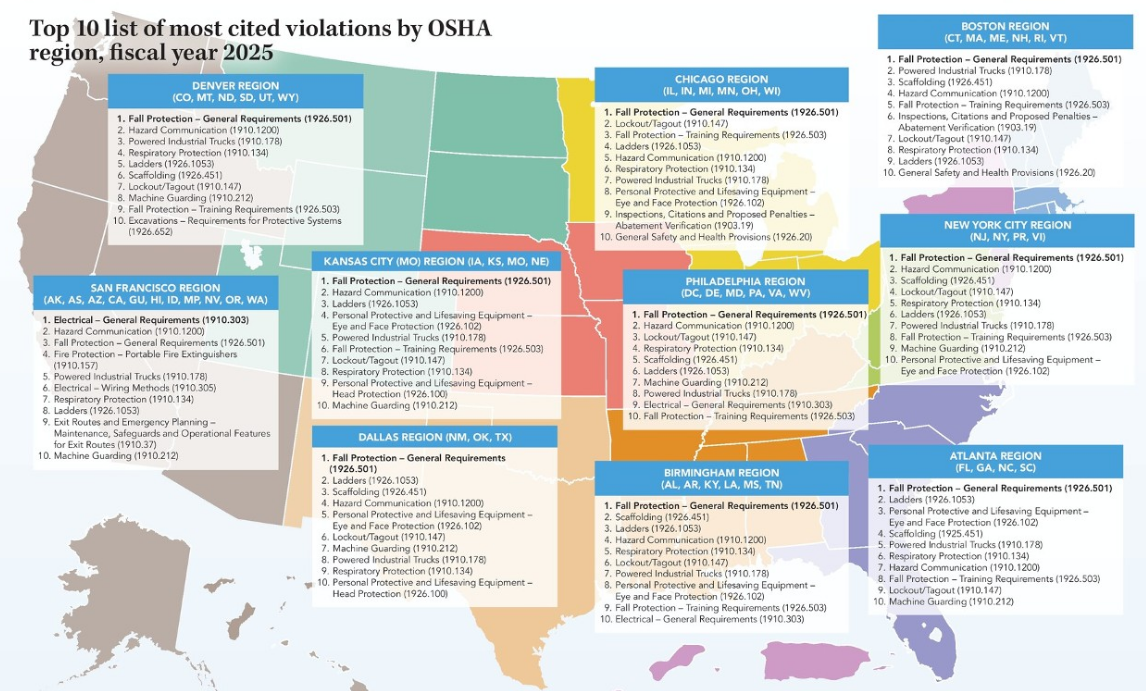 (Click for a larger version)
A note from OSHA
“We know that there has been significant progress in improving workplace conditions. However, we can’t achieve our mission with enforcement only. That’s why we’re taking a balanced approach – one that values partnerships and strong compliance assistance as essential strategies alongside traditional enforcement.”
The agency adds that its vision reflects:
- Working more closely with small businesses because they’re the backbone of the economy and often need additional support to keep workers safe.
- Listening to stakeholders and making sure that employers and workers help guide its decisions.
- Building greater collaboration because real progress can be made when stakeholders come together.
- Increasing the use of compliance assistance to give employers the tools and knowledge they need to protect workers to prevent tragedies.
“We are working to expand our cooperative programs so more workplaces can benefit from engaging with OSHA and one another to build and enhance their programs along the way.”
OSHA Top 10 standards cited in fiscal year 2025 with the highest cumulative proposed penalties
| Standard |
Penalty
|
|
|
1. |
1926.501(b) – Duty to provide fall protection in construction |
$48,388,975.63 |
|
2. |
1910.147 (c) – General requirements for hazardous energy control programs |
$13,134.743.26 |
|
3. |
1910.212 (a) – General requirements for machine guarding |
$11,897,408.87 |
|
4. |
1926.1053(b) – Use of ladders |
$10,168,918.87 |
|
5. |
1926.102(a) – General requirements for eye and face protection |
$6,951,273.90 |
|
6. |
OSH Act of 1970.5(a) – General Duty Clause violations |
$6,459,089.55 |
|
7. |
1910.28(b) – Protection from fall hazards in general industry |
$3,992,226.24 |
|
8. |
1926.503(a) – Training requirements for fall protection in construction |
$3,979,763.25 |
|
9. |
1926.652(a) – Protection of employees in excavations |
$3,896,047.25 |
|
10. |
1910.178(l) – Powered industrial truck training |
$3,808,389.45 |
* OSHA Information Data current as of Sept. 26.
Citation Solutions
The following Safety+Health advertisers offer products and services to help you avoid citations related to OSHA’s Top 10.
Fall Protection – General Requirements (1926.501)
Hazard Communication (1910.1200)
Lockout/Tagout (1910.147)
Respiratory Protection (1910.134)