Responding is Dave Delleske, senior vice president of sales, A-SAFE, Plano, TX.
Traditional facility safety infrastructure has long been built around fixed assumptions: clearly marked pathways, permanent vehicle routes, standard guardrails and predictable operations. In many facilities, those measures still form the foundation of a safety program. The challenge is that operations rarely stay fixed for long. As layouts evolve and vehicle traffic increases, gaps can emerge between how a facility is designed and how it’s actually used.
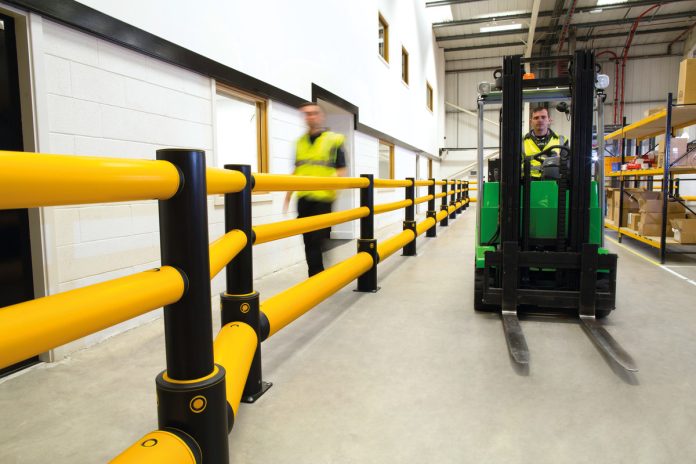
One of the most common blind spots is overreliance on passive controls. Floor markings, signage and designated lanes are important, but they depend heavily on consistent human behavior. In busy environments with forklifts and frequent pedestrian movement, those controls can lose effectiveness – particularly when congestion, noise or changing workflows come into play. This is significant given the scale of the risk: In the United States, forklift-related incidents cause tens of thousands of injuries each year, resulting in dozens of fatalities.
Another often overlooked issue is how facilities account for impact. Traditional safety infrastructure has typically been designed to withstand impact once, but not necessarily to perform consistently over time. When barriers are struck, they may bend, break or require replacement. Each incident can trigger repair work, downtime and additional risk if damaged infrastructure is left in place. The total cost of a single vehicle impact – factoring in equipment damage, labor and operational disruption – can easily reach five figures.
This has prompted a broader shift in how safety leaders evaluate infrastructure. Rather than focusing solely on upfront installation costs, many are taking a lifecycle view – considering how systems perform under repeated impacts and how often they require repair or replacement. In some cases, more resilient carrier systems can achieve a return on investment within 12 to 18 months by reducing maintenance demands, minimizing equipment damage and limiting operational disruption. Although cost isn’t the primary driver of safety decisions, these factors often reinforce the value of more durable protection.
Data visibility is another persistent gap. Many facilities still lack a clear picture of where impacts and near misses occur most often. Without that insight, safety improvements tend to be reactive. By tracking collision patterns and identifying high-risk zones, organizations can make more targeted changes to layouts, traffic flow and physical protections – reducing exposure before a serious incident occurs.
Another issue is misalignment over time. Production demand shifts, storage footprints expand and new equipment is introduced, yet safety infrastructure isn’t always updated accordingly. A pedestrian route that was once low risk may now intersect with a vehicle lane with heavy traffic. These changes are often gradual, making them easy to overlook without regular review. Modern safety approaches are helping to close these gaps by combining more resilient infrastructure with better data and more frequent reassessment of risk. The goal isn’t only to prevent a single incident, but to create systems that continue to perform under real operating conditions – day after day, impact after impact.
Ultimately, the biggest blind spot is a static approach to safety in a dynamic environment. As facilities become more complex and automated, safety infrastructure must evolve as well – shifting from fixed protection to adaptive, performance-driven prevention.
Editor’s note: This article represents the independent views of the author and should not be considered a National Safety Council endorsement.