

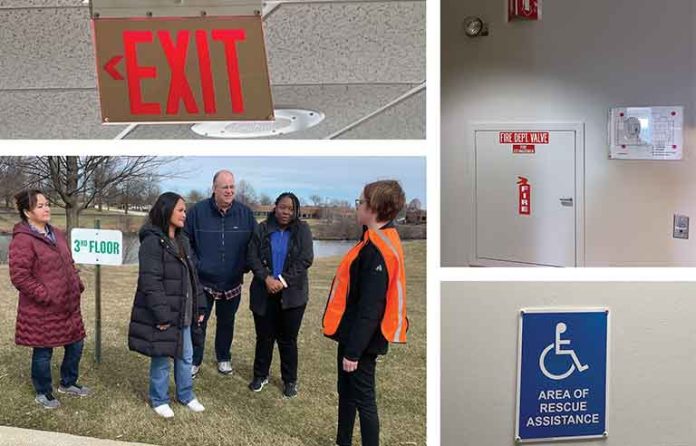
If a fire alarm sounded at your workplace, would every employee know what to do? Would they take it seriously? Would your emergency action plan fit the bill – or falter?
All of these questions can be answered through regular fire drills.
“Fire drills are one of the most important things that you can do in safety,” says Butch Browning, executive director of the National Association of State Fire Marshals. “The whole purpose of a fire drill is to facilitate quick and accessible egress out of a building in times of emergencies. It’s a paramount piece of any plan.”
Drills familiarize workers with the steps they’d need to take if a fire broke out. That means they “have to spend less time making the decisions of ‘What am I supposed to do?’” when an actual emergency occurs, says Greg Harrington, principal engineer at the National Fire Protection Association. “That reduces response time.”
And potentially saves lives.
Get prepared for fire drills
Preparation and training for fire drills is where Justin Sassen begins. As the safety manager at Porter Pipe & Supply in Addison, IL, Sassen oversees a nearly 300,000-square-foot facility that has two fire drills a year. One is announced a week in advance and the other goes off unannounced.
“The preparedness is what saves the day,” he said. “You want to make sure everyone knows what to do if that situation ever were to occur. It’s constantly keeping it in the forefront. Everybody has to be on the same page.”
During new-employee onboarding, Sassen shares information and resources on fire safety, including where exits and designated meeting places outside the building are, evacuation maps, and the organization’s emergency policies and procedures.
For veteran employees, Sassen regularly asks them random fire safety-related questions. For example: “Where’s the closest fire extinguisher?” and “If an event happened, what door would you leave out of?”
Sassen relies on members of Porter’s safety committee and key leaders to serve as “sweepers,” tasked with making sure employees exit various portions of the building safely. Sassen and the sweepers use two-way radios to communicate throughout the process.
Harrington encourages safety pros to present different fire scenarios during drills.
“You might do something like put an orange traffic cone in front of one of the exit stair doors and say, ‘This exit is blocked by the fire. You need to go find another egress path.’”
Using the radios and cellphones, Sassen and the sweepers check with frontline managers to get an accurate head count and make sure no one is unaccounted for during a drill.
“It’s a lot of back and forth,” he said.
Associate Editor Barry Bottino discusses this article on the April 2023 episode of Safety+Health‘s “On the Safe Side” podcast.
Look to standards and guidance
A good resource for safety pros? Browning points to NFPA 101: Life Safety Code – a standard that addresses fires and similar emergencies in both new and existing buildings.
NFPA 101 covers requirements for various types of workplaces and residences to “help eliminate risks in the built environment efficiently and effectively.”
OSHA doesn’t have a specific standard relating to fire drills, but various aspects of fire safety are covered in the Occupational Safety and Health Standards regulation 29 CFR 1910 Subpart E, which includes:
- Adequate exit routes for evacuation during fires and other emergencies – 1910.34
- Adequate number of exit routes – 1910.36(b)
- Exits must discharge into a safe area – 1910.36(c)
- Exits must be of adequate capacity and width – 1910.36(f) and 1910.36(g)
- Exits must be clearly lighted and marked – 1910.37(b)
- An employee alarm system is provided – 1910.37(b) – and complies with 1910.165
Partner with the fire department
No matter your industry, connecting with local emergency responders is a must. “That partnership needs to be the first thing you do before you start creating safety plans and teaching safety classes,” Browning said. “When all the safety measures fail and you have to call 911, having a preplanned relationship with those folks is important.”
Harrington, who began his career in fire services, recommends notifying your local fire department of upcoming drills and inviting representatives to observe. This will allow them to better understand the layout of the building, evacuation points and assembly areas for workers, as well as get to know key safety leaders onsite.
“The benefit is you’re much better off if you have an actual emergency when the fire department is responding,” Harrington said. “They’ve been there. They know what the building looks like. They’ll know where to tie into the sprinkler system, if the building has a sprinkler system. They’ll know right where the fire hydrants are on the property or on the street, and that will make their response much more efficient.”
Review and share
For safety pros, a post-drill review – via email, electronic survey or in person – can bring to light what went well and where improvement is needed.
“There’s a lot of things that can be learned,” Sassen said. “Even in preplanned events, nothing ever goes 100%.”
Sassen shares his observations, along with those of the sweepers and a fire inspector who attends the events, with all employees via email after every drill. One thing he doesn’t do, however, is criticize individuals. “That’s a coaching/counseling moment.”
For example, he might explain that a forklift driver needs to lower a load before exiting the building. Workers also might have questions about containing chemicals they’re working with before exiting or turning off machinery.
Various sizes and types of workplaces will have expected evacuation times that vary, so focusing strictly on time isn’t enough.
“It’s about an orderly drill,” said Browning, who added that the first priority of any post-drill is asking employees for their observations and thoughts. “You’ve got employees who might be working on cranes or forklifts. They may not have heard the alarm. You’ve got to drill down to those folks much different than the 40 people working in office cubicles with no noise and no distractions.”
For any employees who treat drills lightly or consider them a nuisance, Sassen said he reinforces how training can benefit them and others.
“We do it for you to understand,” Sassen said. “In a true event, I guarantee if you didn’t have this training, you would be a deer in the headlights. I know I would be.”
To Harrington, having a culture of safety that starts with high-level leadership is a must for the success of fire drills and other emergency action plans.
“If the CEO or the president of the company is not bought into it, or if they think, ‘I don’t have to take part in a fire drill,’ then why should anybody else take it seriously?”

