

Ann Arbor, MI — Allowing exoskeleton users to set their own preferences not only accelerates the customization process, but may also lead to increased adoption and use of the technology, according to the results of a recent study.
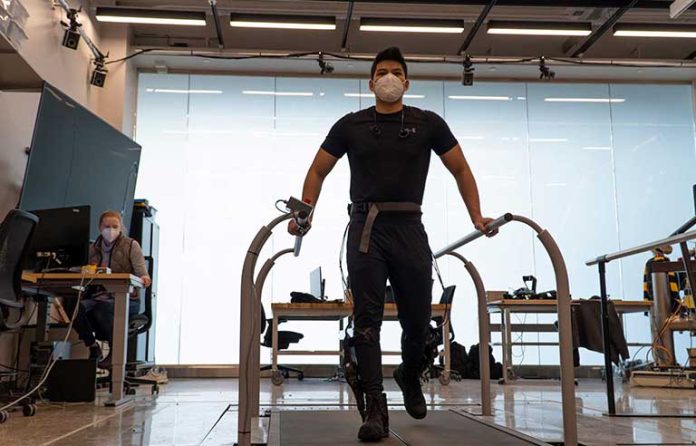
University of Michigan researchers asked 24 participants, half of whom had no experience working with exoskeletons, to wear a powered ankle exoskeleton while walking on a treadmill with a tablet displaying a blank grid. “Selecting any point on the grid would alter the torque output of the exoskeleton on one axis, while changing the timing of that torque on the alternate axis,” the researchers said.
The participants tried to find their optimal settings. The inexperienced participants were able to do so, on average, in 1 minute and 45 seconds.
“We were surprised at how precisely people were able to identify their preferences, especially because they were totally blinded to everything that was happening – we didn’t tell them what parameters they were tuning, so they were only selecting their preferences based on how they felt the device was assisting them,” lead researcher Kim Ingraham said in a press release.
Typically, experts choose exoskeleton settings based on user height and weight, among other characteristics, including gait biomechanics.
“This can be done by crunching quantifiable data, such as metabolic rate or muscle activity, to minimize the energy expended from a user, or more simply by asking the user to repeatedly compare between pairs of settings to find which feels best,” the release states. “What minimizes energy expenditure, however, may not be the most comfortable or useful.”
The researchers next want to learn why users have certain preferences and how the preferences affect their energy, muscle activity and physiology. Another area of future study will focus on how to implement automatic, preference-based controls in exoskeleton use.
“To be able to choose and have control over how it feels is going to help with user satisfaction and adoption of these devices in the future,” Ingraham said. “No matter how much an exoskeleton helps, people won’t wear them if they are not enjoyable.”
The study was published online in the journal Science Robotics.

