

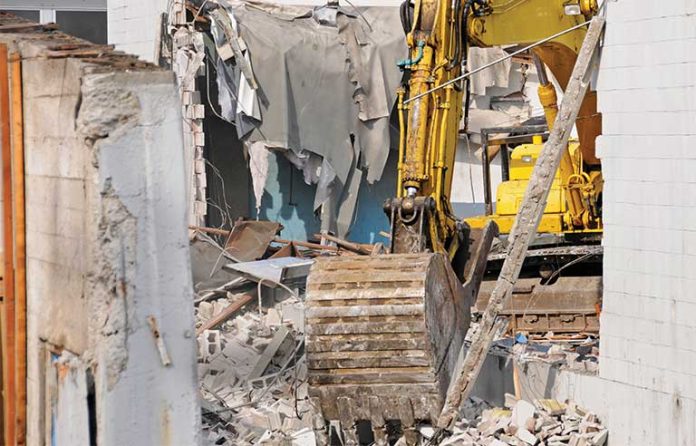
Before a new building or home can go up, sometimes another structure has to come down.
That’s where demolition work comes in.
According to 2020 data from the Bureau of Labor Statistics, 78 workers died while engaged in site preparation contracting, which includes demolition. That total is down from 88 in the previous year – the most since 98 fatalities were recorded in 2007.
So, what are some of the hazards associated with demolition work, and how can they be avoided?
Engineering surveys and JSAs
One of the most obvious demolition hazards is falling objects. With weaknesses or damage often hidden within walls and floors, it’s important to take at least two safety measures.
The first: Conduct an engineering survey before work begins. It’s a requirement under OSHA’s 1926 Subpart T standards on preparatory operations – 1926.850(a). This standard accounts for up to 75% of citations on demolition worksites, the agency says.
Despite the words that make up the term, an employer may not always need an engineer to conduct an engineering survey, according to the regulation.
“Every project is different, and some may require engineers to be involved,” adds John Satterwhite, chair of the National Demolition Association’s Safety Committee and vice president of Lloyd D. Nabors Demolition.
OSHA requires a “competent person” to determine the condition of the framing, floors and walls, as well as the possibility of an “unplanned collapse of any portion of the structure.” In addition, any adjacent structures where employees may be exposed need to be similarly checked, and written evidence of the engineering survey is required.
“The survey should be performed prior to the project starting, but it is a living document, and as the building conditions change, the survey may need to be updated,” Satterwhite said.
The other safety practice is a “task-specific” Job Safety Analysis, also known as a job hazard analysis or task hazard analysis. A JSA needs to be updated if new hazards are uncovered or conditions change.
Falls
Falls are another hazard associated with demolition work. OSHA requires employers to guard wall openings that are 42 inches or higher. Also, floor openings must be secured “with material able to withstand the loads likely to be imposed,” and those “used for material disposal” may not take up more than 25% of the total floor area “unless the lateral supports of the removed flooring remain in place.”
In certain structures, workers may be at risk of falling into a basement, warns Rob Matuga, assistant vice president of labor, safety and health at the National Association of Home Builders.
Fall protection may be necessary in these situations, such as when workers are operating from aerial lifts, the Laborers’ Health and Safety Fund of North America says.
OSHA regulations state that workers operating on a horizontal or vertical surface, also known as a walking-working surface, that has an unprotected side or edge 6 feet or more above a lower level must be protected from falling by a personal fall arrest system, a safety net system or a guardrail system.
Hazardous materials
During an engineering survey, the competent person may discover materials such as asbestos or lead. These materials are often found in buildings that are 40 or more years old, and testing may be required to confirm the presence of hazardous materials, LHSFNA notes.
The removal of asbestos and other substances can mean employers must follow not only OSHA regulations but those from the Environmental Protection Agency, Matuga said. An example: “Asbestos has to be labeled. It has to go to a specific dump.”
He added that if an employer is demolishing or renovating a home or structure with water damage, mold is another potential concern.
Silica and noise
Demolishing concrete, used for foundations, can present at least two additional hazards. One is exposure to silica dust.
According to OSHA, inhaling small crystalline silica particles can lead to multiple health issues, including lung cancer, chronic obstructive pulmonary disease, kidney disease and silicosis – an incurable lung disease.
Additionally, demolishing concrete may involve the use of a jackhammer or other noisy machinery, so hearing protection will likely be needed. This is another important reason to perform a JSA before starting work.
Page 2 of 2
More dust and location concerns
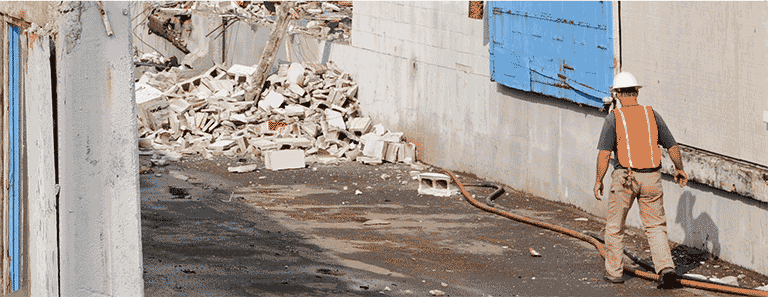
Other kinds of dust can be dispersed during demolition work, especially when an entire residential structure is being taken down. Typically, crews will spray water on the structure to contain that dust. This inclusion of water may cause other issues or the need for a cleanup, Matuga cautioned.
Dust containment in especially critical when the demolition site is in a populated area.
“Spraying down with water mist is really important so the dust doesn’t go to the neighbor’s yard and the neighbor’s house, or things of that nature,” Matuga said.
For demolition crews working in more populated settings, safety concerns also include moving vehicles and people.
“Working in a residential setting can sometimes be a little more of a logistically daunting task than commercial, but each job is always different in its own way,” Satterwhite said. “You may tear a house down on a 100-acre farm with nothing around or in a heavily congested neighborhood with tight streets and lots of pedestrian traffic, including children and joggers.
“You have to be just as cognizant of dust and noise in a residential neighborhood as you would in a commercial setting.”
Heat
Matuga noted that heat can be another demolition work-related issue, especially if workers are wearing respirators or protective clothing during remediation of hazardous materials.
Complicating this potential hazard further is the likelihood that air conditioning units aren’t in working order in structures that are under renovation or being demolished.
Both situations mean employers must monitor their workers for signs of heat stress and provide water, rest and shade.
Electrical hazards and utilities
An engineering survey can help reveal whether electrical or other utility hazards are present.
“What about gas? What about water or sewer?” Matuga asked. “All of these other services need to be controlled, either turned off or somehow controlled. And, typically for electricity, you can flip the main breaker switch and do whatever you need to do.”
The national number to call before you dig near utility lines is 811, or you can go to call811.com for more information.
Photos: PhilAugustavo/iStockphoto
Safety measures
An engineering survey or JSA can go a long way in determining what personal protective equipment is needed for workers. For example, if a ceiling or other objects are overhead, workers are required to wear hard hats.
Along with planning, employers should communicate with workers in ways such as job safety briefings. OSHA also requires training on topics such as PPE, fall protection, scaffolds, confined spaces, and welding and cutting.
“You have to train them and educate them on the hazards that they’re going to be exposed to,” Matuga said. “It starts with safety orientation for each new worker, and then making sure there’s regular training on the hazards that are there, especially any new hazards that could be present.
“There’s also making sure that the workers are supervised, and that they’re wearing the personal protective equipment that is needed, that they’re following the same practices and they’re doing the job right.”

