
“How safe do you feel on the job?”
The nonprofit Women in Trucking Association posed this question to its members in a recent survey, asking female drivers to rate how they felt on a scale of 1 to 10.
“The average score was 4.4,” WIT President and CEO Ellen Voie said. “When I stand up in front of executives, I say, ‘How would you feel if you only felt safe half of the time you went to work? Think about that.’”
For many female workers, feeling safe – both physically and psychologically – is a major concern. Although Voie estimates that women make up 10% of over-the-road truck drivers in the United States, Injury Facts – an online statistical database from the National Safety Council – reports that, in 2020, women experienced 26.6% of the workplace injuries reported in the transportation and warehousing industry. Among all industries, women are far more likely to be victims of assault. In 2020, a woman was the target in 73.3% of all assaults reported on the job.
Employers in all industries must create “an environment where women are accepted,” said Tricia Kagerer, executive vice president of risk management for Dallas-based Jordan Foster Construction. That includes making women feel safe.
“There needs to be an intentional focus,” Kagerer said.
Travel safety
With thousands of WIT members on the nation’s roads each day, Voie is keenly aware of the challenges faced by women whose jobs require travel.
Security at truck stops is a high priority. Many WIT members have shared best practices such as not parking in the back of a lot, having a buddy on hand and not walking between parked trucks.
“A lot of women have told me that they will eat, shower and fuel at one truck stop and then go to the next one to sleep so that nobody knows it’s a solo female,” Voie said. Kagerer said being the only woman on a construction jobsite and traveling alone early in her career taught her to be more attentive.
“Just being aware of your environment is really important,” she said. “I’ve checked into a hotel that wasn’t in the area that I thought it was. Instead of being nice and accommodating, I got my stuff and moved to a safer place. My gut and my intuition were telling me, ‘You don’t want to stay here.’ Women need to listen to our intuition.”
PPE concerns
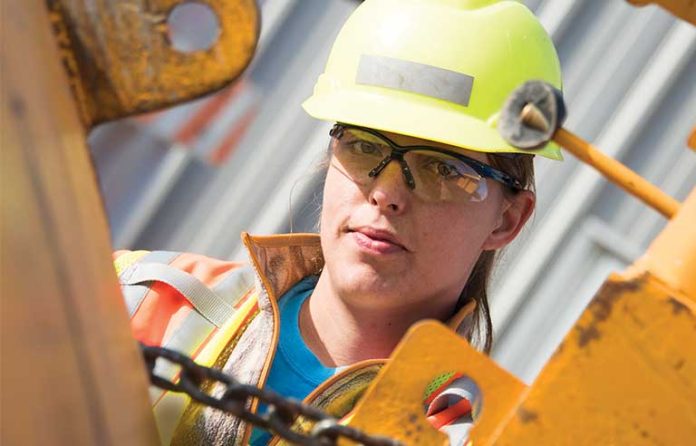
For many women in the workforce, ill-fitting personal protective equipment is a big problem – as it has been for decades.
Rather than provide proper-fitting women’s sizes, Nicole Randall said, some employers simply offer smaller men’s sizes.
“Unfortunately, that just assumes all women are petite,” said Randall, director of marketing and external affairs at the International Safety Equipment Association. “People fall into all ranges and sizes. Available PPE should reflect that reality.”
PPE for women has come a long way, according to Voie, who mentioned several women-owned manufacturing companies that produce, among other items, vests, boots and high-visibility garments.
“Manufacturers have started to produce a lot more PPE that is designed to fit the female face, hand and body,” Randall said. “It has to fit properly so that it can effectively protect the employee from the hazard for which it was designed.” Improper PPE can take a toll on female workers’ mental health, Randall noted.
“How can she trust her employer if the proper PPE isn’t provided?” she asked. “If an employee doesn’t feel welcome, then retention becomes an issue.
“As employers provide the necessary resources, I think they’ll begin to see more satisfaction in the workplace.”
Page 2 of 2
What can leaders do?
Leslie B. Hammer is the co-director of the Oregon Healthy Workforce Center – a NIOSH-funded Total Worker Health Center of Excellence – and a professor at the Oregon Institute of Occupational Health Sciences at Oregon Health and Science University.
In an October post on NIOSH’s Science Blog, Hammer and three of her colleagues discuss a trio of web-based TWH training programs that promote supportive leadership behaviors that can enhance employee health and well-being while driving organizational improvements.
They note that job stressors such as interpersonal conflict, lack of supervisor support, low job control, task overload and work-family imbalance can have an adverse effect on workers’ health as well as their ability to function on and off the job. For women, additional job stress is common.
“Women tend to have additional stressors related to the types of work they’re engaging in,” Hammer said, referring to those in industries in which women are underrepresented. “Women also have stressors related to sexual harassment moreso than men. Women are also typically experiencing higher levels of work-life stress.
“Because women are the ones to bear children, they are also the ones to experience stress due to various types of pregnancy discrimination at work.”
This can include, in some cases, pregnant workers being denied opportunities or having to accept a different role. After the birth of a child, caregiving becomes a major factor. For some women, they’re managing the care of children and aging parents, along with work, which can lead to safety and health concerns.
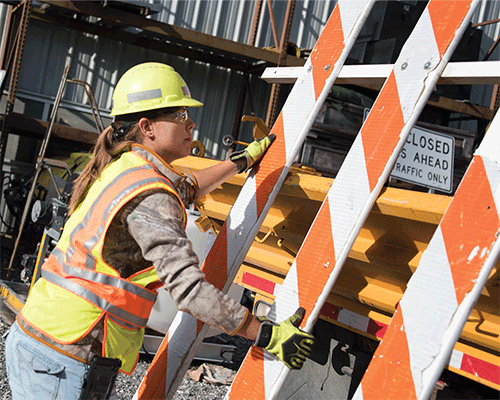
Photos: Missouri Department of Transportation Flickr
“The stress that people experience in trying to manage work and non-work does spill over and does impact safety,” Hammer said. “It impacts safety behaviors. It impacts safety compliance. It impacts the ability to focus on the job because people get caught up in their non-work stress.”
OHWC has developed multiple one-hour online training courses for leaders with the aim of improving outcomes for workers, thus reducing job stress.
“Employees who view their supervisors, organization or both as being supportive of family priorities report experiencing significantly less work-family conflict, greater job satisfaction and increased organizational commitment,” Hammer and her co-authors write.
One of the training courses, known as the Safety & Health Improvement Program, is aimed at teaching supervisors how to provide emotional and instrumental support for safety communication and work-life balance challenges. Hammer says supervisors and managers can serve as “linking pins” to improve worker safety, health and well-being.
For more information on the program, visit yourworkpath.com/ship.
Where can workers turn?
When they experience safety and health issues on the job, female employees should seek out a supportive leader. “We always advise women to talk to their employer, talk to their supervisor or their union representative,” Randall said.
Of course, that’s not always as easy as it sounds.
“It really comes down to the company’s culture,” she said. “Is it a worker-friendly environment where a woman can feel free and safe to come forward and report her concerns?”
After such concerns are reported, the next step is paramount for employers and managers. “It’s not just that the person feels confident to speak up,” Kagerer said, “but then what happens when they do? Positions of authority must respond. There has to be a path and a mechanism to respond to those concerns. When concerns are not immediately addressed, the intended culture of an organization begins to unravel.”

