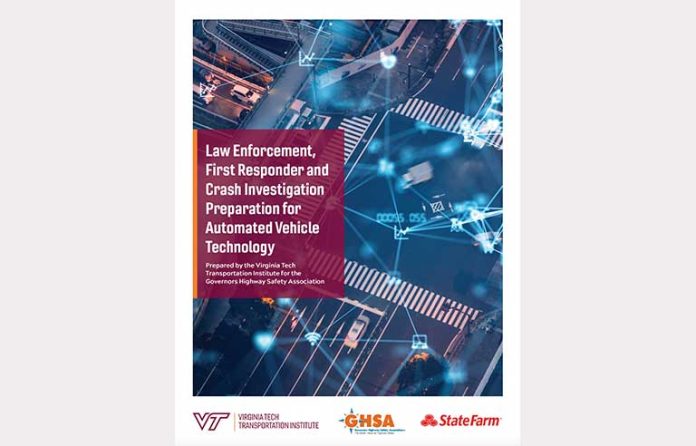
Denver — A new report from the Governors Highway Safety Association explores what training is needed to keep first responders and crash scene investigators safe when reporting to crash sites involving cars equipped with automated technologies.
Law Enforcement, First Responder and Crash Investigation Preparation for Automated Vehicle Technology, produced by the Virginia Tech Transportation Institute for GHSA, is based off interviews with government administrators, first responders, law enforcement officials, automakers, crash reconstruction experts, insurance professionals and safety advocates.
As the presence of vehicles with a wide variety of automation and driver assistance technologies continues to increase, key questions facing first responders – including law enforcement officers, firefighters, emergency medical technicians and public safety responders – are:
- How is such a vehicle disabled, moved or stabilized after being involved in a crash or abandoned?
- How do responders cut through a vehicle to remove an occupant after a crash without putting themselves or the occupant in danger?
- How do responders know that such vehicles can detect emergency vehicles or first responders directing traffic at a crash scene and take action to avoid them?
Recommended training topics include:
- Understanding the differences between, and capabilities of, vehicles with different technologies
- Identifying vehicles with automation technologies
- Understanding governmental responsibilities regarding vehicle oversight
- Anticipating future technology deployment
- Interacting with automated vehicles
- Understanding and accessing data
“The rise of automated vehicle technology creates new opportunities to prevent crashes and accelerate efforts to reach our goal of zero roadway deaths,” GHSA Executive Director Jonathan Adkins said in a press release, “but this technology also poses new problems for public safety officials. GHSA remains focused on helping state highway safety offices and our law enforcement partners be ready for widespread deployment of vehicles with these technologies so everyone stays safe regardless of who is, or isn’t, driving.”