
Some jobs require putting people in proximity. So, Centers for Disease Control and Prevention guidance for reducing the spread of COVID-19 has proved a challenge for employers in certain industries. In addition to following the recommendations from CDC, OSHA and other authorities, employers and safety professionals have turned to technology and their own creativity to find ways for people to work safely in this new normal.
Basic best practices
Universal best practices – familiar to most people – include wearing a face covering or respirator while working, frequent handwashing, and maintaining 6 feet of distance from other people when possible. In addition, many employers are screening workers for potential COVID-19 symptoms before they enter the workplace (mobile apps are available) and encouraging sick employees to stay home.
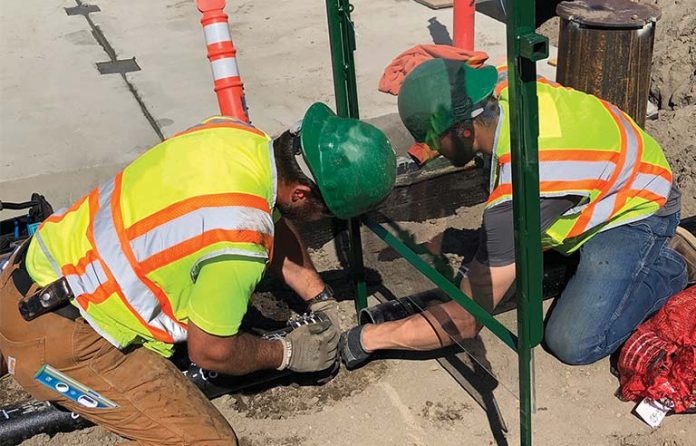
Other mitigation measures vary by industry. For example, for construction workers, recommendations from the Oregon Institute of Occupational Health Sciences include:
- Placing a plexiglass barrier between workers when 6 feet of physical distancing isn’t possible
- Using one-way lanes of travel on paths and stairs
- Assigning tools to workers to prevent the risk of exposure through sharing
- Allotting more time to complete jobs so workers can allow others to pass when working in tight or narrow spaces
CDC guidance for manufacturing facilities includes variations of those above, as well as staggering work shifts when possible; consulting with a heating, ventilation and air conditioning engineer to ensure adequate ventilation; and modifying the alignment of workstations and production lines.
Roy
“I think there’s lots of opportunity to look at workstations as you evolve a facility going forward,” said Deb Roy, president and owner of SafeTech Consultants Inc., as well as president of the American Society of Safety Professionals. “I think we’re going to have to look at more distancing and whether or not the layout is appropriate regarding exposures to other people.”
Safe communication
Even activities as simple as pre-work safety meetings have had to be rethought.
Physical distancing is a point of emphasis among National Utility Contractors Association members, said George Kennedy, who retired last year as the organization’s vice president of safety. He said the association advises contractors not to share or pass cellphones, tablets or other electronic devices during meetings and safety talks.
If screens are needed for communication, meeting leaders should display the devices from a safe distance, NUCA recommends, with workers spaced apart as they listen.
A sample plan document exploring COVID-19 exposure prevention, preparedness and rescue developed by the Construction Industry Safety Coalition, and later revised by the Associated General Contractors of America, suggests all in-person meetings be limited and changed to telephone meetings when possible. For in-person safety meetings, the groups advise against gatherings of more than 10 people while keeping participants 6 feet apart. In addition, attendance should be taken verbally rather than passing around a paper sheet or mobile device for sign-in.
Technology
Speaking during a webinar series presented by the National Safety Council as part of its SAFER: Safe Actions for Employee Returns initiative, BAE Systems’ Safety, Health and Environment Manager Alex Eggleston said the COVID-19 pandemic “is forcing folks to embrace, more readily, technology and innovation.”
NSC says organizations at the forefront of adopting technology during the pandemic “saw a boon” that enabled them “to more quickly shift to new modes of working, leveraging tools and platforms for both safety and productivity.”
Technologies include wearable proximity detectors, contact-tracing apps, touch-free methods for workers to clock in and out, and motion-sensing doors at facilities.
Garner-Janna
“We started out with, ‘What could we do right away to ensure that our employees were safe and had the best level of protection possible?’” Michelle Garner-Janna, executive director of corporate health, safety and environment at Cummins Inc., told Safety+Health. “Since the early days of the pandemic, our solutions have evolved based on new information as well as new needs. Sometimes, it takes a crisis like this to really see what you’re capable of doing.”
One of the company’s success stories involves the development and use of collaborative robots, or “cobots,” which have been used in its operation for some time but now can be expanded as a tool to help reduce the risk of exposure to COVID-19.
“Cobots can allow for an individual employee to perform more than one task,” Garner-Janna said, “while also working collaboratively with the cobot in the workstation and allowing for appropriate social distancing between employees in a safe and efficient manner.”
Bobbie Schaefer, risk engineering manager at the IoT innovation lab at The Hartford insurance company, said during a SAFER webinar that, amid the pandemic, many technology providers either have adapted existing devices or created new ones “to help provide some relief and assistance to employers by helping them in implementing these new safety practices.”
As an example, she pointed to the evolution of artificial intelligence technologies: Whereas the technology already had the capability to identify the presence of – or the lack of – personal protective equipment being worn, Schaefer said some developers have adjusted AI to detect facemask use, too.
(The SAFER technology webinar series is available at no cost at nsc.org/safer.)
Maintaining morale and looking ahead
Although the COVID-19 pandemic has reached the one-year mark, the various adjustments employers have made can still feel burdensome to workers. Adrian Russell, project manager for Mattcon General Contractors Inc., said promoting a message of togetherness among employees has been effective at limiting worker pushback.
“We feel that by individuals taking on a team mentality, being mindful of one another, respecting one another, and doing their best every single day and never taking shortcuts, never cheating the system, we believe that we’re doing everything we can to protect ourselves as well as those around us,” Russell said.
Kathy Freeman, director of safety at HEI Civil, a general contractor, said the company’s campaigns to promote COVID-19 self-awareness help “keep it fresh.” No matter the campaign or activity, supervisors strive to reinforce the theme that worker safety and health is essential to the operation. “It’s been a challenge,” Freeman said, “but they’ve pulled through.”
From morale boosters and workspace adjustments to implementing technology, experts say employers need to both maintain their current efforts and look ahead.
“From a planning standpoint, safety professionals really are going to need to be sure that they have plans in place that are going to work for the next pandemic, because the reality is, we will see another pandemic, likely, in our lifetime,” Roy said. “And so, we need to be better prepared for it.”