

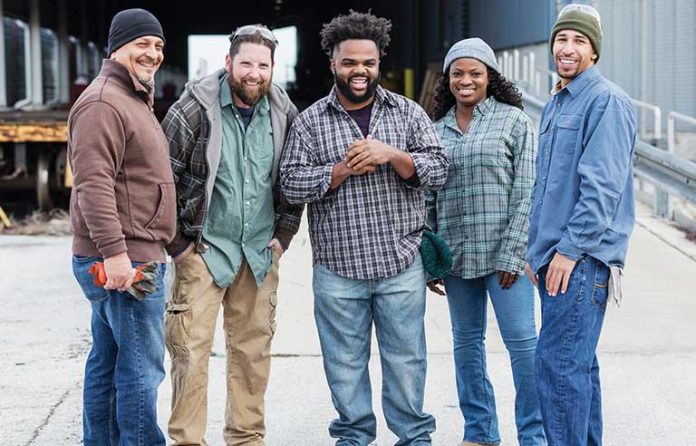
Adrian Russell occasionally elicits surprised expressions from clients when arriving at a jobsite for the first time. The construction program manager is Black, an attribute that typically goes unnoticed in pre-work email exchanges.
“I don’t think that we can deny the fact that when you think of construction, or safety and leadership, and you think of individuals being in leadership positions within this industry, you still, generally, assume white,” Russell said.
However, ongoing workplace initiatives concerning diversity, equity and inclusion spurred by the May 25 death of George Floyd – a Black man who died while in the custody of the Minneapolis Police Department – and other recent racially charged incidents around the country give Russell hope about the movement to remedy the deep-seated issues that influence altered treatment of minority workers.
But Russell and other safety professionals are quick to stress that meaningful change doesn’t happen overnight, and can only be accomplished by creating structural transformation centered on increasing acceptance and opportunities for minorities in the workforce.
‘An employer has to care’
According to data from the Bureau of Labor Statistics, the majority of the U.S. workforce in 2019 identified as white (77.7%) and male (53%). Blacks constituted 12.3% of all workers but comprised a mere 6.4% of construction occupations.
The makeup of Black workers in manufacturing (10.4%) and mining, quarrying, and oil and gas extraction (5.1%) also was markedly low. For Hispanic or Latino workers, the breakdown was 30.4%, 16.8% and 20.1% for construction; manufacturing; and mining, quarrying, and oil and gas, respectively. Among workers of Asian descent, the percentages were 1.9, 6.8, and 3.7 in these respective industries.
Associate Editor Kevin Druley discusses this article in the October 2020 episode of Safety+Health‘s “On the Safe Side” podcast.
At issue, experts said, isn’t merely bridging the gap in demographic figures, but ensuring employers afford minority workers equal treatment, consideration, training, advancement and representation despite such data.
Although Title VII of the Civil Rights Act of 1964 makes discrimination based on certain specified characteristics – including race – unlawful, the Equal Employment Opportunity Commission received 23,976 allegations of race-based discrimination in fiscal year 2019 – a total that excludes charges filed with state or local Fair Employment Practices agencies.
Encouraging leaders within organizations to engage in reflection and self-examination related to DE&I issues is a vital starting point to begin building more diverse and accepting workplace cultures. Experts urge employers to give these exercises the time and serious thought they deserve. Approach them with a long-term outlook that views achieving a diverse and inclusive workplace as a value – not simply checking a box.
“First of all, an employer has to care,” said I. David Daniels, a veteran safety leader and environmental, health and safety professional for Jacobs Engineering Group in South Fulton, GA. “It has to matter that when they look around their office, their business, and they see everyone looking, sounding and thinking alike. If that observation doesn’t matter, they can stop a conversation right there and move on to something else.”
Barriers to safety
Disparities in language, training and employer understanding of the cultures of their employees can create mental and physical barriers to safety.
In 2018, 5,250 workers died as a result of on-the-job injuries, the most fatalities recorded by the BLS Census of Fatal Occupational Injuries since 2007. Within that total, the 615 deaths among Black workers were the most since 1999, while the 961 deaths among Hispanic or Latino workers marked a 6.4% increase from 2017.
Daniels said minority workers commonly battle psychosocial safety hazards stemming from stress related to harassment, intimidation, communication difficulties, inadequate training and job insecurity. When combined with perceived or actual mistreatment from employers and/or colleagues, these stressors may put workers at additional risk.
“They’re just distracted,” Daniels said. “It’s hard to really pay attention to the work and to focus on doing it safely when you don’t feel supported or protected by your employer.”
To experts, this underlines the need for employers to commit to more fully understanding the diverse cultures of the workers in their organization. This may require employers to adapt the way they ask questions of and listen to workers.
When speaking about DE&I issues, Lindsay Bell, a regional health and safety manager at Baltimore-based Solvay USA Inc., often uses the acronym HOPE – honor other people’s experiences – to stress the importance of a more active listening culture among safety leaders.
“I think the biggest thing with HOPE is, when you look at all of these DE&I efforts and the intentions and outcomes don’t add up, usually it’s because you’ve designed a program around what you think other people need and not what they are telling you they need,” Bell said. “So, when we say honor other people’s experiences, it’s realizing that your experience isn’t the default and accepting that your life experiences aren’t this universal baseline from which other people’s experiences vary.
“So, other people are going to have a different experience and reality than you, so you want to have HOPE … because it is going to vary, and it is going to be, sometimes, so vastly different from what your life is like that people have a hard time conceptually understanding what I’m telling you is a problem, and it’s because they have just never experienced that problem.”
Wong
Still, unconscious bias – or social stereotyping – can impact this process if employers or safety professionals are unable to recognize it in themselves. On an interpersonal level, unconscious bias can influence how employers handle workplace concerns or complaints, said Cori Wong, assistant vice president for gender equity at Colorado State University in Fort Collins, CO. This presents trickle-down considerations for the entire organization.
“There could be gender and race and class and language – all sorts of different bias can inform how someone hears another person who might raise a concern,” Wong said. “So, safety professionals should become aware of and check their own personal biases.”
Another common example of bias in safety involves fit testing and ordering personal protective equipment, Wong noted. If an employer unconsciously assumes the size of a standard worker and buys PPE that is best suited for a 6-foot, 180-pound man without considering the needs, abilities, sizes and materials suited for those who are larger or female, for instance, affected employees are likely to face unnecessary hurdles and hazards that improper fit present.
Taking initiative
In a November 2018 report on the business case for diversity and inclusion in the construction industry, The Associated General Contractors of America says “empirical evidence has proven the value of a diverse and inclusive work environment” on safety, productivity, innovation and retention – all of which improve the bottom line.
The report cites extensive related research, including a 2013 Deloitte study that concluded employees who “think their company is committed to diversity and … feel included” are 83% more likely to provide innovation.
“People notice if they don’t belong, if they’re made to feel like they don’t belong,” Wong said. “Because then they’re sort of reduced to just, ‘You’re here for your labor. That’s it.’”
Added Daniels: “Human beings are generally less likely to shoot holes in a boat they’re actually in. To the extent people get the opportunity to participate in a process, then they’re going to be more supportive of it. OSHA makes it clear that employee involvement and management commitment are critical elements of an effective safety management system.”
Huneke
In March, AGC and the organization’s Washington state chapter launched the Culture of CARE initiative – a program intended to enhance diversity and inclusion in the industry. At press time, Brynn Huneke, director of diversity and inclusion and member engagement at AGC, said more than 350 organizations had taken the initiative’s pledge to:
Commit to hire and pay based on skill and experience regardless of age, ethnicity, gender identity, nationality, race, religion, sex or sexual orientation.
Attract prospective employees by creating inclusive workplaces that are free from harassment, hazing and bullying.
Retain high-performing employees by identifying and removing barriers to advancement.
Empower every employee to promote a culture of diversity and inclusion.
“We recognize that there are some significant gaps in our industry and that we are not recruiting individuals into the industry in numbers that we should to be a well-rounded, really diverse industry,” Huneke said. “Especially before the pandemic happened, we were facing a very significant workforce shortage and recognized that we need to expand the diversity of the industry.”
Advice for employers
Martin
National Safety Council President and CEO Lorraine M. Martin reiterated the importance of making DE&I part of an organization’s fabric and value system. That way, the “heightened awareness” of DE&I issues that has resulted from the Floyd tragedy can be a catalyst for meaningful change.
“In the safety world, we know we must walk the walk every day, and our commitment to safety has to be real,” Martin said. “When you look out for your colleagues, you’re helping to keep them safe. DE&I is a safety issue. People need to feel included and part of the team, because everyone has rich experiences that make their perspectives both valuable and unique. Successful organizations recognize how critical DE&I is to their operations, but only when it is authentic. If for some reason the efforts are not genuine, or never were, organizations must take time to reset and recalibrate.”
Experts offer advice for employers seeking to improve the DE&I culture in their workplaces:
Diversify management: Jack Jackson, a senior safety consultant with SafeStart, said that although he’s been fortunate to speak at numerous safety conferences worldwide, he knows he’s “not the only qualified minority in the field.” In many instances, he said, fellow minorities “have not been included or they were simply passed on by because of who they were.”
Ensuring upper management is truly committed to increasing diversity and inclusion can help to remedy the issue, namely when leadership boards lack diversity themselves, Jackson added.
Daniels agreed: “Every system is perfectly designed to produce whatever it’s producing right now,” in his experience.
“It’s difficult to have policies and focus on diversity when the leadership is homogenous, because they’ve got a limited view of the world,” Daniels said. “It’s not that they’re bad. It’s not that they’re nefarious. It’s none of that. But it’s really difficult to see through somebody else’s eyes. And if you don’t have diverse opinions included in the decision-making, the decisions aren’t going to be diverse.”
In the interim, Minneapolis-based safety consultant Abby Ferri, a panelist on a recent safety seminar about DE&I in the workplace, said safety professionals who serve on organization boards can make a difference in DE&I culture by using their communication skills. “And communication is both ways, right? We listen a lot, and so we’re able to listen to what the workers are saying,” Ferri said. “Often, the workforce – the labor force that’s doing the work – is more diverse than the management at an organization. So, it’s a great way to bring those perspectives to the management level, and that’s where a safety professional can demonstrate their value.”
Consider committees: Shortly after conducting a series of listening sessions for employees to discuss their views on racial injustice and social unrest, NSC created its Diversity, Equity and Inclusion Committee, comprising representatives from across the organization. Martin said the group will assess how effectively the council applies DE&I internally and externally through its mission and delivery of services.
“We can aspire to many things, but when we measure them and hold ourselves accountable, they’re more likely to get done,” Martin said.
Is your organization considering forming a similar committee? Ferri reminds leaders to be sure they aren’t choosing members simply for their diversity and are using members’ talents properly.
“People should be brought into those committees and initiatives based on their career path, not because of how they look,” she said. “As companies are intentionally recruiting better and elevating diverse people and perspectives in their organization, I think it’s important to realize that those people aren’t there to teach you about diversity – those employees need to be sponsored and mentored into higher-level management initiatives and other projects that are directly related to their actual career path.
Russell
On-the-job outreach: Russell, who grew up in Indianapolis and works for Mattcon General Contractors in his hometown, said he sometimes asks youth he encounters near jobsites if they’ve ever met an architect, engineer, construction manager or superintendent. Frequently, the answer is no, said Russell, who also is a diversity consultant. This prompted an idea for a possible grassroots solution to boost diversity numbers in industry professions: Send employers into underserved communities to make a direct appeal to teens.
“Show them how cool it is to be an electrician,” Russell said. “Show them how cool it is, how amazing it is to be an ironworker, or the life they could carve out for themselves as a pipefitter. Show these individuals that they could absolutely have a future in the industry. That’s how you compel people of this background so that they may one day see themselves actually going into that. But you can’t be interested in what you don’t know. The elephant in the room that we must address is that if they don’t see many who look like them in the industry – and not just in the industry, but doing well at a high level – of course they won’t be very interested.”
Sharing the journey
After instances in which he’s been treated differently on a jobsite – ostensibly because he’s Black – Russell practices perseverance. “For me, being a professional and priding myself on being exactly that, I just look at it as one challenge among many that ultimately you have to find a way to rise above and overcome,” he said.
Experts stress that creating more diverse and inclusive workplaces requires similar resolve. Martin called it a shared journey of consistent improvement – one she relates to a quote from late writer and civil rights activist Maya Angelou:
“Do the best you can until you know better. Then when you know better, do better.”
“Safety, particularly physical safety, is just one aspect of caring about the people in the workplace that you’re trying to get good work out of,” Daniels said. “Inclusion and diversity has limited effectiveness as a program. It has to be a value.”

