
Washington — For employers, safety technology should be a good fit rather than just the newest option, says Matt Law, director of the Work to Zero initiative at the National Safety Council.
“It’s not about the shiny object,” Law said June 2 during an NSC webinar titled, Moving Safety Forward: The Evolution of Safety Tech and the Safety Innovation Journey.
Kenna Stanley, research manager at NSC, was a co-presenter. “Something we never want to do is encourage the use of technology just for its sake,” Stanley said. “We want to avoid employers investing thousands of dollars into technologies that don’t address their problems, don’t fit into their workflows or just don’t address their challenges.”
Every three years, NSC, via the Work to Zero program, surveys 500 employers and 1,000 employees on various aspects of safety tech. In 2023, 65% of the employers surveyed said their organization recently researched or considered adopting new safety technologies. Among the employees, 83% said they were open to trying and using new technologies at work.
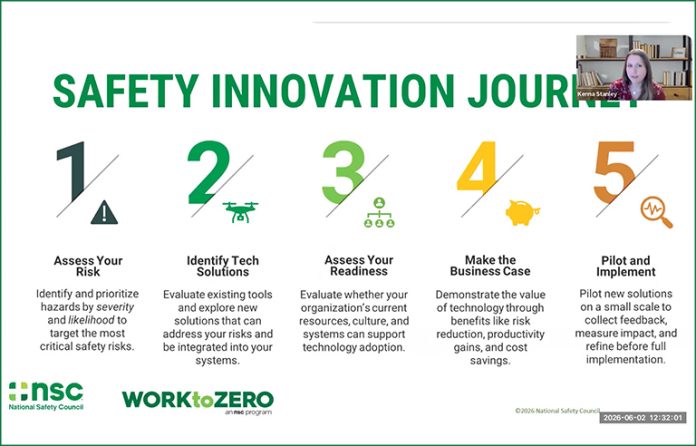
Work to Zero has created a five-step Safety Innovation Journey to help guide workplaces through the adoption process:
- Assess your risk
- Identify safety technologies
- Determine your readiness
- Make a business case
- Pilot and implementation
Stanley stressed that employers shouldn’t be leery of the fifth step.
“Pilots are a great opportunity to learn, to iterate, to reduce the initial investment risk,” she said.
A recent Massachusetts Institute of Technology report shows that 95% of generative artificial intelligence pilots have failed. But failure can be valuable.
“Failure has a really negative connotation,” Stanley said. “We have seen so many good lessons learned (from failed pilots).”
Digital tech options may be attractive, but safety professionals should also look for solutions outside of that realm.
“Safety tech isn’t always digital,” Law said. “Things like self-retracting lifelines engineered out specific hazards associated with fall arrest. Now we have things like trauma straps, which are making fall arrest less hazardous.”
Technologies for hand and arm protection also have advanced exponentially over the years.
“I remember being really impressed about an 18-gauge glove that was Cut Level 2,” Law said. “Now we have 18-gauge gloves that are Cut Level 9. That’s insane.”