

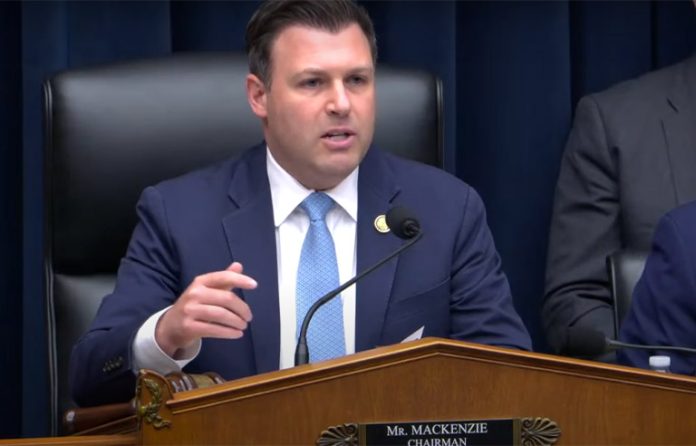
Washington — In the eyes of Rep. Ryan Mackenzie (R-PA), the House Workforce Protections Subcommittee hearing on May 15 was for employers who are “seeking clarity and flexibility in OSHA standards.” To Rep. Ilhan Omar (D-MN), it was another chance for Republicans to “demonize OSHA.”
The title of the hearing was Reclaiming OSHA’s Mission: Ensuring Safety Without Overreach. In large part, the subcommittee majority and its witnesses focused on what they consider “a one-size-fits-all” proposed heat rule from OSHA and an unrealized tree care standard. “As the nature of work continues to change, broad-based regulatory efforts can unintentionally create more problems than they solve,” Mackenzie, who chairs the subcommittee, said in his opening statement.
Omar, in contrast, called the hearing “just the latest attempt to weaken the institution of rules that keep workers safe and healthy at their jobs.”
Proposed heat rule
Witnesses claimed multiple times that the proposed heat rule doesn’t take regional climate differences into account.
“I’ve talked to people in New Mexico who say 80 degrees is a great day to build – it’s perfect weather,” said Felicia Watson, senior counsel at the Littler Mendelson law firm. “And you might have something completely different in Florida.”
Rep. Greg Casar (D-TX), meanwhile, said to another witness, Jake Parson, president of CRH Americas Materials’ Northeast Division: “It sounds like what you’re saying is we have different conditions in Maine than in Texas. But what I’m confused about is if it’s 90 degrees in Austin or 90 degrees in Maine, 90 degrees is still 90 degrees.”
Casar then asked Parson and Watson: “Is it appropriate for someone to have to work outdoors, paving streets or up on a scaffold in 90-degree heat, 95-degree heat or 100-degree heat for four or five hours without being allowed to come off the scaffold or without being allowed to take a water break?”
Watson responded: “There would be no opposition to that. The idea behind working in temperatures like that is they take their rest breaks as needed.”
Casar replied, “I think people likely need to take rest breaks more often than that.”
NIOSH staff cuts; DOGE actions
Omar; her fellow Democrats; and their witness, Jordan Barab, former deputy assistant secretary at OSHA, focused on the recent cuts to NIOSH and the Department of Government Efficiency’s proposed cuts in the Department of Labor.
“The functioning of NIOSH is critical to the mission of OSHA,” Barab said. “Almost the entire NIOSH staff was [laid off] last month, then a few were brought back and restored a couple of days ago because of the court order.
“Most of these workers have not been brought back and their programs are not operating despite [Department of Health and Human Services Secretary Robert F. Kennedy Jr.’s] claims that they are just being reorganized. Secretary Kennedy was lying [at a May 14 Senate hearing] when he claimed that no working scientists at HHS were fired. Hundreds of working scientists and engineers at NIOSH have been [laid off].”
Regarding DOGE, Omar said in her opening statement that:
- It targeted at least 11 OSHA field offices to be permanently shut down – including the only office in Louisiana, located in what is known as Cancer Alley.
- It slated, on its “hit list,” at least 30 MSHA field offices for closure, including an office created in response to the Upper Big Branch Mine disaster.
- It’s cutting staff and planning to close 20 Wage and Hour Division offices “while we face a surge in child labor violations.”
“Shutting down field offices will endanger workers’ lives by cutting off the public from DOL’s most vital services,” Omar said. “This also means severely limiting the geographic coverage of inspectors’ and investigators’ enforcement activities against law-breaking companies and further straining an already resource-strapped DOL.”
Tree care standard
Ben Tresselt, president and owner of Arborist Enterprises, noted that the tree care industry has been waiting two decades for OSHA to promulgate a standard. OSHA currently regulates the industry under a patchwork of general industry standards.
“We don’t have a standard that addresses all of our concerns for what we see on a daily basis,” Tresselt said. “Unifying this would help protect our workers. It would help employers have a guideline on how to protect their workers and would give OSHA a clear picture of what we’re doing and judge us on that.”
When asked why more progress hasn’t been made on a standard, Tresselt told Rep. Tim Walberg (R-MI), the chair of the House Education and Workforce Committee who was sitting in during the hearing: “I don’t really have a direct answer for that. I think other priorities at OSHA have taken precedent.”

