

KEY POINTS
- More than 90 percent of survey respondents reported that their job is stable
- The EHS profession was not the first career choice for three-fourths of respondents
- Being able to help people remains a draw for EHS students
Does the environmental, health and safety profession have an image problem? Ensuring the safety and health of the workforce is important for individual workplaces and the economy, yet many students may not even know the field exists or do not consider it an attractive option.
Patrick Holden, safety manager at Eden Prairie, MN-based Cardinal Glass Industries, discovered this recently when his son enrolled in college. Holden tried talking to him about studying safety, but the teen was not interested.
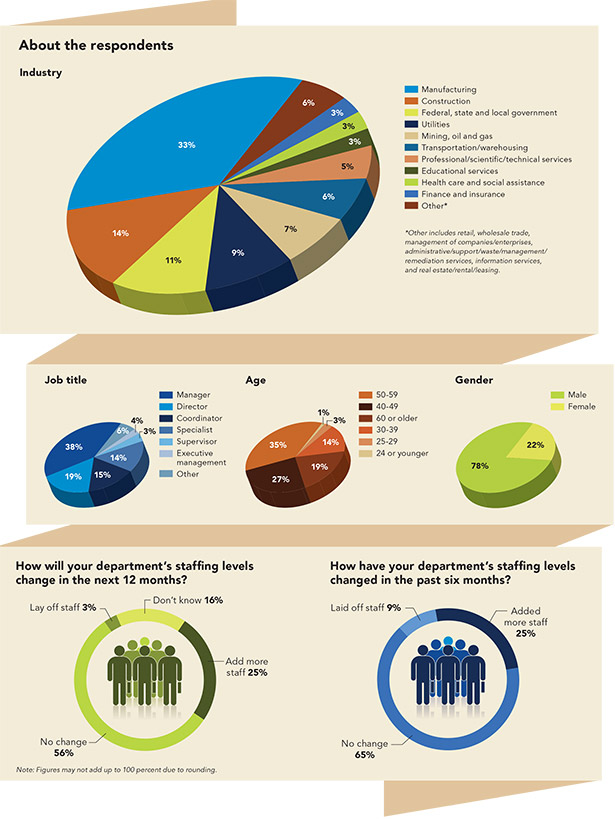
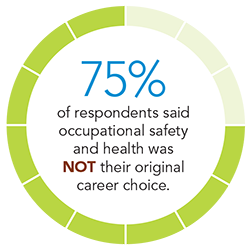
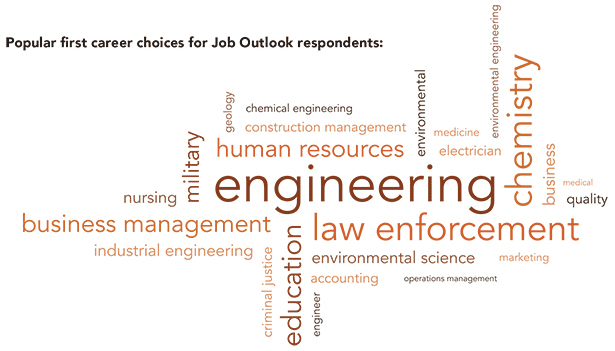
His observation lines up with results from Safety+Health’s 2014 Job Outlook survey. A total of 959 subscribers took the survey in February. Of those, 75 percent said occupational safety and health was not their first career choice. Of the 718 respondents who answered a follow-up question, 74 percent indicated they were not aware in college that safety and health was a field of study.
 Some of this is understandable. More than half of respondents were 50 or older. OSHA was in its infancy or non-existent when they were college age, and schools may not have had degree programs aligned with a career in safety.
Yet even now, promoting the EHS major remains a challenge for colleges and universities.
“That’s the perennial question,” said Anthony Veltri, associate professor of Environment Occupational Health & Safety at Oregon State University in Corvallis. “I think not only do we struggle with it, but most other colleges and universities do as well.”
> Next: Marketing the safety field
Marketing the safety field
Veltri said his department is developing a marketing strategy, specifically contacting undergraduate advisors in other university programs to establish outreach with them and their students. One effort already in place involves working with the schools of engineering, business and construction management to help educate their students about integrating EHS courses into their respective curricula.
Although Oregon State offers an EHS minor for undergraduates, Veltri said most students are at the master’s or doctorate level. That means he focuses on reaching out to working safety professionals who may be interested in obtaining an EHS graduate degree.
One of the distinguishing features of Oregon State’s EHS program is its emphasis on research, particularly in the areas of exposure assessment, risk characterization, control, prevention and management systems, Veltri said.
At Murray State University in Murray, KY, students can major in occupational safety and health after meeting the prerequisite course requirements, and the program is divided into three main tracks: safety, environmental and industrial hygiene.
John W. Wells Jr., assistant professor in Murray State’s Department of Occupational Safety and Health, agreed that the safety and health career is not well-known or understood by the public.
“A lot of people don’t realize the profession exists until they run into it at a university setting or they have a parent who knows of the position or the profession by merely experiencing it in the workplace,” Wells said.
His education experience was similar to many respondents of the Job Outlook survey, in that he switched career paths while in school. As a student at Murray State in 1983, Wells started out in geology, but said he reconsidered when the oil boom came to an end a year or so later. He heard occupational safety and health had employment growth and paid well.
The outlook for the safety profession is still strong, Wells believes. This is supported by the 91 percent of Job Outlook respondents who said their job was “stable” or “relatively stable,” up from 86 percent last year.
Regarding salary, Wells said Murray State students with an undergraduate degree in safety typically start out earning $45,000-$55,000, and safety professionals with a graduate degree may make as much as $75,000. “The students are really in high demand,” Wells said.
> Next: What attracts people to EHS?
What attracts people to EHS?
Job demand and good salaries are not the only factors that drive people to become safety professionals. This year’s Job Outlook survey included space for respondents to explain what attracted them to the field, and many described motivations such as wanting to make a difference, being faced with interesting challenges each day, and having a job that uses both science and people skills.
In their own words:
“Bottom line, I want to help workers survive a workday.”
“I worked in the steel industry and saw many injuries. I was an hourly worker and thought something should be different. I decided that I wanted to make a difference.”
“I enjoy working with all levels of associates from top management to hourly associates.”
“It is also a noble profession, [and] while sometimes thankless, it is great to know that you are making an impact.”
“New challenges each day.”
“Not a desk job. Interacting with people.”
“Travel.”
“I love to use critical thinking skills daily to solve real-world problems that arise. It is never boring or monotonous.”
“The safety profession allows me to influence people in a positive way while challenging me intellectually.”
“Endless education opportunities.”
“The combination of biology, physics, psychology, law and human interaction.”
In conversations with students, Wells hears a common reason for their interest in EHS: service. “[This] generation is more about helping each other, working with each other,” Wells said. “So when you look at the safety and health profession, it’s serving your fellow man, and it fits right in with what we’ve been teaching these kids for the last decade as far as community service goes.”
On the following pages, some readers share their journey to becoming a safety professional.
> Next: Veteran EHS pros talk about how they got their start
Veteran EHS pros talk about how they got their start
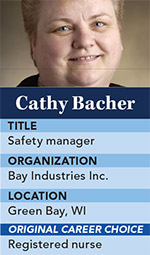 |
Cathy Bacher remembers the moment like it was yesterday: She was working as an emergency medical technician at a large paper company when her boss burst into her office. “They had an OSHA inspection that did not go well, so my boss dropped the citations on my desk and said, ‘Get us into compliance, but don’t spend any money,’” Bacher recalled. “That started my safety career.” It took five years for Bacher to change the safety culture from “miserable” to “strong” by using free online resources and training. She also recruited employees who were natural leaders for the safety program, realizing that others would follow their example. However, she said she made an early mistake by purchasing a canned hazard communication program. It failed – employees were not labeling chemicals, looking at Safety Data Sheets or wearing the right type of gloves. When Bacher talked to workers, she found that many spoke Spanish and could not read the posters and documents printed in English. She started over and developed signage using pictures rather than words. Bacher said that over the course of 30 years in safety, her medical training has been an asset because she understands how different exposures will affect the body. “I wouldn’t trade it for the world,” she said of being a safety professional. “This job is one of the few ones in the world where you can seriously make a difference in people’s lives for the better.” |
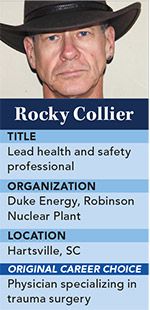 |
Rocky Collier credits his safety career to serendipity. He had no intention of applying to be a safety professional when he walked into a nuclear plant with a friend more than 22 years ago. In fact, he had already accepted an engineering position at a local fire department, and the only reason he filed an application was for his unemployment paperwork. The woman who took his application noticed he had not listed which position he was seeking, such as welder, pipe fitter or carpenter. “Through divine intervention or whatever, the words ‘safety man’ popped in my head and I told her I wanted to be the safety man,” Collier recalled. It turned out the plant had an opening for a safety person with first aid knowledge, and Collier’s prior experience as an emergency medical technician made him a perfect fit. Plus, the salary was higher than the job he was planning to start in a few weeks, so he changed plans. Collier said he had studied pre-med at Eastern New Mexico University, but he was not accepted into the first medical school to which he applied, so he became a firefighter and EMT instead. Looking back, he sees a direct connection between the career as a trauma surgeon he first envisioned and the one he now has in safety. “It’s all service; it’s all doing something for someone else,” Collier said. “Instead of trying to fix them up after they get hurt, I’ve evolved to helping to keep them from getting hurt.” |
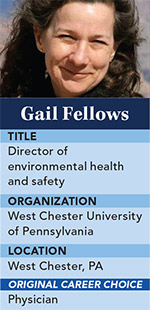 |
After earning a B-minus in zoology class her freshman year, Gail Fellows decided to switch from pre-med because the professor had said anyone who did not get an A should not go into medicine. She was not sure what to major in until her father, an aeronautical engineer who had become a safety professional, suggested she follow in his footsteps. “One day he came to me and said, ‘I think I know what you want to be,’” Fellows said. “Instead of saying ‘no you don’t,’ I listened and he said, ‘I’ll set up a meeting with an industrial hygienist who works for state OSHA. That way you can find out for yourself what it’s about.” After a day with the industrial hygienist, Fellows knew it was the field for her because it had the right mix of science, creativity, and working inside and outside an office. Most important, “it was helping people not get hurt, which was why I wanted to be pre-med in the first place,” she said. There was one problem, however: In the mid-1970s, OSHA was new and the University of Arizona did not yet have an industrial hygiene program. Fellows continued taking relevant courses while the university developed a program and was the first traditional student to graduate with the degree in December 1981. “I just had faith that it was really going to happen,” she said. “I often think if my dad hadn’t been in that profession, what would I be doing now because there was no indication while I was going through college that this field even existed.” |
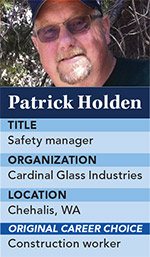 |
After 25 years in general and marine construction, Patrick Holden had to make a change. “It’s a young man’s game,” he said. “It just got to the point where physically it wasn’t working for me, so I had to do some soul searching.” He considered construction management, but decided against it because construction hiring was slow with the economic downturn. When he thought about which parts of his job he enjoyed most, the answer was clear: regulatory compliance and safety. Holden went to Centralia College to earn his associate’s degree in safety and was hired at Cardinal Glass Industries after graduating in 2009. He said he plans to enroll in a bachelor’s program. Holden said that over the course of his career in the construction industry, he has seen safety emerge as a true profession, as opposed to a generation ago when a construction worker was assigned safety duties. As he explained, a lot of older workers entered safety by way of “You’re the guy that gets hurt; now you get to be the safety guy, thinking that magically you’re going to be able to translate that experience into training and accident prevention.” For Holden, entering a degree program – not just learning safety on the job – was crucial, and he left with more than textbook knowledge. “I’m in my 50s and a lot of our workforce is much younger, and I think particularly the communication courses – and then just interacting with younger people – was a benefit for me,” Holden said. |
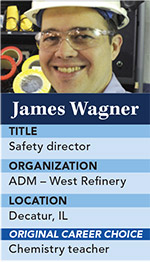 |
In his early 20s, James Wagner planned on becoming a chemistry teacher. That all changed when he started student teaching and encountered a few teens whose use of obscenities conflicted sharply with the values of respect and discipline he had learned in the U.S. Navy. Wagner switched to research, a career that would still tap his passion for science. After being deployed again, he came back intent on being a safety professional. He had seen up-close how skipping a step could cost someone his or her life, and he was comfortable learning and explaining rules and procedures. “The transition from military to safety is probably almost a natural fit,” Wagner said. “I want to spend time trying to make sure people go home the way that they came to work, and because of the unique perspective I have – whether I wanted to be exposed to it or not – I have seen the extreme of what happens when you can’t understand, communicate and follow simple rules.” Wagner sought out safety training with the help of OSHA employees who also were veterans. When a safety position opened up, he was ready. His strategy for reaching workers is to form genuine relationships. He likened it to being in the military, where everyone in uniform puts aside disagreements because they are on the same team with the same mission of making it home. At the end of the workday, “I stand outside at shift change and I watch everybody go out and everybody come in,” Wagner said. “And to me that’s no different than watching everybody get on the plane and watching everybody get off the plane.” It is a silent affirmation that he has made a difference because everyone returned home as they left – without injury. |
Share the story of how you got your start as a safety professional by adding a comment below.
> Next: More career stories
More EHS career stories
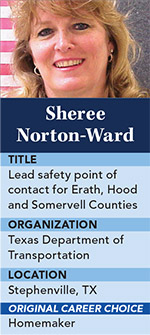 |
Not knowing can be fatal. That is the message from Sheree Norton-Ward, who remembers the alarmed look on her obstetrician’s face when her husband mentioned that he had been a dog handler during the Vietnam War. The doctor said their child could have birth defects because of his exposure to the defoliant Agent Orange. Her child was born healthy, but Norton-Ward believes her husband being exposed to Agent Orange in Vietnam – as well as other chemicals later as a firefighter – played a role in his death from cancer more than a decade ago. At the time in the late 1970s, when her husband was a firefighter, “They knew to fight the flame, but they never thought of what they were breathing in,” Norton-Ward said, adding that personal protective equipment technology and awareness among workers is much higher now. While working as a secretary after her husband’s death, Norton-Ward took advantage of every opportunity to learn about safety – from classes with FEMA to safety meetings with firefighters. She said her current employer treats safety as No. 1 and provides PPE and hazardous material training to all employees. Her personal tie to safety “makes me better because I don’t just call it in; I believe in it,” Norton-Ward said. “When it touches you, it makes it a whole lot more important to share the message.” |
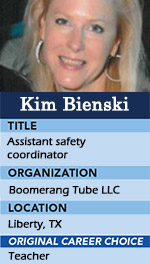 |
Working as a wedding coordinator at a conference center was just a job for Kim Bienski – not a calling. So when a family friend reached out to her about a position as a safety professional with a small contractor company, she said yes. At the time, Bienski had completed only a handful of general education classes leading toward a degree in education and had no formal training in environmental, health and safety. During the interview, she was told part of the job would be attending classes full-time (at the employer’s expense) to complete a degree in safety management technology. The role also involved recordkeeping, issuing personal protective equipment and providing employee training. Initially, Bienski thought this was just another job with perks. But when she started taking the required OSHA safety courses, the training resonated with her. She graduated at the top of her class and realized compassion was the key to engaging with workers. “My biggest accomplishment is when I am able to make a significant change in a worker’s attitude towards safety,” she said. “When someone asks me about my career, I tell them I fell into safety on accident, and never looked back.” As a kid, Bienski was torn between becoming a teacher or working in the health field. For her, safety combines the best of both worlds. “The teaching part is employee training, and the health part is preservation of the employees’ health,” she said. |
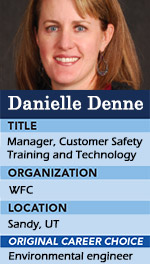 |
Danielle Denne went to Brigham Young University with the intention of becoming an environmental engineer, but during her sophomore year realized she did not like the engineering part. She met with a counselor, who directed her to occupational safety and health. Learning about OSHA, environmental regulations and industrial hygiene appealed to Denne, who said she also liked that being in safety would allow her to make a difference in the lives of workers. In her current position at WCF she oversees safety training for customers of the insurance company as well as the safety content of their website. “I love what I do,” Denne said. “I feel lucky to do what I am passionate about every day. My favorite part of my job, we do a lot of consulting, is actually sitting down with a customer and seeing that lightbulb go off, when they actually get why safety is important.” |
‘I cannot imagine doing anything else’
Below are more stories about how safety professionals got their start.
“I crushed my leg in a forklift accident. In complaining about the forklift condition, lack of training and work surface conditions, I was challenged by a manager that if I thought I could do better, then I should speak up. I proceeded to the office of the company president and laid that gauntlet on his desk. The rest of the story is history. I have been in the safety field now for 28 years.”
“I could not handle the blood and guts of nursing. Since I had a heavy chemistry and math background, I looked through the college catalog and made a list of all the degrees most of my credits would transfer into. One of them was environmental, health and safety. This was the late ‘80s and I had no idea what the heck those folks did. At a college party, I ran into a guy who was in that program. He was telling me how interesting it was and it had 100 percent job placement upon graduation. I was a broke kid, and all I needed to hear was ‘100 percent job placement’ and I was in. I have never looked back and it was one of [my] biggest strokes of luck ever.”
“I was in between jobs and working security to pay the bills. The safety supervisor at the facility had heard I could write and handed me a stack of papers and asked if I could make it into something people would understand. I took it home, put together a program and handed it back to him the next morning. He walked off with it and came back 20 minutes later and said, ‘Effective immediately, you’re transferred to safety. Come with me.’ I was bitten by the safety bug and it’s been my passion now for 24 years.”
“I was employed at a small construction firm and was injured off the job. During my recovery, the management never contacted me. This led me to seriously evaluate how much consideration was given to employees’ health and safety. I started taking OSHA classes and got my first position a few months later. [I’ve been] exclusively in the field since.”
“One day I was called into a meeting with our plant manager and the VP of operations, handed a folder with a checklist inside, and told I was going to be the new safety director. I knew absolutely nothing about the field of safety. But over the past four years I have received several certifications, and have attended so many training courses I have lost count. I love the field and I love my job – I cannot imagine doing anything else!”
Share the story of how you got your start as a safety professional by adding a comment below.
> Next: Survey demographics / EHS staffing levels
Survey demographics / EHS staffing levels