

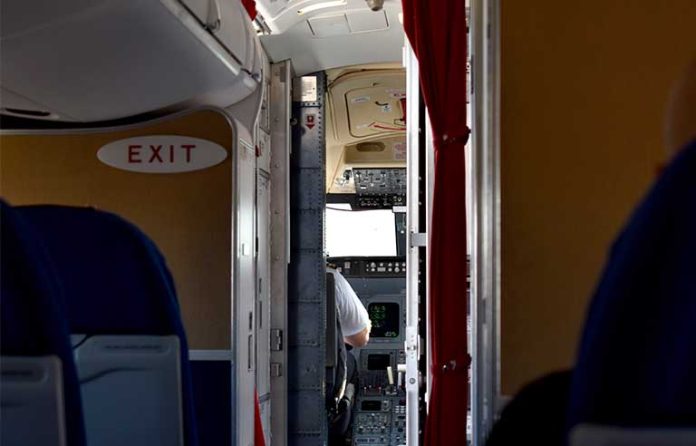
Washington — A trade association that represents U.S. passenger airlines and cargo carriers is asking the Federal Aviation Administration to give them two more years to comply with a final rule that requires a secondary cockpit barrier on new commercial aircraft.
The rule went into effect in August 2023 and will apply to aircraft manufactured after Aug. 25. It states that installed physical secondary barriers, or IPSBs, will slow potential attacks “long enough so that an open flight deck door can be closed and locked before an attacker could reach the flight deck.”
In a May 5 petition, Airlines for America writes that it believes “current flight deck security processes have demonstrated their effectiveness and are considered to provide an equivalent level of safety,” and it has concerns about meeting implementation deadlines for the new rule.
The petition claims FAA hasn’t certified IPSBs or approved training programs, and that IPSB certification wasn’t expected until June or July.
“At this point, the Aug. 25, 2025, implementation date creates an impossible timeline for operators to execute and complete the necessary and required training associated with the introduction of the IPSB,” Airlines for America writes, “thus relief is needed on the training and operating requirements of IPSBs.”
FAA has set a deadline of June 23 for stakeholders to comment on the petition.
The FAA Reauthorization Act of 2018 directed FAA to require secondary barriers, but the agency didn’t issue a notice of proposed rulemaking until Aug. 1, 2022.
Aircraft manufactured before Aug. 25 won’t need to be retrofitted with a secondary barrier.
Jason Ambrosi, president of Air Line Pilots Association, International, believes airlines have had enough time to comply.
“ALPA has long advocated for installed secondary flight deck barriers and was proud to lead the charge to enact legislation implementing this critical security enhancement,” Ambrosi said in a press release. “The airlines have had two years to implement these requirements, yet they are now requesting an extension for the same time granted to them by the final rule.
“We urge the FAA to reject this latest stalling tactic and implement, without delay, the secondary barrier requirement as Congress mandated.”