
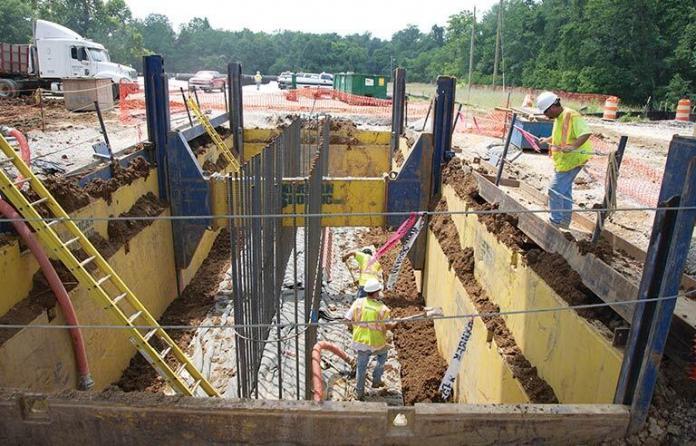
Keeping workers safe during trenching and excavation is a challenge for many safety professionals. The work poses numerous risks, particularly collapses.
Trench-related deaths have prompted OSHA emphasis programs at the federal and state levels, as well as other outreach efforts, including an annual stand-down organized by the National Utility Contractors Association.
“Every contractor should know trenching can be dangerous,” said Perry Tamarra, Region 2 compliance manager at the Washington State Department of Labor & Industries. “There are things that you really should consider before you move forward.”
Know the dirt on dirt
OSHA warns that trench collapses are rarely survivable because a cubic yard of soil can weigh as much as 3,000 pounds. That’s “about the same as a Volkswagen,” said Ed DeNeale, director of safety at NUCA. “I don’t care how tough you are; you’re not moving it. You’re not going to get yourself out.”
Tamarra emphasizes that the fatal injury associated with collapses is suffocation – not physical, bodily harm. “The air is pushed right out of them and their lungs cannot inhale due to the great amount of pressure.”
CPWR – The Center for Construction Research and Training says workers are in danger if trench walls aren’t protected and if a trench:
- Hasn’t been inspected by a competent person.
- Doesn’t have a safe way for workers to enter or exit.
- Has standing water or a hazardous atmosphere.
- Has equipment or materials close to the edge.
Understand the regulations
OSHA’s standard on trenching and excavation (1926, Subpart P) requires protective systems such as sloping, benching, shoring and shielding for trenches that are 5 feet or deeper, unless the excavation occurs in stable rock.
Sloping: Cutting back the trench wall at an angle that’s inclined away from the excavation.
Benching: Forming one or a series of horizontal levels or steps into the sides of an excavation, usually with vertical or near-vertical surfaces between levels.
Shoring: Installing aluminum hydraulic or other types of supports to prevent soil movement and cave-ins.
Shielding: Using trench boxes or other supports to prevent cave-ins.
For excavations shallower than 5 feet, a protective system is required if a “competent person” finds any potential for a cave-in. (OSHA defines a competent person as “one who is capable of identifying existing and predictable hazards in the surroundings or working conditions that are unsanitary, hazardous or dangerous to employees, and who has authorization to take prompt corrective measures to eliminate them.”)
Because other protective systems involve moving additional dirt, Tamarra finds that “most of the time, the trench box is the best option for time and ease of making a trench safe.”
Have a plan
Never underestimate the importance of planning ahead for trench work.
“No matter how many trenching, shoring and backfilling jobs an employer has done in the past, it’s important to approach each new job with care and preparation,” OSHA says. “Many on-the-job incidents result from inadequate initial planning.”
Factors to consider:
- Proximity and physical condition of nearby structures
- Overhead and underground utility lines
- Soil classification (detailed in Appendix A of 1926, Subpart P)
- Quantity of shoring or protective systems that may be required
- Fall protection needs
Additional OSHA requirements may affect planning, especially if multiple utilities must access a trench. OSHA requires that a safe way of entry or exit, such as a ladder, is no more than 25 feet away from workers for excavations that are 4 feet or deeper.
“Multiple people in a particular trench at the same time does pose its own danger,” said Mike Kassman, director of OSHA and disaster response training at CPWR. “Think about safe access and egress. There might be a ladder, but is that one ladder enough to accommodate the amount of people that you have in the trench, or do you need others?
“One good practice is to have one craft down there doing their job at a time. Everybody wants to get in and get out of there. It comes down to coordination, so you don’t work on top of each other or create a danger for another craft.”
Take traffic into account
Under its standard on specific excavation requirements, OSHA requires high-visibility garments for workers exposed to “public vehicular traffic.”
In DeNeale’s experience, traffic presents more than struck-by hazards.
“If you’re digging a trench next to a roadway, all those vehicles all day long driving by create vibration,” he said. “And that vibration is going to weaken that soil, and eventually that is going to give way. That’s why you need trench boxes or you slope it back.”
Another hazard: carbon monoxide.
“The cars driving by give off that carbon monoxide,” DeNeale said. “Well, guess what? That’s going to go to the lowest point, which could be your trench.”
Avoid complacency
Some safety professionals are so familiar with the regulations under 1926, Subpart P that they may think, “I’ve got this.”
DeNeale cautions against that attitude, which can lead to complacency.
He recalls a recent training session in which an attendee who worked as a plumber described surviving a partial cave-in of a trench. The attendee said he was working the same way he had during countless other instances.
“They’re thinking, ‘Oh, I’ll just get in there for a second,’ or ‘Hey, I’ve done this a hundred times; it’s not going to happen to me.’” DeNeale said. “But it only takes a split second for something bad to happen.”
He encourages workers to be vocal if they see someone operating unsafely or preparing to enter an unprotected trench.
“Speak up. We all need to look out for each other. That’s the easiest thing to do, but it’s also the hardest thing to do. Telling somebody, ‘Hey, that’s not right’ or ‘Hey, that’s not safe’ is tough, especially when you’re working with your peers who are on the same level, and you don’t want to look like you’re afraid.
“So, when I talk to my training classes, I stress that it’s a lot easier to say something now than have to say something at a funeral because you didn’t speak up.”
Use consultation services
In May, OSHA marked the 50th anniversary of its free and confidential On-Site Consultation Program. The resource is intended to help small and medium-sized employers “identify workplace hazards, comply with OSHA standards, and establish and improve safety and health programs.”
Although the program operates separately from enforcement and doesn’t result in penalties or citations, experts find it’s often underused, in part because some employers aren’t aware it exists or they associate OSHA solely with enforcement.
Washington L&I has a similar program for employers in the state.
“I encourage contractors to use Washington L&I’s Consultation Program,” Tamarra said. “Our professionally trained consultants will come to your worksite or talk with you over the phone free of charge. They’ll go over the rules, offer options on the proper equipment to use, things like that. They’ll point out what needs to be fixed, but they won’t fine them. They’ll help you find ways to fix the hazard and come into compliance with the rules. Their job is to educate, make the jobsite safe and be proactive before anyone gets hurt.”
Added DeNeale: “There’s a lot of resources out there. There’s a lot of free resources for small companies. You’ve just got to pick up the phone and call somebody or send an email.”