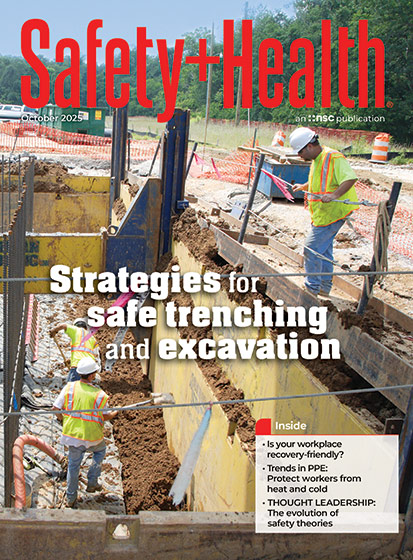
“Effective safety isn’t about one strategic lever, nor is it about picking the ‘right’ theory or model. It’s about understanding the rich toolkit of models available to safety professionals and adapting those approaches to fit the evolving reality of a workplace.”
For millions of workers in the construction, maintenance, mining, forestry, transportation, agriculture and automotive industries, the effects of sustained on-the-job exposure to vibration – whether hand-arm or whole-body – may lead to various health problems.
One out of 12 adults have asthma, according to the American Lung Association, and about 11 million workers are exposed to at least one known asthmagen (a substance that causes asthma symptoms) at work.
It’s been more than 20 years since the launch of the 988 Suicide and Crisis Lifeline. People in need can call or text 988, as well as chat online at 988.gov.
Which type of signs require or are recommended by the Manual on Uniform Traffic Control Devices to use hi-viz reflective materials? What are the specific types of reflective materials?
This white paper explores why the cost of proactive safety – AED ownership, remote monitoring and program management – is far less than the financial, operational and human costs of inaction.
Compliance is essential, but it doesn’t always reflect how well contractors manage real-world safety risks. To make smarter decisions, organizations need insight into safety maturity.
Gloves are often the first thing most people think of when it comes to winter-specific personal protective equipment – and for good reason. Cold hands quickly lose dexterity, slowing down work and raising safety risks.