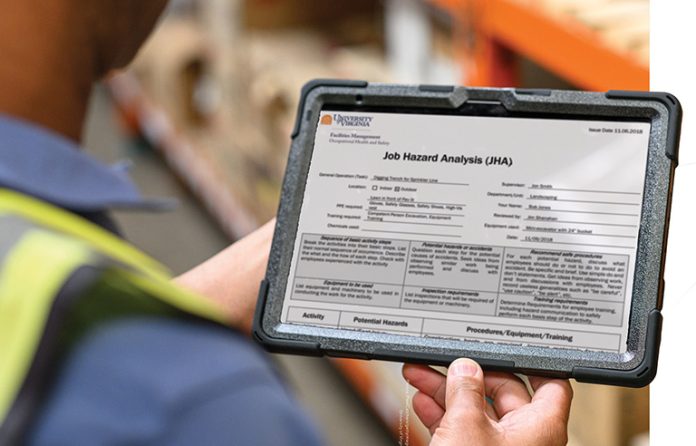
Every work task involves multiple steps. Within many of those steps are hazards – some less obvious than others.
That’s where, for safety professionals, a Job Hazard Analysis comes in.
Also known as a job safety analysis, a workplace hazard analysis or an activity hazard analysis, a JHA is a documented process that “focuses on job tasks as a way to identify hazards before they occur,” OSHA says.
It’s different from a standard operating procedure, adds Michael Kumpf, an instructor at the OSHA Training Institute Education Center at Chabot-Las Positas Community College District in Pleasanton, CA.
Although an SOP also lists the steps of a job, “a Job Hazard Analysis is the process that you use to systematically go through the job to find where the hazards exist,” Kumpf said. From there, you can determine what’s needed to reduce or eliminate them.
Where’s the best place to start?
OSHA calls a JHA “an exercise in detective work” that should answer five questions:
- What can go wrong?
- What are the consequences?
- How could it arise?
- What are other contributing factors?
- How likely is it that the hazard will occur?
To begin, focus on where injuries occur, experts say.
“If you don’t have anywhere to start, go and look at your OSHA 300 log and look at the highest injury rate you have – what category and what task – and start there,” Kumpf said.
Review all the jobs you oversee and focus on the ones that have the highest consequence of fatality or severe injury, he advises. Then, take a deep dive into the steps involved in each task.
“Break them down into a reasonable number of steps. We like to say eight to 10,” said Rebekah Mosci, an occupational safety advisor with Michigan OSHA. “Getting too many steps in there starts to get confusing and messy.”
What’s next?
Safety pros should observe workers as they perform the job and ask questions about each step, Mosci said. Workers may be doing something that’s helping them stay safe and should be made part of the job process – or, conversely, something that’s making the task less safe – without even realizing they’re doing it.
“They’re most familiar with the process,” she added. “Not involving the employees really handicaps your Job Hazard Analysis.”
Patrick Durbin, associate director of risk control at the University of Texas System, said the job environment also needs to be taken into account.
“A good JHA has to acknowledge at least two things: the specific work you’re doing and the environment that it’s in,” Durbin added. “You don’t have to reinvent the wheel with every JHA. You can say, ‘We’re fitting these pipes together.’ But then say, “We’re doing it outside. We’re doing it at height. We’re doing it on uneven ground.’
“Very rarely are you going to have the perfect environment to do the task you’re given. So, you need to be able to adapt.”
What makes a JHA effective?
The result of a JHA should be a clear, concise document. Kumpf said it’s important to make sure that what workers need to know isn’t “buried in nomenclature of words that sound really good if you’re a health and safety professional talking to another health and safety professional.”
Kumpf’s advice to his students: “Think about it from the worker standpoint. If I can’t follow this logically and systematically to help me do my job, I’m not going to look at it. I might read it and sign off that I read it, but I’m not going to go back to it.”
Use plain, clear language. Pictograms and photographs can be helpful, too. Also important: Avoid legalese or regulations-speak.
“It doesn’t matter what our standards or the federal standards say,” Mosci said. “It’s not helpful to the average person to read it that way. Use language that they’re comfortable with.”
Language barriers and cultural barriers can make it harder for some workers to understand a JHA document. That’s why Mosci recommends having them repeat key elements back to you.
“Have them tell you how they understand it and whether or not you need to correct what you’ve written,” she said.
When’s the best time to review?
A JHA should be considered a living document.
“It should change,” said Mosci, pointing out that jobs can change based on new equipment, new chemicals, a new process or procedure, employees who are new to an organization, or workers who have moved into a new role. “With each of those circumstances, there should be a new JHA because you’ve introduced a new hazard.”
During her work in lab settings, Mosci said, JHAs often included changes based on a person’s stature and even hand size, which can affect how a worker opens tubes. Durbin, meanwhile, noted that housekeeping can factor into the need to revise a JHA, as can a worker using a new or unfamiliar vehicle.
“Some little things can really make a difference,” he said.
An effective JHA “allows workers to feel confident to do a more complex job,” Kumpf added. “It’s about their safety and that of those around them.”