

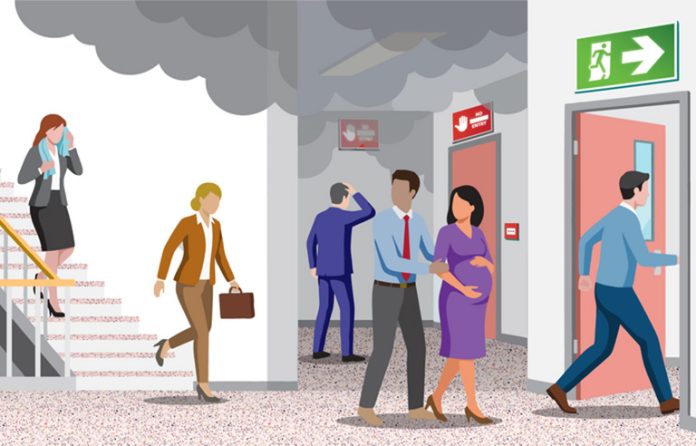
Gaithersburg, MD — A new artificial intelligence model is aimed at identifying – in real time – the safest evacuation routes for occupants in burning buildings.
The model, known as Safe Step, was developed by a team led by researchers from the National Institute of Standards and Technology. It’s intended to be used in “smart” buildings that have electronic displays and sensors that monitor real-time environmental conditions, including temperature and air quality.
“Some of these buildings are testing a new technology called a dynamic emergency exit display, which can indicate that the exit is safe to use or point arrows to a safer route out of the building,” an NIST press release states.
Currently, the AI model is available only for single-story buildings, but the researchers hope to expand into multilevel floor plans. That would involve “multiple agents,” an AI system in which agents throughout the building are connected to each person.
“For instance, during a fire, congestion can build up at the building’s entrance as multiple people try to exit at the same time,” the release states. “This creates a bottleneck, but with an improved algorithm, the model could direct evacuees to different exits while coordinating access points for firefighters to enter the building. This would make it easier for firefighters to extinguish the fire or rescue vulnerable individuals, such as older adults, children and people with disabilities.”
The release notes that previous research has proposed using traditional algorithms. However, they don’t “consider the cumulative hazards that evacuees can face along the route.”
Added Wai Cheong Tam, a mechanical engineer with NIST: “We asked ourselves, ‘Can we build a better algorithm that predicts how the fire evolves, and in a way that helps save more lives?’”
The goal is to start seeing the technology in buildings within the next five to 10 years.
“This research is still in the early research and development stage, but it represents an important step toward intelligent firefighting where effective use of advanced technologies can protect property and save lives,” said Hongqiang “Rory” Fang, a research associate at NIST.