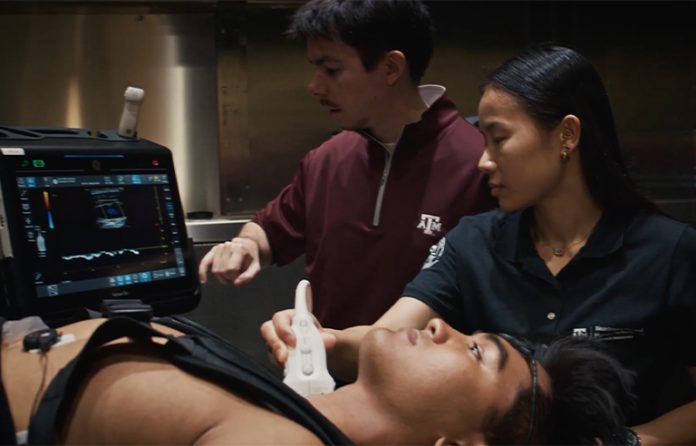
College Station, TX — Texas A&M University researchers are studying how the human body reacts in harsh environments, particularly during extended exploratory and commercial spaceflights.
The team is hoping to learn how the body manages heat and blood flow when gravity is altered, as it would during space travel.
The study has implications not only for astronauts and others who go into space, the researchers say. They noted that first responders and industrial workers, among others, also may endure physical stress while under extreme heat. The implications extend to nurses as well, “particularly in austere or resource‑limited environments where adaptability and precision medicine are critical.”
By better understanding how the cardiovascular and thermal systems respond together, “researchers can inform training strategies and safety guidelines designed to reduce risk and improve resilience,” a university press release states.
To simulate spaceflight and its altered gravity, the researchers are using a lower body negative pressure device, in combination with lower body positive pressure, that’s commonly used in aerospace research.
“The device redistributes blood within the body to reproduce some of the conditions astronauts experience in microgravity, when blood moves toward the upper body, as well as during reentry, when gravity rapidly returns and the cardiovascular system is challenged,” the release states.
“This allows us to study how the cardiovascular system responds to a blood volume shift in a very precise and controlled way,” said Adrien Robin from the university’s College of Nursing and one of the study’s lead researchers.