
Do you notice workers not paying attention when you’re giving a safety presentation?
If your presentation and materials are stale, old-fashioned and/or uninspiring, your message isn’t likely to stick.
“A lot of times, they’re hearing the same thing over and over again,” said Ricky Rollins, a longtime steel industry supervisor who is now a motivational speaker in the safety field. “If you’re looking at pie charts and graphs, honestly, you walk out of that room and got nothing.”
Safety professionals who want to develop more effective presentations – and a more engaged workforce – often face many challenges, though. And “there’s a bazillion of them,” said Regina McMichael, president of The Learning Factory Inc., who presents nationally on a variety of safety topics.
McMichael
“Certainly the most obvious answer is time and resources,” the author of the book “The Safety Training Ninja” added. “Many safety professionals, regardless of how dedicated they are to the topic or the concept of great safety training, are pulled in so many directions.”
That often means little time or budget to invest in unique training opportunities. “So, they’re kind of forced to make do with what they have,” McMichael said.
For safety pros who want to enhance their training presentations, here are five tips experts say will help.
Know your audience
When JoAnn Dankert starts to develop a safety training presentation, “My first thing to consider is: Who’s the audience?” said Dankert, a senior safety consultant at the National Safety Council. “You’ve got to do a good job understanding who that audience is to be able to give them two or three good takeaways.”
Part of McMichael’s strategy is to arrive a day before a presentation to learn as much as she can about the training attendees. “Even though it’s more work up front, that will pay you back ultimately,” she said.
McMichael often leans on the first step of the instructional training design model ADDIE – analyze, design, development, implementation and evaluation.
“Analyze their knowledge,” McMichael said of the audience. “Is English not their first language? Is there a literacy issue? Are there cognitive issues? Are there production issues? Don’t schedule training right before the end of the month when everybody has to make quota. All of that has to be considered during your analysis phase.”
“Look to the person who likes safety training the least and the one who likes it most, and seek them out.”
Regina McMichael
The Learning Factory Inc
Be active
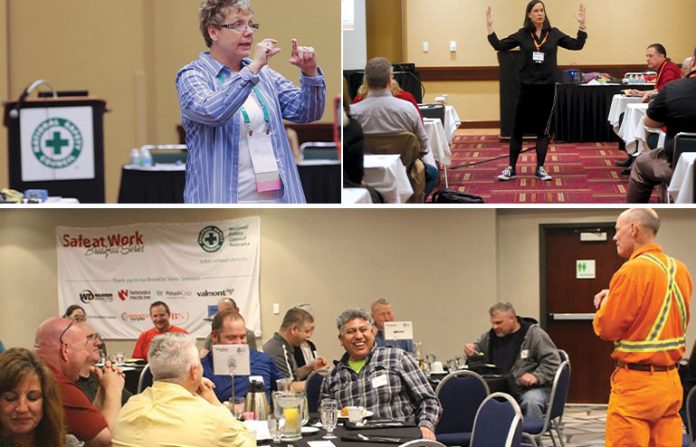
When Rollins presents, he’s not one to stay glued to the podium. “I’m a people person,” he said. “I’m going to get out into the audience, make some connections, slap some guys on the back and get them to laugh.”
Moving around the room and stage also is something McMichael relies on to help her gauge her audience’s attention.
“Casually move from one side of the room to other,” she said. “Do people’s heads go with you? Do their bodies turn as you move around the room? I’ll literally be behind people and watch the entire room shift in their chairs. I think, ‘Cool, gotcha!’”
Dankert is a proponent of including activities to get attendees more involved.
McMichael
“I’ve been in industry, and I’ve taught a lot about the Hazard Communication Standard,” she said. “Still, when my employees were audited and were asked questions, they gave the deer-in-the-headlights look. What happened was that I gave them a lot of information, but I didn’t put in an activity to increase their skills. For retention, that’s pretty important.”
One activity Dankert favors is putting a commonly used chemical in front of trainees, separating them into pairs and providing them with the chemical’s Safety Data Sheet. She then instructs them to identify the symptoms of overexposure and requisite first aid procedures.
“Give them two or three critical things they need to know,” Dankert said. “They can learn from each other and learn as we debrief from the group as a whole.”
Tell a story
Stories can be powerful, as Rollins can attest. He shares many of them during his presentations.
“Stories can touch people,” he said.
Rollins spent 25 years working in the steel industry. He still gets emotional when discussing his experiences, including a 2005 incident in which a co-worker was run over by a forklift, which led to five surgeries and six months of rehabilitation for the injured worker.
Another one of Rollins’ colleagues, Preston Taylor, who was a friend of the injured man, went home that September day and shared the news with his family.
Taylor’s then-17-year-old daughter, Rachel, wondered aloud why workers in the steel industry wore green every day. “Why don’t you wear orange like hunters do?” she asked her father. Word got back to Rollins about what Rachel said, and a change was made to orange work gear to enhance worker visibility and safety.
The impact of the teen’s words still humbles Rollins.
“I had a 17-year-old girl who never stepped foot in a steel mill tell me how to take care of her daddy better than I knew how,” he said. “I had to put ego and pride and stubbornness aside because Rachel Taylor was right.”
The impact of one relevant story to an audience is something Rollins believes can help safety pros make presentations more memorable.
“I know that would be more effective than you just telling them, ‘OSHA says …,’” he said.
Think about the message you’re sending
One recent trend McMichael has noticed – on social media and at some training events – is the sharing of videos featuring workers being seriously injured on the job.
“It’s not good for the profession,” she said. “Presenters are looking for something awesome and impactful, and they think that’s it.”
Social media posts of these videos often are accompanied by comments such as, “Look at that idiot!” or “What were they thinking?” she said.
McMichael believes the reactions to those videos set a bad precedent.
“As a profession, we shouldn’t do it because we’re telling our people, ‘If you have an accident, we’re going to make fun of you on a video,’” she said. “We’re kind of discouraging reporting. We’re setting a standard that safety is no longer a moral imperative, it’s a source of fun.”
Try and try again
Testing out new approaches to safety training used to rev up Dankert’s nerves.
“It is scary at first,” she said. “When I was working in a plant, I had an affinity for my third-shift maintenance group. Whenever I did something new, I tried it out on them.”
The group provided thoughtful critiques on many occasions.
“If I bombed, they weren’t going to make fun of me,” she said. “They were a safe haven. They would give me the feedback I needed to make it better.”
Presentations also can be practiced in front of a trusted colleague or family member. The goal is to get beneficial feedback for improvement.
“Look to the person who likes safety training the least and the one who likes it most and seek them out,” McMichael said. “Bring them in on the decision-making.”
Even if the feedback is personal – you’re speaking too fast or not making the content relevant to the audience, for example – it will improve future presentations, the experts say.
“It can be very challenging to receive feedback, but those are things you need to know,” McMichael said.