
In recent years, OSHA’s standard on hazard communication (1910.1200) has been the agency’s most frequently cited standard in general industry. A significant area where employers often fall short is training.
Under the standard, employers must provide training to workers who will encounter hazardous chemicals under normal operating conditions or in foreseeable emergencies. That training should occur at the time of an initial assignment or when a new chemical hazard is introduced into the workplace – not necessarily a new chemical or new formulation.
For example, if an establishment has worked only with chemicals that are irritants but brings in one that’s flammable, that’s a new hazard.
Although OSHA doesn’t require training for workers who encounter hazardous chemicals in non-routine, isolated instances, employers tend to provide hazcom training to a broad array of employees to cover their bases, according to Shannon Gainey, technical and regulatory director for consulting firm REACH24H USA.
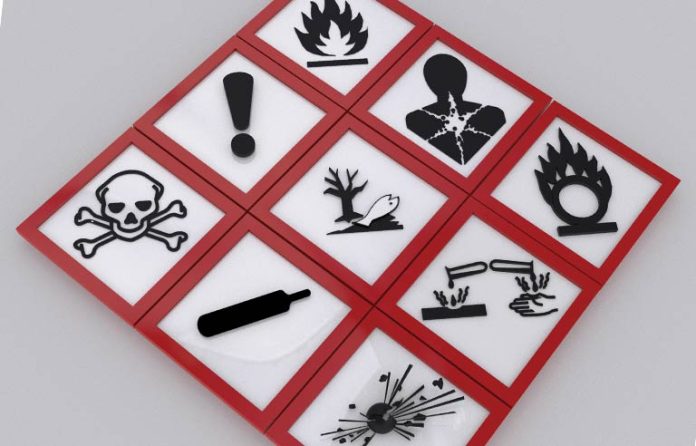
Another requirement is that training must align with the tasks the worker is performing. That includes information about the hazards of the chemicals with which they’re working, methods to detect the presence or re-lease of those hazardous chemicals, where to find and how to read Safety Data Sheets, what the emergency procedures are, where to find and how to use personal protective equipment, and how to get information from items such as labels and pictograms.
The varied aspects of the Hazard Communication standard, understanding/measuring potential chemical exposures and providing the proper relative training are among the reasons why, experts say, employers likely need help – internally or externally – to navigate their way.
“That’s a big failure of a lot of programs,” Product Safety Solutions President Daniel Levine said. “They don’t have access to someone who can make sure their employees are safe.”
Write it down
Another common issue employers have with the Hazard Communication standard? Not following the program.
For example, if a hazcom program document states that training will be conducted in-person but the organization switches to virtual training without updating its document, that’s a violation.
“Your written hazcom program needs to reflect what you’re actually doing,” said Chandra Gioiello, vice president of consulting firm IHSC.
The good news, Gioiello added, is employers can make their written program as general as possible, “to give themselves enough leeway.” However, they must make sure the document includes “what their training is going to consist of – basically an overview.”
Gainey noted that employers can help themselves by not writing down specific names of trainers in the document, in case those trainers leave the organization. “My recommendation is to keep it simple, even for names,” she said. “Otherwise, you’re always reviewing and updating documents.”
Additionally, it’s important to document which employees have received training. This can bolster evidence of compliance with the standard.
Review and audit
Another helpful step is to review your hazcom program on a regular basis (e.g., once or twice a year) to make sure it’s up to date.
Associate Editor Alan Ferguson discusses this article in the June 2021 episode of Safety+Health‘s “On the Safe Side” podcast, and Chandra Gioiello, a source for this piece, gave a longer interview on hazcom on the July 2022 episode.
Third-party audits every couple of years or so, Gainey says, are a good way to see if gaps exist in an organization’s hazcom training or its overall program. She pointed out that voluntary International Organization for Standardization standards recommend conducting audits and reviewing all safety-related documents.
Likewise, Gioiello said near misses can expose gaps in training, while listening to feedback from employees can prove helpful as well. For instance, they might let you know that a certain chemical is difficult to work with or they don’t understand how to handle it safely.
“Make sure they can give feedback without any repercussions,” Gioiello said.
It’s also a good idea to review your training to ensure it’s delivered in a language that all workers understand.
Hazcom training should include an opportunity for employees to ask questions to make sure they understand the information they’re given, OSHA notes on a webpage of frequently asked questions.
Reinforcement and practice
How many of us have sat in a classroom and forgotten what was said within days or even hours?
This is why it’s important to reinforce hazcom training from time to time.
“If it’s rarely used, it’s not really remembered,” Levine said.
Reinforcing training or gauging its effectiveness can be as simple as asking employees during informal conversations if they know what chemicals they’re working with, if they know where to find appropriate PPE and other basic questions.
JoAnn Dankert, senior safety consultant at the National Safety Council, said one useful practice is setting up audits or hands-on training. You can have an employee retrieve the SDS for a chemical they use and find pertinent information from it, such as health hazards and PPE.
A supervisor or safety professional also can test whether employees know what to look for on a label and how to get information from it, she said.
Another way to reinforce training, Gioiello noted, is placing – in break rooms or other common areas – posters on subjects such as pictograms or a summary of chemical hazards. Additionally, “lunch and learns” or online options can be part of a multipronged approach.
Most of all, look at what works best for your employees.
“Hazcom training is not one size fits all,” she said.
Try an interactive version of Safety+Health‘s pictogram quiz
And share the link with employees.
Click a GHS symbol and click its hazard description. When they match and dissolve, click the next matching symbol and description.
Keep everyone in the loop
To improve the effectiveness of training, employers have to know what chemicals are coming into their facility and the hazards they pose. That’s why it’s important to maintain lines of communication between departments such as purchasing and/or research and development and EHS personnel, Gioiello said.
“The EHS department doesn’t know there’s a new chemical coming in and they haven’t evaluated it into their training methodology,” she said. “That conversation is huge.”
Another issue in terms of information sharing, Dankert said, is within multiemployer worksites.
In such cases, it’s a shared responsibility, according to OSHA. For example, if a temp agency sends workers to a facility, OSHA says the temp agency is “expected to provide generic hazard training and information,” such as categories of chemicals that an employee might encounter. That training must be completed before the temporary employee begins work on a project, OSHA says in a Temporary Worker Initiative bulletin on hazcom.
“The staffing agency also has a duty to inquire and verify the host employer has adequately fulfilled its shared training responsibilities for assigned employees,” the bulletin states. “To ensure the host employer provides appropriate and sufficient information and training regarding hazardous chemicals, the staffing agency should be-come familiar with the hazards at the host employer’s worksite.”
To accomplish that, OSHA says, staffing agencies can review a host employer’s hazcom program and training, or perform a walkthrough of the worksite. They also should maintain communication with employees and the host employer, who is responsible for “site-specific” hazard training.
Be ready for changes
On Feb. 16, OSHA published a proposed rule that would update its Hazard Communication regulations to align with the seventh version of the United Nations’ Globally Harmonized System of Classification and Labeling of Chemicals, also known as GHS. The proposed rule features no changes to 1910.1200(h) from the current training regulations, which align with the third version of GHS. However, new subjects may need to be added to training.
Among the proposed changes are updates to health hazards (Appendix A) and expansion of certain physical hazard categories (Appendix B), such as aerosols and flammable gases. Others include a new chapter in Appendix B on desensitized explosives, along with changes to labeling and two sections of SDSs.
OSHA contends that the goal, as with other updates, is to increase worker protections and reduce the incidence of chemical-related occupational illnesses and injuries.
“Companies training people on the chemicals they’re working with and making sure they can handle them safely means that we have safer workers, safer families and safer communities,” Gioiello said. “Everyone is just better off.”

