

Employers bringing workers back to physical locations – or thinking about it – amid the COVID-19 pandemic have plenty of decisions to make. From mask and vaccine requirements to implementing safety measures such as testing, physical distancing, and frequent cleaning and sanitizing (to name a few), protecting employees from exposure requires creating a comprehensive plan, and then executing that plan and adjusting when necessary.
So, where should you begin?
“Start by looking internally at your own workforce,” advises Stephanie Roberts, program manager for SAFER: Safe Actions for Employee Returns – a National Safety Council initiative aimed at developing industry- and risk-specific resources and recommendations for employers. “How at risk are your workers? Looking at some of those things can really help decisions on how to safely expand operations.”
Here are 10 key focus areas to help guide a safer in-person return to offices and workplaces.
Know your workforce
First, employers should identify where exposure could occur.
“Look at if it’s a people-facing environment,” Roberts said. “Are they working closely together at a plant or con-struction site? Are they in an office?”
The most common safety measures recommended by the Centers for Disease Control and Prevention are masking, physical distancing, and enhanced cleaning and disinfecting of workplaces.
SAFER and CDC guidance also includes increasing ventilation and air filtration; providing necessary personal protective equipment based on a worker’s risk exposure; reducing touch points by having lights that operate on sensors; and installing hands-free, arm-pull or foot-operated door openers wherever possible.
Roberts adds: Company leaders should know whether their workers are vaccinated. They also should decide 1) if they’re going to require proof of vaccination and 2) whether they plan to encourage, incentivize or mandate vaccinations.
Examine your workspace
Start by assessing the space in your facility before workers return. How can you make sure they’re safely distanced?
For workstations and common areas, restrict the number of people by setting capacity limits. Another strategy: Rearrange seats and furniture in gathering places such as cafeterias, meeting rooms and locker rooms in a way that allows for physical distancing. The flow of foot traffic can be adjusted by designating stairwells for going up or down, and separate doors as entrances and exits.
To avoid exceeding maximum capacity, use a hybrid schedule in which employees rotate days they come into the facility or work remotely, if feasible.
In addition, a formal assessment of the workplace can determine what rooms or gathering areas can be closed off, according to SAFER.
Another consideration to keep in mind is the length of time the facility was shut down. For those that were un-occupied for prolonged periods, CDC encourages checking for mold growth and rodents/pests that have found their way in, increasing circulation of outdoor air, and testing water systems to minimize the risk of Legionnaires’ disease and other diseases associated with water.
Enhance communication
Communication will be imperative once workers – who have been meeting virtually throughout the pandemic – return to the physical workplace. This might mean encouraging safely distanced visits to a colleague’s work-station or a manager’s office.
For in-person group meetings, allow workers to express their concerns and ask questions without fear of retaliation.
“Maybe set aside the last five to 10 minutes of a meeting where you’re giving updates,” Roberts said. “In the COVID-19 landscape, everything is constantly changing.”
Create a welcome wagon
Bringing employees back to the workplace calls for a welcoming committee, of sorts.
“Even if workers have already seen it, they might not have been there for a year and a half,” Roberts said.
That calls for explaining what policy changes have been made regarding meeting spaces, work locations and building foot traffic flow.
“Almost like a tour if they’re a new employee, whether they are or not,” Roberts said. “Set aside time and be really intentional to get them reacclimated.”
Stay on top of what’s working
In a survey of nearly 300 organizations, along with two worker surveys with nearly 3,800 respondents, SAFER asked employers and employees what safety measures implemented in their workplace were most effective.
Facemask requirements and newly installed hand sanitizer dispensers were considered the top two control measures by both groups.
The least effective measures, according to the employees, were salary increases for frontline/at-risk workers, increased time between shift changes and at-home COVID-19 testing.
The employers ranked temperature screenings at the facility’s entrance, signage to educate workers on COVID-19 prevention and hygiene, and salary increases as the least effective.
New report highlights lessons learned
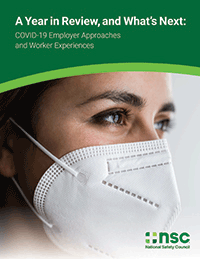
The National Safety Council’s SAFER: Safe Actions for
Employee Returns initiative – a comprehensive effort
aimed at helping employers prioritize workplace safety
amid the COVID-19 pandemic – issued its latest report on
Sept. 29. “A Year in Review, and What’s Next: COVID-19
Employer Approaches and Worker Experiences” includes
data based on surveys and interviews conducted between
June and August of 300 U.S.-based employers and nearly
3,800 individuals.
Page 2 of 2
Plan for ‘What if?’
Any reopening plan should include a worst-case scenario, according to Roberts.
“Let’s say you’re a small business with 40 employees,” she said. “If 30 of them test positive for COVID, what are you going to do as far as operations? Having some of those plans in place, if that were to happen, will help ensure your business can still function.”
Considerations include a testing plan – along with who pays for it – and determining the need for testing close contacts and contact tracing. Employers also should plan for time off to allow infected workers to recover.
Monitor mental health
For workers, this means knowing when they need a break and asking for time off.
“Everyone is having a hard time with COVID-19,” Roberts said. “You need that level of comfort where you can say, ‘I need a mental health day.’ If we’re not taking care of ourselves, we’re not going to be able to effectively work.”
As an employer, you can play a significant role in promoting mental health by allowing – and encouraging – workers to openly voice concerns and seek out mental health services.
Review safety basics
If workers have been remote for an extended period, a safety refresher may be in order.
That means, according to Roberts, covering topics such as tornado and fire drills, parking lot safety, and safety for workers who must travel.
“It’s important to review some of those policies and guidelines that you’ve had in place but haven’t had to deal with because so many people have been working from home or in a different environment,” she said.
Take a stand on vaccine requirements
As the delta variant drove up cases, hospitalizations and deaths across the country over the summer, vaccine and testing requirements became an even more critical decision for employers and a key concern for employees returning to the workplace.
On Sept. 9, President Joe Biden announced that OSHA will develop an emergency rule that will require employers with at least 100 workers to “ensure their workforces are fully vaccinated or show a negative test at least once a week.”
In a statement issued two weeks before that announcement, NSC called on all employers to implement a COVID-19 vaccination requirement for workers.
“It’s clear COVID-19 has and will continue, perhaps indefinitely, to affect the way we live and work,” NSC President and CEO Lorraine M. Martin said in the statement. “Employers must put worker health and safety first. That begins with prioritizing vaccination.”
But what does that process entail?
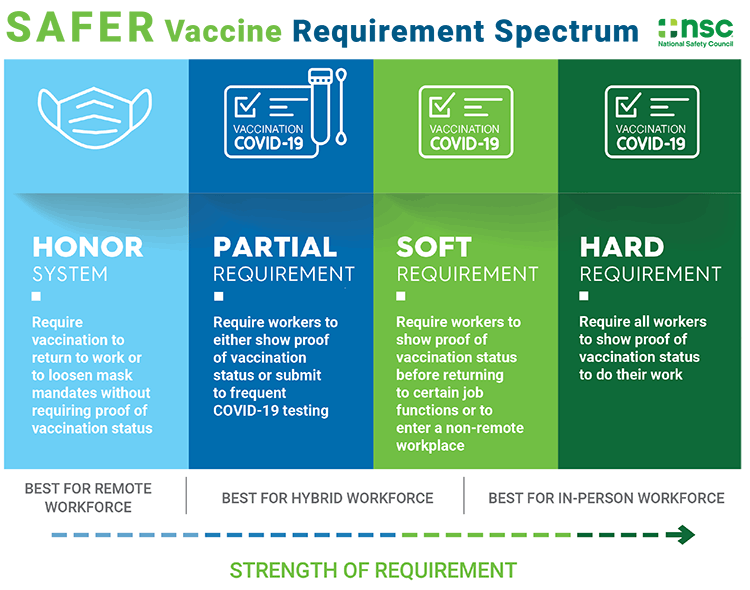
For employers who decide to require vaccination, a requirement spectrum infographic published by SAFER (see below) outlines four different levels:
Honor system: Vaccination is required to return to work or to loosen mask mandates without requiring proof of vaccination status. (Best for remote workforces.)
Partial requirement: Workers must show proof of vaccination status or submit to frequent COVID-19 testing. (Recommended for a hybrid work arrangement.)
Soft requirement: Workers must show proof of vaccination status before returning to certain job functions or enter a non-remote workplace. (Designed for either hybrid or in-person work.)
Hard requirement: All workers must show proof of vaccination status to do their work. (Best for an in-person workforce.)
In its vaccine requirement guide, SAFER spells out considerations surrounding vaccine requirements, such as the costs of not having vaccinated workers and the feasibility of workers receiving a shot(s).
Dig into the resources
Numerous online resources can serve as a guide for various work settings. OSHA, for example, features updated information about protecting workers on its website, while CDC’s COVID-19 resources include a “Workplaces and Businesses” webpage.
SAFER resources include six tip sheets on topics including masking policies, hybrid workforces and safety concerns as operations expand.
NSC and the Health Action Alliance have partnered to create an online decision tool for business leaders. The tool presents employers with eight questions to consider and explains key aspects of each answer.
“All of these are different things you have to think of,” Roberts said. “The tool is a big decision tree.”

