In December 2004, Rich McElhaney and his co-workers were learning how to use a water lance – a piece of equipment that uses 20,000 pounds per square inch of pressure to cut through concrete and steel. They were in such a hurry to get through the training that day that they didn’t perform their usual Job Safety Analysis. If they had, they likely would have learned that the person operating the water lance was planning to use it on full power. And that the equipment was set up for a right-handed operator instead of the left-handed worker who was at the controls.
McElhaney was about 12 feet away when the operator lost control of the tool. Water from the lance cut through his legs, hitting both femoral arteries.
“I almost bled out,” he said.
After three years of infections, multiple surgeries and learning how to walk again, McElhaney plays the 911 recording from that day during his presentations as a keynote speaker. He’ll reveal, to the audience’s surprise, that the voices on the call are talking about him. Then, he’ll show his scars.
“They can’t believe I’m still alive,” said McElhaney, a safety consultant based in Pittsburgh. “That’s why I’m a proponent of JSAs.”
What’s in a name?
Whether you call it a job safety analysis, a Job Hazard Analysis or an activity hazard analysis, experts say the process is the same.
“A more accurate term would be ‘task hazard analysis,’” said JoAnn Dankert, senior safety consultant, workplace training, at the National Safety Council. “We analyze tasks an employee performs – not jobs.”
Key benefits to a safety program include the identification, elimination or mitigation of workplace hazards. Another, Dankert said, is employee engagement.
For example, an employer can ask employees to share their expertise and experience on the “right way” to perform a task while leading a JSA or contributing to its creation. Employers and safety pros also can involve workers in recognizing and identifying potential hazards and then discussing meaningful ways to control or mitigate them.
“With employees engaged in the process, they have a better understanding of why the organization is requiring them to wear certain PPE, use other controls, or use tools or equipment in a certain way,” Dankert said.
JSAs can aid with training, performance standards, incident investigations and as a way to remind employees to remain safety conscious.
One of the best benefits, says McElhaney, is “it’s a time-saver.”
That counters one of the main criticisms of JSAs: They can be time-consuming.
McElhaney contends, however, that time is saved because workers, their departments and the employer are more organized.
“When all the workers read it or go through a JSA, they know exactly what’s going to happen, what PPE is required and exactly which tools they need to get,” he said.
Starting the process
JSAs aren’t explicitly required by OSHA. However, the agency’s PPE regulations for general industry – 1910.132(d) – state that an employer shall “assess the workplace to determine if hazards are present, or are likely to be present, which necessitate the use of personal protective equipment.”
Many employers use JSAs to show they’re complying with that requirement, Dankert said.
One of the first steps in developing a JSA is to review the history of incidents, injuries, illnesses or near misses to determine which jobs pose the highest risk.
In its JSA guidance document, OSHA says priority should go to tasks:
 That have the potential to cause severe or disabling injuries or illnesses, even if no history of previous incidents exists.
In which one simple human error could lead to a severe injury or incident.
That are new to your operation or have undergone changes in procedures and/or processes.
That are complex enough to require written instructions.
OSHA standards that apply to a task should be identified and included in a JSA.
According to the Maine Department of Labor, employee involvement can include a discussion on why a JSA is being conducted and an overview of what’s going to happen. This helps show that the employer is examining the task, not employee performance.
“That’s a big thing with JSAs,” McElhaney said. “They have to be two-way conversations.”
Page 2 of 3
Steps of a JSA
According to NSC and MDOL, conducting a JSA involves essentially three main steps:
- Observe step by step how a worker does the task.
- Look for possible hazards in each step of the task.
- Review the list of hazards with employees who perform the task. These workers can help formulate suggestions for eliminating or reducing the hazards in each step.
Those three steps can serve as the basis for a chart with the columns in order from left to right:
- The tasks or the steps of a task
- The potential hazards
- Recommendations
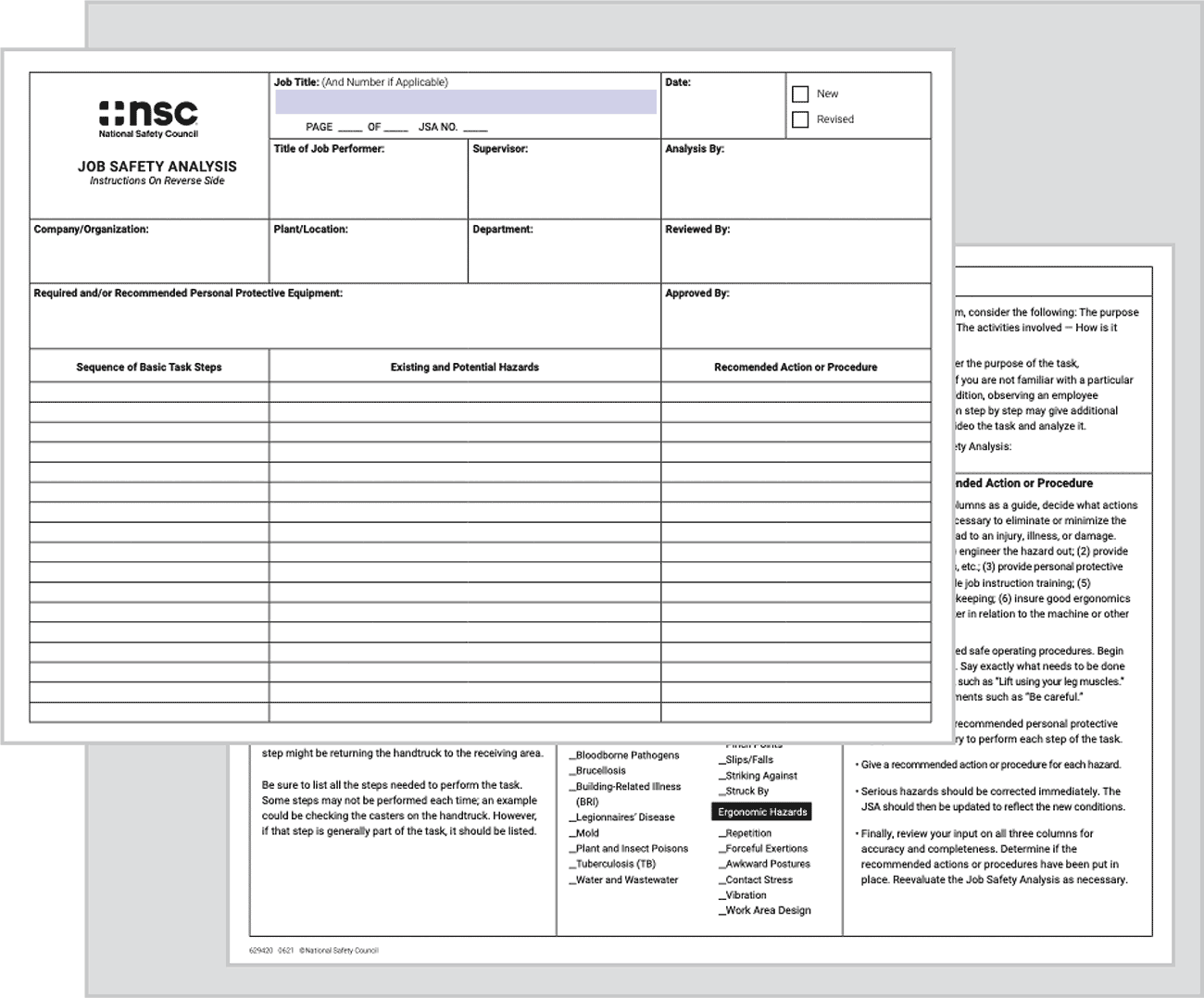
NSC recommends numbering each step and listing the steps in the order they’re performed. Use action words such as “load,” “steer” or “unload.”
Try to briefly describe the steps (e.g., “Lift the load and back out”) and avoid being too detailed (e.g., “Lift the load with the fork slightly raised and back out slowly”). “By being brief, we can keep it to the point and (have) a one-page document that’s easily referenced – and therefore used,” Dankert said.
MDOL suggests using videotape or photography when putting together the list.
Finally, employers should review the steps with workers to make sure the list is complete.
Questions about hazards
When attempting to identify hazards, MDOL says the questions to think about are:
What can go wrong?
What are the consequences?
How could it happen?
What are other contributing factors?
How likely is it that the hazard will occur?
According to NSC, other questions to ask when seeking to identify hazards are:
- Is there danger of striking or being struck by an object?
- Is there a danger of being caught in, by or between objects?
- Is there a danger of slipping, tripping or falling?
- Can pushing, pulling, lifting, bending or twisting cause strain?
- Is there a danger of harm to eyes, hands, feet or other parts of a worker?
Page 3 of 3
When to review or revise
McElhaney said the frequency of JSAs may depend on the work that’s being performed. He went on to say that a JSA should be conducted if conditions change and new hazards are introduced to the work environment.
“If your crew discovers a new hazard, you should stop and add the hazard and reevaluate the job task,” McElhaney said, adding that employees should be empowered with stop-work authority.
Additionally, reviewing a JSA should occur when a task or process changes. Dankert said a periodic review is helpful to make sure the JSA is up to date and accurate.
Creating a periodic review process is an effective method to set safety metrics for frontline leaders, such as supervisors or foremen, “on proactive safety activity they can control,” she said.
MDOL advises employers to consider a review if injuries or near misses occur while workers are performing a certain task.
Disseminating information

As a way of distributing information, Dankert said, some employers laminate their JSA forms and attach them to equipment “so they are right there for the employees to reference.”
Another best practice is to use JSAs in as many ways as possible, she added, and offered examples: as part of new-hire orientation/training, periodic safety talks or reviews during safety meetings.
“If the organization plans right, they can find three to four ways to use them on a regular basis,” she said. “It’s not a one-and-done type of activity.”