

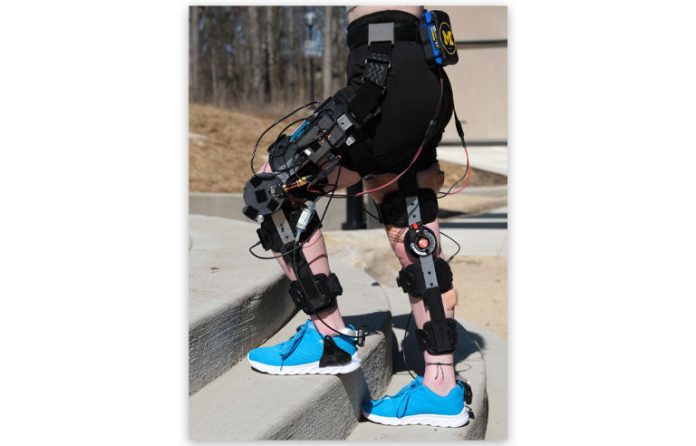
Ann Arbor, MI — University of Michigan researchers have developed and tested a set of knee exoskeletons that they say help counteract fatigue during lifting and carrying tasks.
The researchers used commercially available knee braces and drone motors to craft the exoskeletons, which support the quadricep muscles when users lift and carry objects.
For their study, the researchers asked 10 participants to complete tasks while lifting and carrying a 20-pound kettlebell and wearing the exoskeletons over two days. Among the tasks were carrying the kettlebell up and down stairs and up and down an incline.
“After becoming fatigued, the participants kept better posture with the help of the exoskeleton,” a U-M press release states, “and they also lifted faster – just 1% slower than their pre-fatigued paces, versus 44% slower without the aid of the exoskeletons.”
Lead study author Nikhil Divekar said that’s important, for example, for a worker whose tasks are at a conveyor belt.
“Usually, when a worker is fatigued, they’ll keep up with that rate, but with a compromised posture,” said Divekar, a postdoctoral research fellow in robotics. “They’ll bend their back more, and that’s when injuries are most likely.”
The study was published in the journal Science Robotics.

