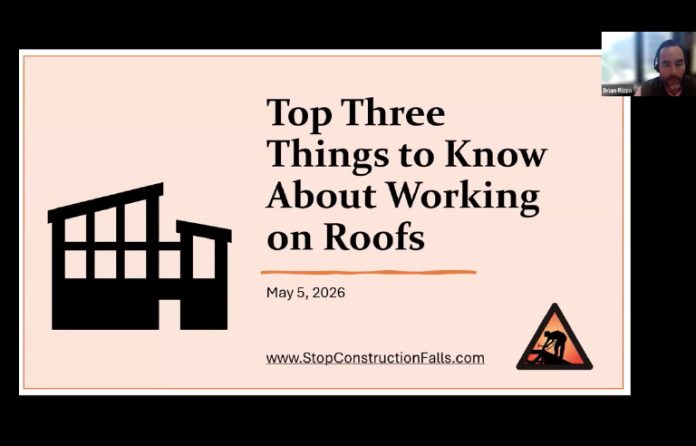
Washington — With falls remaining a persistent risk among roofing workers, a recent webinar hosted by CPWR – The Center for Construction Research and Training highlighted strategies for improving safety.
During the May 8 event, instructor Matt Wittenborn and Trust Fund Field Director Joel Gonzalez of the Roofers and Waterproofers Research and Education Joint Trust Fund emphasized the importance of identifying hazards, selecting appropriate fall protection systems and continuous personal development.
Roofing workers experienced a fatal occupational injury rate of 48.7 per 100,000 full-time equivalent workers in 2024 – more than 14 times the overall rate of 3.3, data from the Bureau of Labor Statistics shows.
“So, for us,” Wittenborn said, “this means that having the ability to identify and prevent these falls is imperative to the safety of the worker.”
While discussing various free resources and guidance available through the National Campaign to Prevent Falls in Construction, the pair emphasized the importance of continual training and education.
Fall prevention awareness comes with practice and is a necessity in roofing, in which many factors must be considered. Wittenborn offered the example of a crew protecting a roof edge with guardrails or scaffolding without considering the momentum a worker might generate if they fall from the roof peak to the gutter.
“Employers and employees have many options for fall protection, but the equipment alone doesn’t change anything,” Wittenborn said. “This is why we need to do better. Training is important, but for the worker, putting that training to use in the real world day after day is what’s going to keep them safe. Repetition is the key to success.”
Roofing contractors received the most citations under five of OSHA’s Top 10 most frequently cited standards in fiscal year 2025:
- Fall Protection – General Requirements (1926.501)
- Hazard Communication (1910.1200)
- Ladders (1926.1053)
- Fall Protection – Training Requirements (1926.503)
- Personal Protective and Lifesaving Equipment – Eye and Face Protection (1926.102)
Gonzalez called for ensuring buy-in from management and supervisors by not only training workers on fall hazards and protection systems but implementing safe practices themselves.
“When we dress the part, when we speak the part, when we do it with them, then they’re going to see that this is more than just a formality,” Gonzalez said. “It’s an actual core value that they’re going to believe. So, we have to all practice it, and that will get our workforce to follow.”