

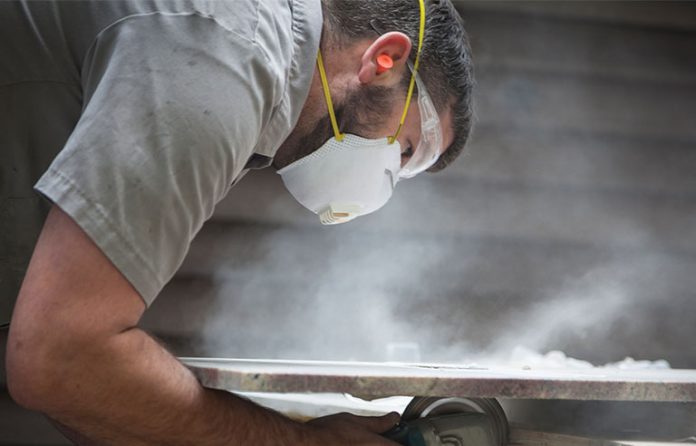
In July, the Mine Safety and Health Administration published a proposed rule that would lower the permissible exposure limit for respirable crystalline silica. The potential standard is aimed at ensuring miners “have at least the same level of protections as workers in other industries.”
Exposure to respirable crystalline silica, however, is present in many other industries and work tasks. So, what is respirable crystalline silica, and why is it so dangerous? We spoke with experts from NIOSH, and others, to learn more about it and how to prevent on-the-job exposure: David Weissman, director of the Respiratory Health Division Barbara Alexander, engineer in the Division of Field Studies and Engineering Researchers from the NIOSH Mining Program (Spokane Mining Research Division and Pittsburgh Mining Research Division).
Silica facts
Silica is another name for the chemical compound silicon dioxide (SiO2). It’s a mineral commonly found in the environment and exists in two main forms: crystalline and amorphous (non-crystalline silica). The most common type of crystalline silica is quartz, contained in stone, sand, concrete and mortar.
Respirable crystalline silica is 100 times smaller than a grain of sand, allowing it to get into the lungs when inhaled.
The small particles can get trapped in lung tissue, causing inflammation and scarring while inhibiting the lungs’ ability to take in oxygen, said Natalie Fox, CSP, a certified industrial hygienist.
That can lead to medical conditions such as black lung disease, chronic obstructive pulmonary disease and silicosis, defined by NIOSH as “an irreversible but preventable lung disease.” Breathing in crystalline silica also can lead to kidney failure and autoimmune diseases such as rheumatoid arthritis and progressive systemic sclerosis, the NIOSH experts added.
“Additionally, silicosis affects the immune system, which can increase the risk of lung infections such as tuberculosis,” Fox said.
Associate Editor Alan Ferguson discusses this article on the October 2023 episode of Safety+Health‘s “On the Safe Side” podcast.
Who’s at risk?
At-risk activities include cutting and crushing stone; abrasive sandblasting, tunneling, sanding or drilling into concrete walls; sawing brick or concrete; and manufacturing bricks, concrete blocks, ceramic products and stone countertops. Workers in hydraulic fracking and foundries also can be exposed.
Overall, around 2.3 million U.S. workers are at risk for exposure, according to OSHA. The agency revived its National Emphasis Program on respirable crystalline silica in 2020 in an effort to safeguard workers in the cut stone and stone products manufacturing industry.
It also launched a new Regional Emphasis Program last year – covering workers in Colorado, Montana, North and South Dakota, Utah, and Wyoming who handle engineered stone used to make household countertops. The move came after the release of a 2019 report in which Centers for Disease Control and Prevention researchers warned of “an emerging public health threat” after they identified an increase in cases of silicosis among workers handling engineered stone.
Exposure limits
OSHA’s standards on respirable crystalline silica (one for construction and another for general industry and maritime) have permissible exposure limits of 50 micrograms per cubic meter of air over an 8-hour time-weighted average. The standard’s “action level” is 25 micrograms per cubic meter of air.
If an employer has “objective data” showing that worker exposure will remain below the action level “under any foreseeable condition,” OSHA standards don’t apply.
MSHA is seeking to lower its PEL to match OSHA’s. MSHA’s current PEL is 100 micrograms per cubic meter averaged over an 8-hour period.
MSHA’s proposed rule has been spurred, in large part, by an increase in black lung disease, or coal workers’ pneumoconiosis. A 2018 study from the University of Illinois at Chicago found that nearly 4,700 coal miners have developed black lung disease since 1970, and almost half of the cases have emerged since 2000.
A subsequent UIC study, published last year, deemed silica exposure “a driving force behind the rising rates” of black lung disease.
“Underground coal miners are extracting thinner coal seams than in the past,” the NIOSH team explains. “To do this, they must cut through rock surrounding the thin coal seams to extract the coal. This generates airborne dust containing respirable quartz, a type of RCS.”
Ways to measure exposure
Breathing zone sampling and industrial hygiene assessments are two ways employers can measure potential respirable crystalline silica exposure.
“The recently promulgated OSHA respirable crystalline silica rule for general industry requires air sampling to assess respirable crystalline silica levels if high levels of exposure are anticipated, and preventive measures must be taken if measurements exceed specified concentrations in air,” the NIOSH experts said.
They also noted that the availability of onsite testing at the end of a shift “could significantly improve on current noncompliance monitoring approaches, which require the use of external analytical laboratories with a significant lag time of days to weeks between the collection of a sample and the resulting data.”
Fox suggested that an industrial hygienist, while taking samples, should observe tasks to see which may potentially cause higher exposure to respirable crystalline silica “so the proper control methods can be developed and implemented.”
Limiting exposure
“The best controls for RCS exposure depend on the work activity and the product or production method, and a combination of several methods may be necessary to control some exposures,” Fox said.
Take engineered stoned countertops, for example. Fox pointed out that studies have shown a combination of water sprays and local exhaust ventilation are best “because water sprays were not always directed in the proper location.”
Also, water use may not be feasible for certain products, or it may cause additional hazards near electrical equipment or via slips, trips and falls.
In OSHA’s standard on silica in construction, Table 1 details engineering controls, work practices and respiratory protection for certain tasks.
“In construction, controls in Table 1 are expected to cap exposures when employed fully and properly, thereby eliminating the requirement to measure employees’ silica exposures,” the NIOSH experts said.
The Hierarchy of Controls
The NIOSH team emphasized that OSHA regulations require engineering and administrative controls to be used before the use of personal protective equipment, “unless they’re unfeasible.”
Cutting or drilling while inserting water into the process is one form of engineering controls for respirable crystalline silica. The water helps reduce the dust. Another is local exhaust ventilation.
Administrative controls for respirable crystalline silica include limiting the number of employees in a hazardous area, avoiding practices such as dry sweeping or cleaning surfaces with compressed air, and posting signs to alert workers of hazards.
Respirators are typically the last line of defense, and shouldn’t be relied on as the only defense, the NIOSH experts stressed.
“Unfortunately, many things can go wrong with respirators, such as not wearing them when needed, not functioning properly, not fitting properly and so on,” they said. “So, they must be used in the context of a comprehensive respiratory protection program to minimize the chance of something going wrong.”

