

Gaithersburg, MD — A new online tool from the National Institute of Standards and Technology is intended to help curb airborne transmission of SARS-CoV-2 – the coronavirus that causes COVID-19.
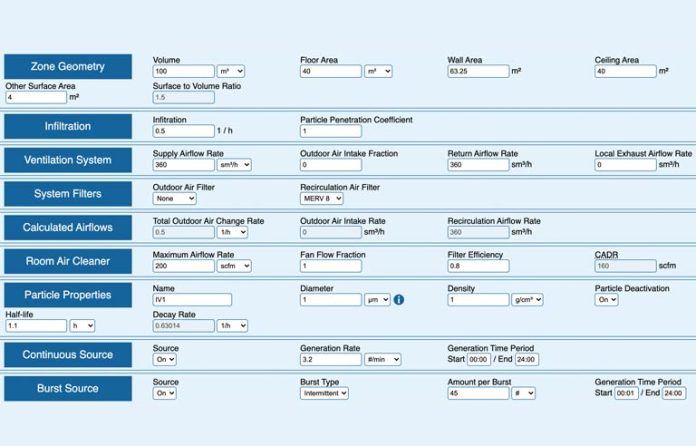
Developed by air quality experts at NIST, the free tool estimates exposure to potentially infectious aerosols in indoor spaces. Users plug in information about 12 different inputs based on their specific indoor spaces, including the ventilation system, system filters, occupant exposure and zone geometry, and then run a 24-hour simulation to determine strategies to reduce exposure among occupants.
The tool models the fate of infectious aerosols generated in an indoor environment, such as SARS-CoV-2. In addition, the impact of control measures can be determined. This allows building managers and engineers to identify strategies such as adjusting ventilation rates and using portable air cleaners to reduce exposure.
According to NIST, an infected person can generate pathogen-containing aerosols by breathing or coughing. Although larger droplets fall quickly to the ground, they can impact surfaces and persons nearby. The Fate and Transport of Indoor Microbiological Aerosols, of FaTIMA, tool focuses on the smaller droplet nuclei that can remain airborne for longer periods of time and affect more people in the environment.
The tool was described in a paper published in the January issue of the American Society of Heating, Refrigerating and Air-Conditioning Engineers’ ASHRAE Journal.

