


When was the last time you took a hard look at your environment, health and safety program? If it’s been a while or you can’t remember, or if you’ve never conducted a safety inspection or audit, it’s time to get to work. By evaluating your facilities, people and processes, you’ll make your workplace safer and more efficient.
You’ll also minimize your regulatory and legal risks. Audits and inspections ensure you stay 10 steps ahead of OSHA, the Environmental Protection Agency, and the other federal and state authorities that can levy citations and penalties.
If you find the prospect of audits and inspections overwhelming, you’re not alone. So, let’s make this as simple and painless as possible by breaking down audits and inspections into manageable pieces. These are the 4 basic components that, when combined, form a comprehensive assessment of your EHS program.
Part 1: The regulatory audit
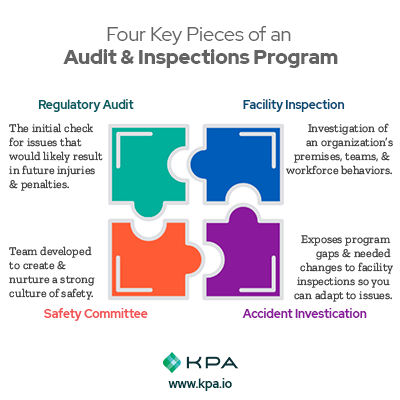
What it covers:
- OSHA compliance
- EPA compliance
- Department of Transportation compliance
- National Fire Protection Association compliance
- Compliance with state and local regulatory requirements
Examples of questions to ask:
- Are all employees trained properly?
- What are your safety policies, and are employees following them?
- Is there a written compliance program?
- Have you conducted a hazard assessment?
- What is the condition of personal protective equipment?
- What are your chemical storage procedures?
- Do you have all required hazardous materials paperwork?
- What are your machine guarding procedures?
- What are your respiratory protection procedures?
- Are any fall hazards present in the workplace?
- What are your shipping, warehousing and transportation procedures?
- Are sprinkler systems in good working order?
- Is all necessary safety signage in place?
Part 2: The facility inspection
What it covers:
- Department-specific regulatory compliance
- Department-specific safety hazards
- Equipment and machinery
- Documents
- Employee behaviors
Examples of questions to ask:
- What is the layout of your facilities?
- Are your ladders in good condition?
- How about your forklifts?
- Have you recently tested alarms?
- Where are your eyewash stations?
- How about your fire extinguishers?
- What are the condition of walking and working surfaces?
- Does anything require maintenance?
- Are employees trained to use the tools they’re using, and are they using their tools safely?
- How are employees performing their jobs?
- Do employees have feedback about how to improve the EHS program?
Part 3: Accident investigation
What it covers:
- Workplace accidents
- Employee injuries
- Incident response
- Preventive measures
- Corrective measures
- Workplace safety trends
Examples of questions to ask:
- How many safety accidents have occurred recently?
- What is the nature of those accidents?
- What are your accident response procedures?
- Which employee(s) are responsible for gathering the details, documenting accidents and following up?
- Is there a standard repeatable accident response process in place?
- Are accidents addressed and documented in a timely manner?
- Why are accidents happening? What are the root causes?
- What kinds of accidents occur most often?
- What are the costs of accidents in the workplace?
- What can be done to prevent accidents? What practices and operating procedures need improvement?
Part 4: Safety committee meetings
What they cover:
- Overall EHS program function and effectiveness
- EHS program efficiency
- Safety team roles and responsibilities
- Current priorities and improvements to make
- Timetables for implementing changes
- EHS program budget and costs
Examples of questions to ask:
- Are employees working as safely and efficiently as possible?
- Are all members of the organization, including leadership, engaged and represented in EHS program decisions?
- What your current safety and regulatory risks?
- What aspects of the EHS program are functioning as intended?
- Are there any gaps in the program?
- What needs to be improved?
- How soon will changes be made?
- What are the improvement costs?
- What is the ROI of an optimized safety program?
- Who is responsible for coordinating changes?
- What will the schedule be for inspections and audits moving forward?
We’ll level with you – audits and inspections can be a lot of work.
But they’re easier, cheaper and a whole lot less stressful than dealing with accidents, losses, penalties, legal claims, workforce turnover and the myriad other adverse consequences of a poor EHS program.
Effective audits and inspections not only save lives, but also tend to:
- Lower workers’ compensation costs
- Prevent citations and fines
- Boost workforce productivity and retention
Learn more at www.kpa.io.
