

Washington — Workers who frequently drill concrete can experience reduced exposure to noise, silica dust and vibration if pneumatic rock drills are replaced with electric rotary hammer drills, according to researchers at the University of California, Berkeley.
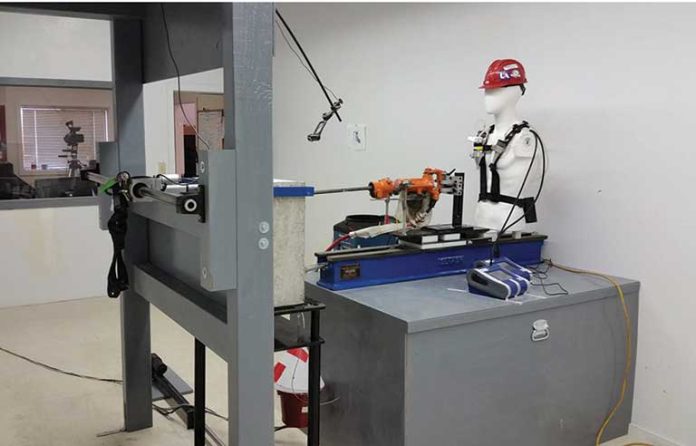
For the study, the researchers used a test bench robotic system to measure silica dust, handle vibration and noise from both types of drills, as well as productivity.
Results showed that silica dust generated by the pneumatic rock drill was at least 444 times greater than OSHA’s permissible exposure limit of 50 micrograms per cubic meter of air over an 8-hour time-weighted average, whereas with the electric drill, silica dust was 11 times greater than the PEL.
In terms of vibration, the pneumatic drill had levels that were about five times higher than the electric drill. Regarding noise, the mean level for the electric drill was a time-weighted average of 102 decibels with a peak of 117.7 dB, compared with 116.2 dBA and a peak of 130.4 dB, respectively, for the pneumatic drill.
Both drills were similarly effective, which was measured by using each to drill three 100 mm holes into cured concrete block.
The study was published online Aug. 13 in the journal Applied Ergonomics.

